Households, Norms and Witchcraft
Introduit| English | Sens |
|---|---|
| patriarchy | A social system in which men hold most power and authority in families and society. |
| witch hunt | A campaign to find and punish people accused of witchcraft, often using torture and false confessions. |
| consistory | In Calvinist Geneva, the church court of ministers and elders that supervised people's morals. |
A letter from prison, 1628
- In July 1628, Johannes Junius, the mayor of Bamberg in Germany, wrote secretly to his daughter from prison. Under torture, he said, he had confessed to witchcraft and named others, though "it is all falsehood and invention". He was burned soon after. In the Bamberg trials of 1626–1631, several hundred people were executed.
- Society in the 1500s and 1600s was under strain, and communities responded in very different ways.
Hierarchy persisted
- Europe remained ordered by rank: nobles, clergy, merchants, peasants; and by gender, with husbands as heads of households under patriarchy 父权制.
- Most people lived in villages and worked the land, and status was usually fixed at birth.
Social status in this period was usually fixed at birth.
Difficulté 1/5 · 100 pièces + un petit bonus lors de la première réussite aujourd'hui
Hierarchy persisted.
A debate about women
- Writers argued over women's nature and abilities in the "querelle des femmes". Some, like the Venetian writer Moderata Fonte (The Worth of Women, 1600), argued women were equal to men in reason.
- Protestant reformers praised marriage and allowed divorce in some cases, but still taught that wives should obey their husbands.
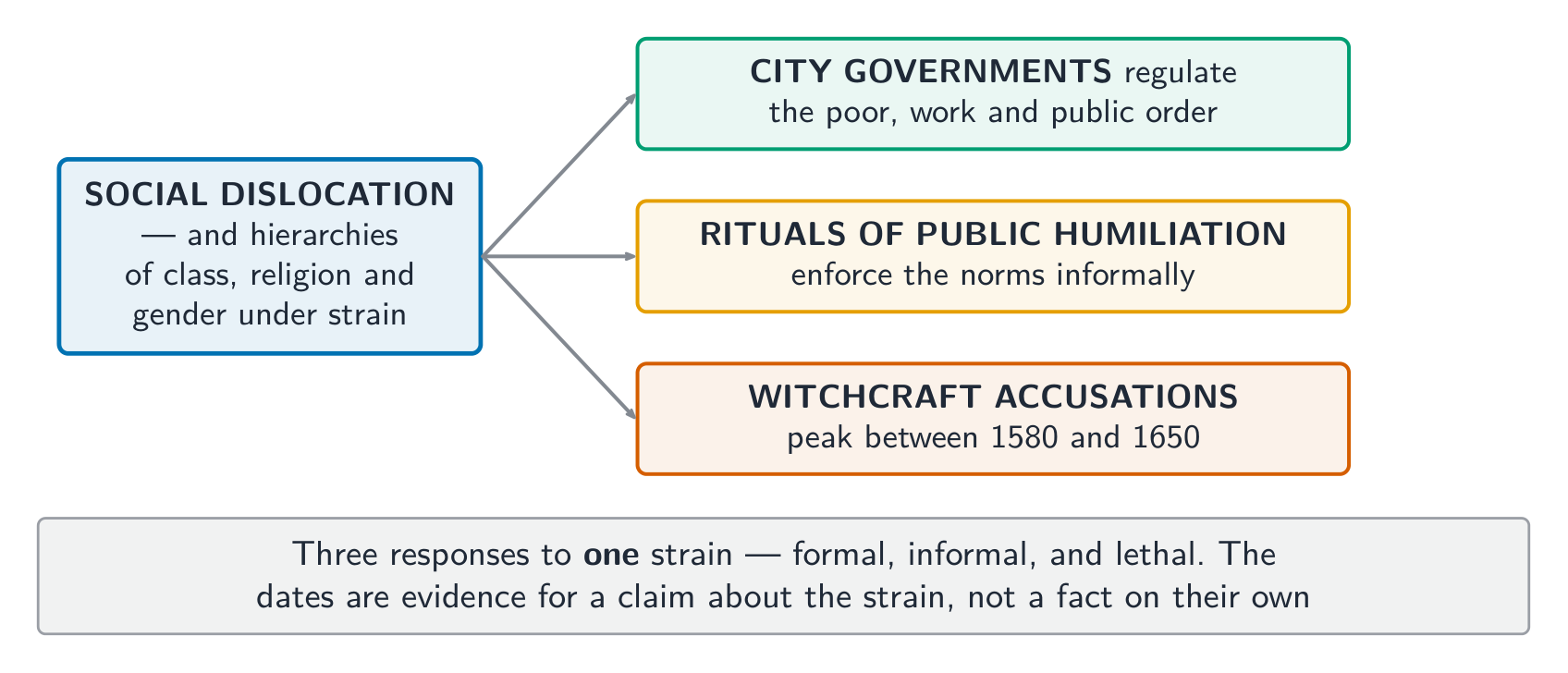
Worked example: why witch hunts peaked
Between about 1580 and 1650, perhaps 80 000 people were tried for witchcraft in Europe and 40 000–50 000 executed; about three-quarters were women.
- Strain: the Little Ice Age brought failed harvests, plague and war, and people looked for someone to blame.
- Religion: Catholic and Protestant authorities both feared the devil; handbooks such as the Malleus Maleficarum (1487) described how to find witches.
- Courts: the worst witch hunts 猎巫 happened where local courts used torture with little central control, as in the small German states. Strong central courts, as in England and Spain, executed far fewer.
Continuity, an opened debate, or evidence of upheaval?
Sort each feature of society 1450-1648.
When did European witch hunts reach their peak?
Difficulté 1/5 · 100 pièces + un petit bonus lors de la première réussite aujourd'hui
Early modern, not medieval.
Which contributed to the witch hunts?
Difficulté 2/5 · 140 pièces + un petit bonus lors de la première réussite aujourd'hui
Central courts reduced executions.
Most people executed for witchcraft were women.
Difficulté 1/5 · 100 pièces + un petit bonus lors de la première réussite aujourd'hui
About three-quarters.
Cities regulate morals
- Protestant and Catholic town councils punished drunkenness, gambling and sex outside marriage. In Geneva, the church consistory 长老法庭 questioned residents about their behaviour.
- Many towns closed brothels and banned dancing on Sundays.
Leisure and community
- Life followed the calendar: Carnival before Lent, saints' days, harvest festivals and village fairs.
- Communities enforced their own norms through "rough music" — noisy public shaming of people who broke local rules.
Match each practice to the kind of regulation.
Difficulté 2/5 · 140 pièces + un petit bonus lors de la première réussite aujourd'hui
Three responses.
Witch hunts were not a medieval event. They peaked in the late 1500s and early 1600s, in the age of the Reformation and the Scientific Revolution. Explain them through the pressures of that time.
Witch hunts were mainly a feature of the early Middle Ages.
Difficulté 1/5 · 100 pièces + un petit bonus lors de la première réussite aujourd'hui
They peaked in the early modern period.
Hierarchies of class and gender persisted, though writers began to debate women's roles. Towns regulated morals and communities enforced norms through festivals and shaming. Under economic, religious and political strain, witch hunts peaked between 1580 and 1650, mostly killing women.
Explain why witchcraft accusations increased in parts of Europe between 1580 and 1650.
Causation.