Print, Conscience and the State
Introduit| English | Sens |
|---|---|
| Anabaptist | A radical Protestant who rejected infant baptism and wanted church separate from state. |
| subordination/ˌsʌbɔːdɪˈneɪʃn/ | subordination |
| Huguenot | A French Protestant (Calvinist) of the sixteenth and seventeenth centuries. |
| censorship/ˈsensəʃɪp/ | Control by authorities over what may be printed, said or read. |
Pamphlets faster than censors, 1520
- In 1520 alone, Martin Luther published about 30 pamphlets in German; about 300 000 copies were printed. Many had woodcut pictures for people who could not read — one showed the pope as the Antichrist. Church censors could not stop them all.
- Printing let reformers reach ordinary people and made religion a political question.
About how many copies of Luther's pamphlets were printed in 1520?
Difficulté 2/5 · 140 pièces + un petit bonus lors de la première réussite aujourd'hui
About 300 000.
Using the press deliberately
- Reformers wrote in everyday German, French and English, not Latin, so more people could understand. Luther's German New Testament (1522) sold thousands of copies.
- Catholic writers answered with pamphlets of their own, so print became a battlefield.
Why did reformers write in German, French and English?
Difficulté 1/5 · 100 pièces + un petit bonus lors de la première réussite aujourd'hui
Reaching ordinary people.
Faith against the state
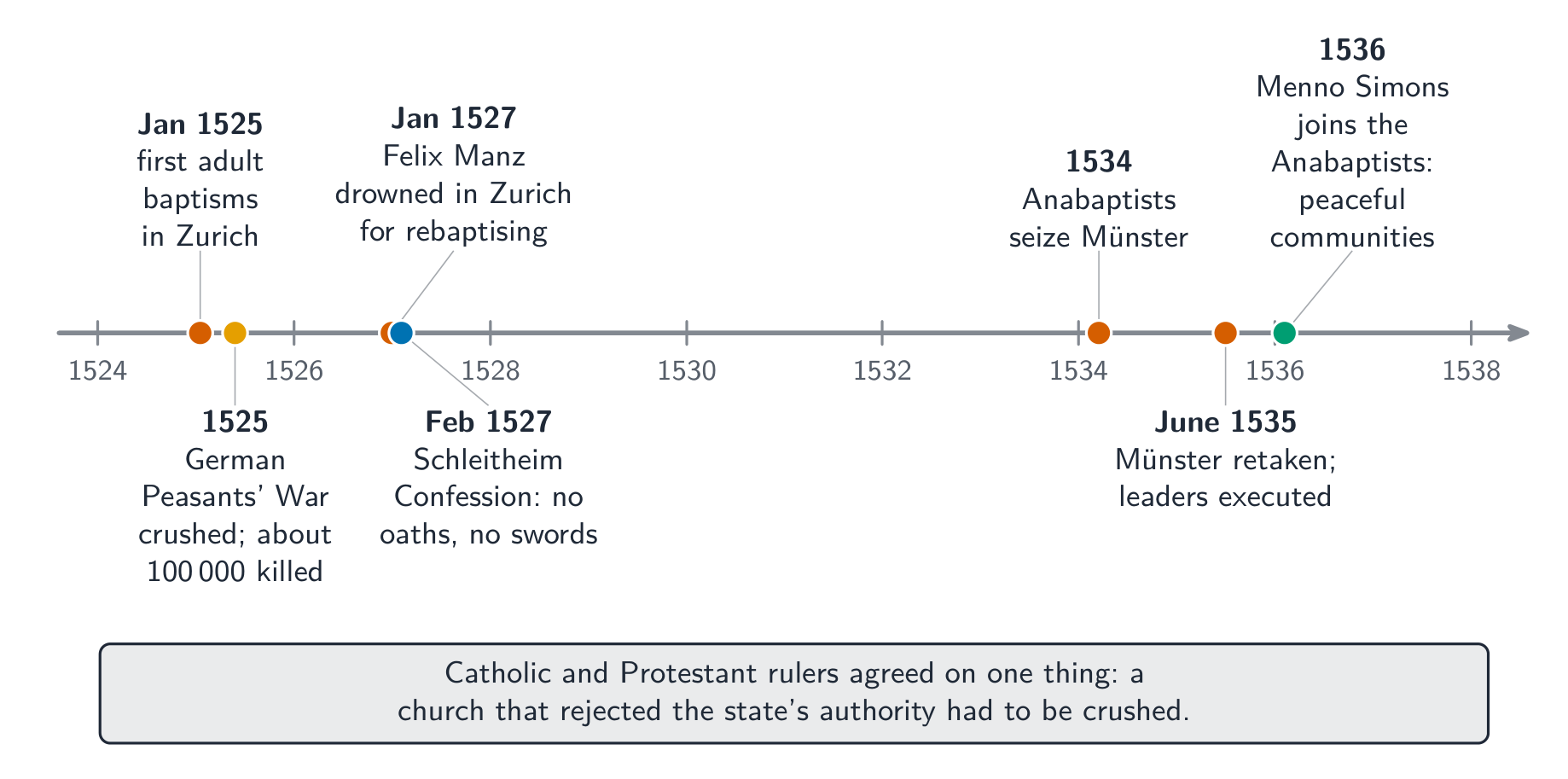
- Some Protestants, such as the Anabaptists 再洗礼派, believed the Church should be separate from the state. They refused to swear oaths or serve as soldiers.
- Both Catholic and Protestant rulers persecuted them; thousands were executed.
Which relationship to the state is this?
Sort each position on church and secular authority.
Both Catholic and Protestant rulers persecuted the Anabaptists.
Difficulté 1/5 · 100 pièces + un petit bonus lors de la première réussite aujourd'hui
Thousands were executed.
Worked example: three relationships to the state
- The state controls the Church: in England and Lutheran Germany, rulers headed the Church — the Church's subordination 从属 to the state.
- The Church guides the state: in Calvin's Geneva, Church leaders supervised morals and influenced the city government.
- Separation: Anabaptists rejected any link between the Church and the state.
Match each case to its Church–state relationship.
Difficulté 2/5 · 140 pièces + un petit bonus lors de la première réussite aujourd'hui
Three relationships.
Religion and rebellion
- In the Dutch Revolt (from 1566), Calvinists fought Catholic Spain for religious and political freedom.
- French Calvinists, the Huguenots 胡格诺派, became a political party with their own nobles and armies.
The rulers' response
- Rulers used censorship 审查制度: the Catholic Church published an Index of forbidden books from 1559.
- Some rulers allowed limited toleration to keep peace, as in the Edict of Nantes in France (1598).
How did rulers respond to religious division?
Difficulté 2/5 · 140 pièces + un petit bonus lors de la première réussite aujourd'hui
Censorship, toleration and persecution.
The Reformation was not only about belief. Religion became a way to challenge rulers or strengthen them. Show the political side as well as the religious side.
The Reformation had no political consequences.
Difficulté 1/5 · 100 pièces + un petit bonus lors de la première réussite aujourd'hui
Religion became political.
Reformers used printing in everyday languages to spread their ideas widely. Protestants disagreed about the Church's relationship with the state — control, guidance or separation — and religion became a language of rebellion in the Netherlands and France, while rulers used censorship and sometimes toleration.
Explain how printing helped the Protestant Reformation spread.
Causation.