The Northern Renaissance
Introduit| English | Sens |
|---|---|
| Christian humanism/ˈkrɪstʃn ˈhjuːmənɪzəm/ | Humanisme chrétien |
A New Testament in Greek, 1516
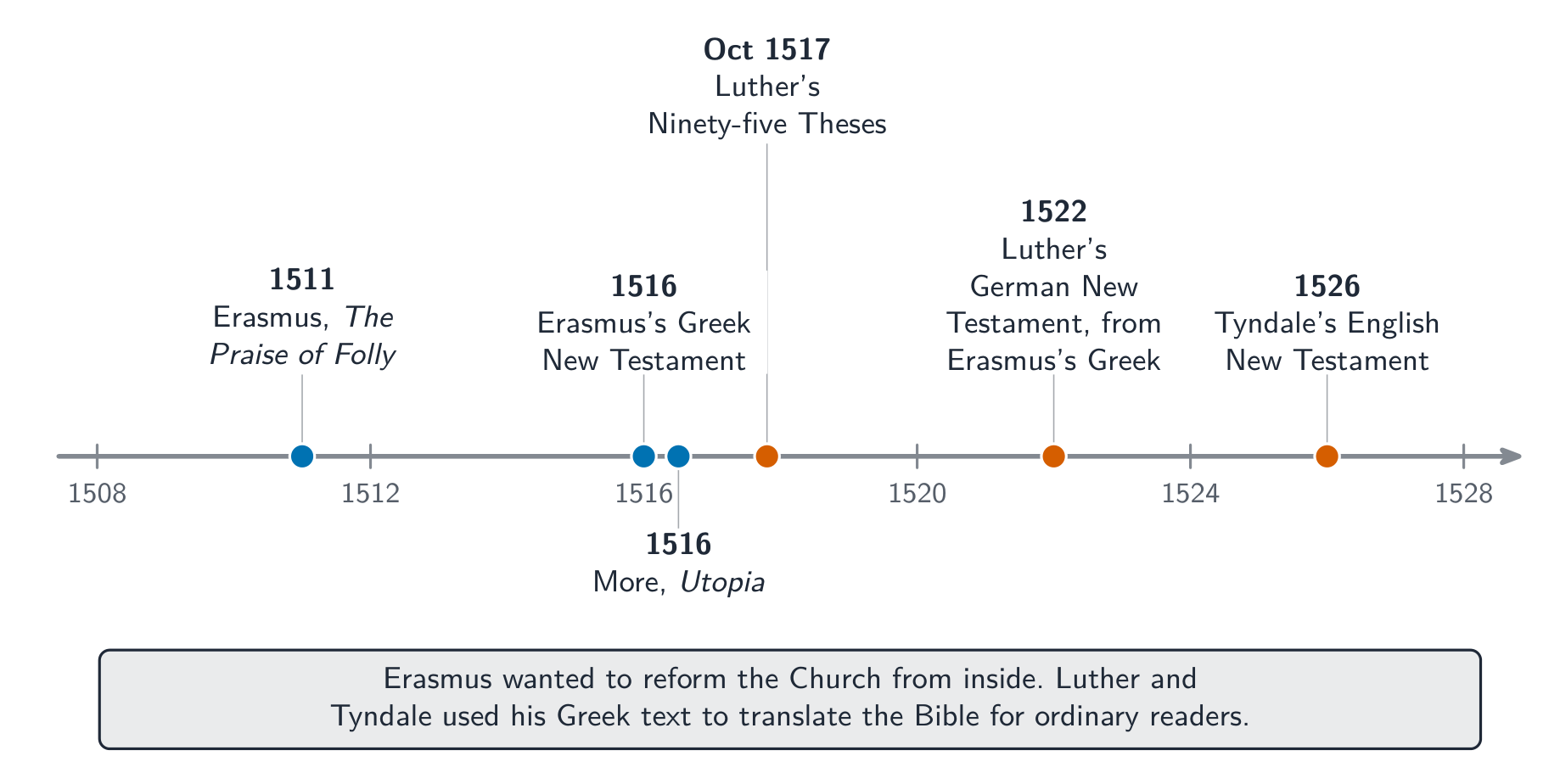
- In 1516, the Dutch scholar Erasmus published the New Testament in its original Greek, with his own Latin translation beside it. He corrected errors in the Vulgate, the Latin Bible the Church had used for a thousand years. Within a year, a German monk named Martin Luther was using it.
- The Renaissance spread north of the Alps, and there it took a more religious direction.
Why was Erasmus's 1516 New Testament important?
Difficulté 1/5 · 100 pièces + un petit bonus lors de la première réussite aujourd'hui
Philology applied to the Bible.
The Renaissance moves north
- From about 1450, students, merchants and printed books carried Italian humanist ideas to France, Germany, England and the Low Countries.
- Northern humanists used the same method — philology — but applied it mainly to the Bible and early Christian writers.
Christian humanism
- Christian humanism 基督教人文主义 aimed to reform the Church and personal faith by returning to the original texts of Christianity.
- Erasmus mocked corrupt clergy in The Praise of Folly (1511); Thomas More imagined an ideal society in Utopia (1516).
Shared, changed, or the consequence?
Sort each feature of the Northern Renaissance.
What was the main focus of Christian humanism?
Difficulté 1/5 · 100 pièces + un petit bonus lors de la première réussite aujourd'hui
Reform from the sources.
Worked example: Italy and the north compared
- Shared: both used philology, both depended on printing and both studied ancient sources.
- Different: Italian humanists focused more on classical Rome and civic life; northern humanists more on the Bible and Christian reform.
- Art: northern painters such as Jan van Eyck and Pieter Bruegel painted everyday life — peasants, weddings, markets — in close detail, often using oil paint.
Match each feature to where it was strongest.
Difficulté 2/5 · 140 pièces + un petit bonus lors de la première réussite aujourd'hui
Compare and contrast.
Printing
- Johannes Gutenberg's press in Mainz printed its first Bible about 1455. By 1500, about 20 million books had been printed in Europe.
- Printing made it possible for many more people to read the Bible and new ideas.
About how many million books had been printed in Europe by 1500?
Difficulté 2/5 · 140 pièces + un petit bonus lors de la première réussite aujourd'hui
Within about 45 years.
The road to the Reformation
- Erasmus wanted to reform the Church from within. But his Greek Testament gave Luther the tools to question Church teaching.
- People said, "Erasmus laid the egg that Luther hatched."
Erasmus intended to start a new Protestant church.
Difficulté 1/5 · 100 pièces + un petit bonus lors de la première réussite aujourd'hui
He wanted reform within the Catholic Church.
Christian humanists were not Protestants. Erasmus and More remained Catholics; More was executed in 1535 for refusing to accept Henry VIII as head of the Church. Their work prepared the Reformation without intending it.
Thomas More remained a Catholic and was executed for it.
Difficulté 1/5 · 100 pièces + un petit bonus lors de la première réussite aujourd'hui
In 1535.
The Renaissance spread north through printing and travel. Northern humanists used philology to study the Bible and call for Church reform, and northern artists painted everyday life. Their work, especially Erasmus's Greek New Testament, prepared the way for the Reformation.
Compare the Italian and Northern Renaissances.
Comparison.