Using Conventions Deliberately
IntroduitOne mark, three meanings
- Read three versions of one sentence. "The bridge was finished on time, it cost twice the budget." (a comma splice: the reader stumbles). "The bridge was finished on time; it cost twice the budget." (two equal facts). "The bridge was finished on time — and cost twice the budget." (the cost lands as a surprise). The words barely change; the punctuation changes the argument.
- Punctuation shows the relationship between ideas. Choose the mark from the relationship you mean, not from how long the sentence feels.
Punctuate the relationship you mean
| Mark | Relationship | Example |
|---|---|---|
| Colon | what follows explains or proves what came before | "The plan failed for one reason: no one paid for buses." |
| Semicolon | two independent statements of equal weight | "The north side gained parks; the south side lost them." |
| Dashes | an interruption that stops the reader | "The report — paid for by the council — was never published." |
| Full stop | a separate point that deserves its own weight | "The bridge cost twice the budget. It was finished on time." |
Garder ou couper ?
Sort each usage by whether it earns its place.
Match each relationship to the best mark.
Difficulté 2/5 · 140 pièces + un petit bonus lors de la première réussite aujourd'hui
Punctuate the relationship you mean.
Which sentence uses a colon correctly?
Difficulté 1/5 · 100 pièces + un petit bonus lors de la première réussite aujourd'hui
What follows the colon explains what came before.
Marks to use sparingly
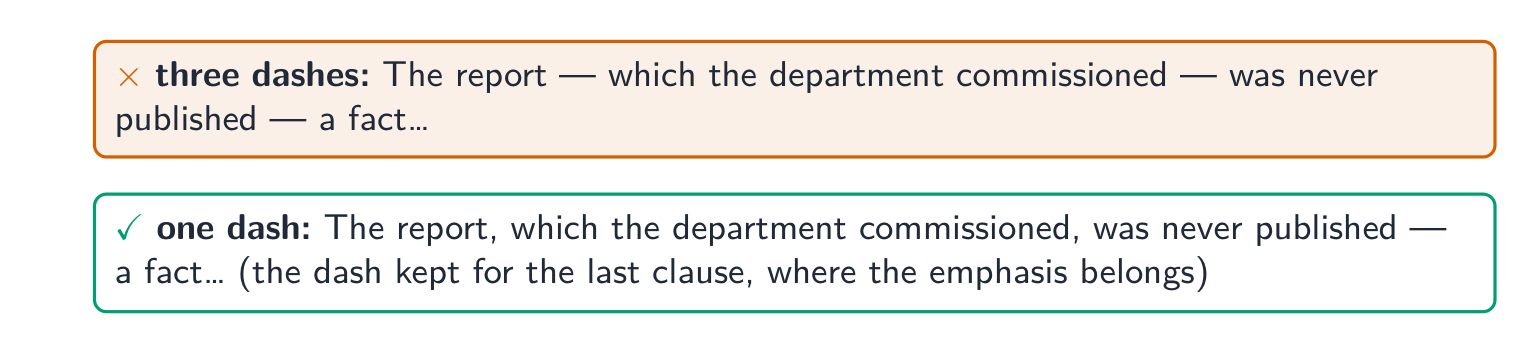
- Dashes and italics create emphasis, and emphasis is relative: one per paragraph stands out, three cancel each other.
- Exclamation marks ask the reader to feel something the sentence has not earned. In an exam essay, leave them out.
A paragraph has four italicised words for emphasis. What is the problem?
Difficulté 1/5 · 100 pièces + un petit bonus lors de la première réussite aujourd'hui
Use one per paragraph, where it matters.
Worked punctuation pass
Before: "The school's new timetable — which nobody asked for — has caused problems!!! Students are tired, teachers are tired, the lunch break is too short — only 20 minutes — and nobody has time to eat."
After: "The new timetable has one clear cost: the lunch break is now only 20 minutes. Students and teachers are both more tired; many no longer have time to eat."
- What changed: the colon now introduces the evidence for "one clear cost"; the semicolon joins two linked facts; the extra dashes, italics and exclamation marks are gone, so the 20-minute fact carries the emphasis by itself.
A punctuation check
- Every colon: does what follows explain what came before? Every semicolon: are both sides full sentences of equal weight? Every dash or italic: is it the only one in its paragraph?
A comma cannot join two full sentences. "Prices rose, people bought less" is a comma splice; use a semicolon, a full stop, or a joining word ("so").
"Prices rose, people bought less" is correctly punctuated.
Difficulté 1/5 · 100 pièces + un petit bonus lors de la première réussite aujourd'hui
It is a comma splice; use a semicolon, full stop or "so".
Choose punctuation by the relationship you mean: a colon to explain, a semicolon for equal statements, dashes for one interruption that matters. Use dashes, italics and exclamation marks sparingly, because emphasis is relative. Following conventions keeps the reader's attention on your argument.
Practice. Repunctuate so the key fact is emphasised once: "The new app is great!!! — it crashed every day — students lost their work, teachers were angry."
One mark for each relationship.