Passer et Retourner des Références
Introduit| English | Sens |
|---|---|
| NullPointerException/nʌl ˈpɔɪntə ekˈsepʃn/ | NullPointerException |
Mutating an object differs from reassigning a parameter
- A caller refers to a Student with score 10. The method executes s.addScore(5); then s = new Student("Other");
- The score of the original shared object becomes 15. Reassigning the local parameter does not change the caller variable, because Java copies the reference value into the parameter.
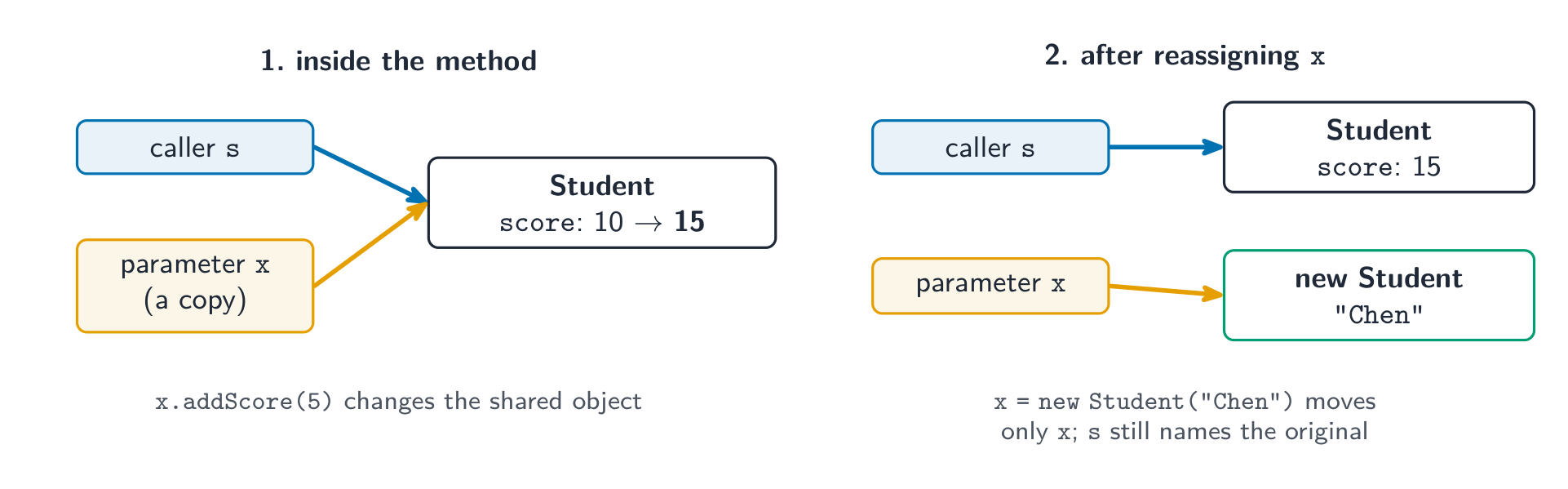
Passing an object to a method
- Java copies the reference value into the method parameter; it does not copy the object. The method's parameter points at the same object as the caller's variable.
- So changes the method makes to the object are visible to the caller. Both primitive and reference arguments are passed by value; the copied reference can still reach a shared object.
Primitives vs. objects as arguments
- A primitive argument is copied — the method can't change the caller's variable. For an object argument, the copied reference reaches the same object — the method can mutate that object.
changeInt(x)can't alterx;student.addScore(10)does change that student. Ask whether the method mutates the shared object or reassigns only its local parameter.
Returning an object
- A method can return a reference to an object — the caller then shares it.
public Student topStudent() { return best; }hands back a reference tobest. - Returning
bestshares an existing object. In contrast,return new Student("Copy");constructs a new object and returns its reference; a method can also returnnull. Read the return expression before deciding whether state is shared.
Référence copiée, objet partagé ; primitif copié
Le score de l'objet change ; le primitif x ne change pas.
Lorsque vous passez un objet à une méthode, la méthode reçoit...
Difficulté 1/5 · 100 pièces + un petit bonus lors de la première réussite aujourd'hui
Java copie la valeur de référence dans une variable paramètre séparée. Les deux références peuvent atteindre le même objet ; la réassignation du paramètre ne remplace pas la variable de l'appelant.
Une méthode peut modifier la variable int de l'appelant en modifiant son paramètre.
Difficulté 1/5 · 100 pièces + un petit bonus lors de la première réussite aujourd'hui
Les primitifs sont copiés — le int de l'appelant reste inchangé.
Appeler une méthode d'instance via une référence null provoque...
Difficulté 1/5 · 100 pièces + un petit bonus lors de la première réussite aujourd'hui
null pointe vers aucun objet, donc il n'y a rien sur lequel appeler la méthode.
Une méthode peut retourner une référence vers un objet, que l'appelant partage ensuite.
Difficulté 1/5 · 100 pièces + un petit bonus lors de la première réussite aujourd'hui
Une méthode peut retourner une référence d'objet existante et partager son objet avec l'appelant. Une autre méthode peut construire et retourner un nouvel objet à la place.
Pour utiliser en toute sécurité une référence qui pourrait être null, vous devez d'abord vérifier...
Difficulté 1/5 · 100 pièces + un petit bonus lors de la première réussite aujourd'hui
Protégez contre null avant d'appeler une méthode dessus.
Toute méthode qui retourne une référence Student doit retourner un objet préexistant.
Difficulté 1/5 · 100 pièces + un petit bonus lors de la première réussite aujourd'hui
Faux : return new Student("Other"); construit et retourne un objet frais.
The null reference
- A reference that points at no object is
null. Calling an instance method throughnullthrows a NullPointerException 空指针异常. - Returning
null(e.g. "not found") is common — the caller must check for it. Guard withif (s != null) { s.addScore(10); }before using a possibly-null reference.
Passing an object copies a reference value — the method can change the caller's object; passing a primitive copies the value — it can't. So student.addScore(10) mutates the caller's object, but changeInt(x) leaves the caller's x untouched. And calling an instance method through a null reference throws a NullPointerException — check != null first when a reference might be null.
After the two statements, what is the original caller-referenced Student score?
Difficulté 2/5 · 140 pièces + un petit bonus lors de la première réussite aujourd'hui
The first statement mutates the original object to 15. The later local reassignment does not replace the caller reference.
Une méthode retourne new Student("Other"); mais l'appelant ignore le résultat. Que devient la variable Student existante de l'appelant ?
Difficulté 1/5 · 100 pièces + un petit bonus lors de la première réussite aujourd'hui
Retourner une référence ne l'assigne pas à la variable de l'appelant. La variable existante pointe toujours vers son objet d'origine.
Reference vs. value:
void addTen(Student s) { s.addScore(10); }— changes the passed object (shared reference).void addTen(int x) { x += 10; }— the caller'sintis unchanged (copied value).- Both parameter values are copied; only the copied reference reaches shared mutable state.
Carry the reasoning to a new case
- Compare
return s;withreturn new Student("Other");: the first returns the supplied reference; the second returns a newly constructed object. Neither return changes the caller's variable until the caller assigns the result. - To predict a change, draw the caller and parameter as separate reference variables pointing to objects. Update the object for a mutator call, and update only the parameter arrow for parameter reassignment.
Passing an object reference copies its value into the parameter, so the method can change the caller's object; passing a primitive copies the value, so it can't. A method can return a reference to an object. A reference to no object is null — calling an instance method through it throws a NullPointerException, so check first.