Energy Diagrams
Introduit| English | Sens |
|---|---|
| enthalpy/enˈθælpi/ | Enthalpie |
| activation energy/ˌæktɪˈveɪʃn ˈenədʒi/ | The minimum energy that reacting particles need for a successful reaction. |
| catalyst/ˈkætəlɪst/ | A substance that increases a reaction rate without being used up overall. |
Drawing heat as height
- A hand warmer gets hot; an instant cold pack gets cold. Picture the chemicals as blocks at different heights: the higher one holds more stored chemical energy.
- Drop from high to low and heat comes out (the hand warmer). Climb from low to high and heat must be taken in (the cold pack).
Reactants and products as levels
- An energy diagram draws reactants and products as horizontal levels. Their heights show relative enthalpy 焓, the stored energy at constant pressure.
- The vertical gap between them is $\Delta H=H_{\text{products}}-H_{\text{reactants}}$.

The vertical gap between the reactant and product levels is $\Delta H$.
Difficulté 1/5 · 100 pièces + un petit bonus lors de la première réussite aujourd'hui
That signed height difference is the enthalpy change, products minus reactants.
The exothermic shape
- Exothermic: the products sit lower than the reactants. Energy is released to the surroundings, which warm up.
- So $\Delta H$ is negative. Examples: combustion, neutralization, the hand warmer (iron rusting).
On an energy diagram, products below reactants means the reaction is...
Difficulté 1/5 · 100 pièces + un petit bonus lors de la première réussite aujourd'hui
Lower products mean energy was released -- exothermic.
An exothermic reaction has a positive $\Delta H$.
Difficulté 1/5 · 100 pièces + un petit bonus lors de la première réussite aujourd'hui
False. Products lower in energy than reactants give a negative $\Delta H$, which is exothermic. A positive $\Delta H$ is endothermic.
The endothermic shape
- Endothermic: the products sit higher than the reactants. Energy is absorbed from the surroundings, which cool down.
- So $\Delta H$ is positive. Examples: melting ice, dissolving ammonium nitrate (the cold pack), photosynthesis.
An endothermic energy diagram
When a reaction absorbs energy, the products sit higher than the reactants.
An endothermic reaction has products that are...
Difficulté 1/5 · 100 pièces + un petit bonus lors de la première réussite aujourd'hui
Absorbing energy raises the products above the reactants.
During an endothermic reaction in a beaker, the beaker feels colder.
Difficulté 1/5 · 100 pièces + un petit bonus lors de la première réussite aujourd'hui
The reaction takes energy from its surroundings, including the beaker and your hand.
Products at $30\ \text{kJ}$, reactants at $80\ \text{kJ}$. Exothermic or endothermic?
- The products are lower, so energy was released.
- $\Delta H = 30 - 80 = -50\ \text{kJ}$, which is exothermic.
Reactants at $60\ \text{kJ}$, products at $90\ \text{kJ}$. The value of $\Delta H$ (in kJ)?
Difficulté 2/5 · 140 pièces + un petit bonus lors de la première réussite aujourd'hui
$\Delta H = 90 - 60 = +30\ \text{kJ}$ (endothermic).
$\Delta H$ equals products minus ____.
Difficulté 1/5 · 100 pièces + un petit bonus lors de la première réussite aujourd'hui
$\Delta H$ = final (products) minus initial (reactants).
Adding the activation-energy hill
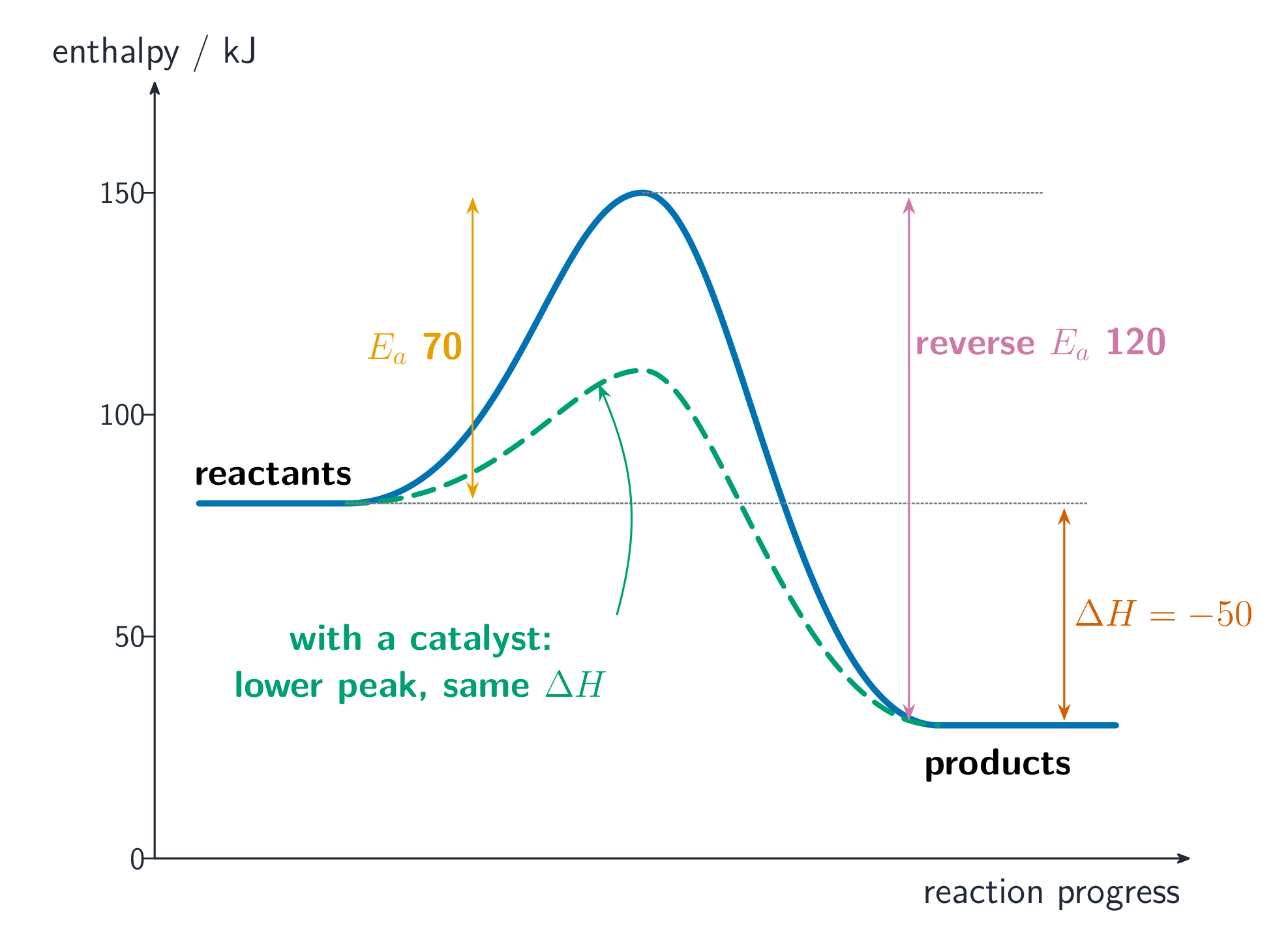
- A full reaction profile also shows the transition state: a hill between reactants and products. Its height above the reactants is the activation energy 活化能 $E_a$.
- A catalyst 催化剂 gives a lower hill, so $E_a$ drops. The reactant and product levels do not move, so $\Delta H$ is unchanged.
Adding a catalyst to a reaction changes:
Difficulté 1/5 · 100 pièces + un petit bonus lors de la première réussite aujourd'hui
A catalyst gives a lower hill. The reactant and product levels stay where they are, so $\Delta H$ does not change.
Reading a reaction profile. Use the diagram above: reactants at 80 kJ, peak at 150 kJ, products at 30 kJ.
- $\Delta H=30-80=-50$ kJ (exothermic). Forward $E_a=150-80=70$ kJ.
- Reverse $E_a=150-30=120$ kJ. The reverse reaction is endothermic, $\Delta H=+50$ kJ, and has the larger hill.
Reactants are at 40 kJ, the peak at 95 kJ and the products at 65 kJ. What is the activation energy of the inverse reaction, in kJ?
Difficulté 2/5 · 140 pièces + un petit bonus lors de la première réussite aujourd'hui
Reverse $E_a$ = peak − products = 95 − 65 = 30 kJ. (Forward $E_a$ = 55 kJ; $\Delta H$ = +25 kJ.)
- Read $\Delta H$ as products minus reactants (final minus initial). Products lower means exothermic and negative.
- $E_a$ is measured from the starting level to the peak, not from zero and not from the products.
- A catalyst changes $E_a$, never $\Delta H$.
An energy diagram draws reactants and products as levels whose heights are their enthalpy. Products lower than reactants means exothermic (negative $\Delta H$); products higher means endothermic (positive $\Delta H$). The vertical gap, products minus reactants, is $\Delta H$. The hill above the reactants is $E_a$; a catalyst lowers it but leaves $\Delta H$ unchanged.