La règle du quotient
Introduit| English | Sens |
|---|---|
| Quotient Rule/ˈkwəʊʃənt ruːl/ | règle du quotient |
| rational expression/ˈræʃənl ekˈspreʃn/ | expression rationnelle |
Dividing functions needs care
- Just as products need the Product Rule, quotients need the Quotient Rule 商法则.
- You can't differentiate top and bottom separately and divide — that's wrong.
- The rule handles a rational expression 分式表达式 $\dfrac{f}{g}$ of two functions.
- Its numerator has a subtraction, so order and signs matter a lot.
The rule
-
$$\frac{d}{dx}\!\left[\frac{f}{g}\right]=\frac{f'\,g-f\,g'}{g^{2}}$$
- Top: "derivative of the top times the bottom, minus the top times derivative of the bottom."
- Bottom: the original denominator, squared.
- A memory hook: "low d-high minus high d-low, over low-squared."
Le numérateur de la règle du quotient pour $\dfrac{f}{g}$ est...
Difficulté 1/5 · 100 pièces + un petit bonus lors de la première réussite aujourd'hui
Le numérateur est $f'g-fg'$, sur $g^2$.
Dans la règle du quotient, le dénominateur de la réponse est $g$ ____ (à quelle puissance ?).
Difficulté 1/5 · 100 pièces + un petit bonus lors de la première réussite aujourd'hui
Le dénominateur est $g^2$.
Sélectionnez tous les énoncés vrais sur la règle du quotient.
Difficulté 2/5 · 140 pièces + un petit bonus lors de la première réussite aujourd'hui
$g^2\ge0$ toujours, donc il n'inverse jamais le signe.
Order is everything
- The numerator is $f'g - fg'$, not $fg' - f'g$ — swapping them flips every sign.
- Always write the $f'g$ term first; that fixes the order and prevents sign slips.
- The denominator $g^2$ is always positive, so it never changes the sign of the answer.
- Keep the pieces labeled: $f,f',g,g'$ before you assemble.
Une courbe rationnelle à dériver
y = a / (x − b)
Un quotient comme $\dfrac{x^2}{x+1}$ a une pente que la règle du quotient calcule — notez l'asymptote verticale où le dénominateur est zéro.
Écrire le numérateur comme $fg' - f'g$ (inversé) donne la même réponse.
Difficulté 1/5 · 100 pièces + un petit bonus lors de la première réussite aujourd'hui
Inverser l'ordre annule le numérateur entier — une erreur de signe.
Dérivez $y=\dfrac{x}{x+1}$.
Difficulté 1/5 · 100 pièces + un petit bonus lors de la première réussite aujourd'hui
$\frac{(1)(x+1)-x(1)}{(x+1)^2}=\frac{1}{(x+1)^2}$.
Sometimes a product is easier
- A quotient $\dfrac{f}{g}$ can be rewritten as a product $f\cdot g^{-1}$ and done with the Product + Power rules.
- For simple denominators this can be quicker: $\dfrac{x}{x^2}=x^{-1}\Rightarrow -x^{-2}$.
- But for genuine two-function quotients like $\dfrac{\sin x}{x}$, the Quotient Rule is the clean path.
- Choose whichever avoids the messier algebra.
Le quotient $\dfrac{x}{x^2}$ est le plus rapidement dérivé par...
Difficulté 1/5 · 100 pièces + un petit bonus lors de la première réussite aujourd'hui
$\frac{x}{x^2}=x^{-1}\Rightarrow -x^{-2}$ — plus simple que la règle du quotient ici.
The Quotient Rule numerator is $f'g - fg'$ — the order and the minus sign are the whole difficulty. Writing $fg' - f'g$ (reversed) negates your answer. And do not forget to square the denominator. Both mistakes are extremely common under time pressure.
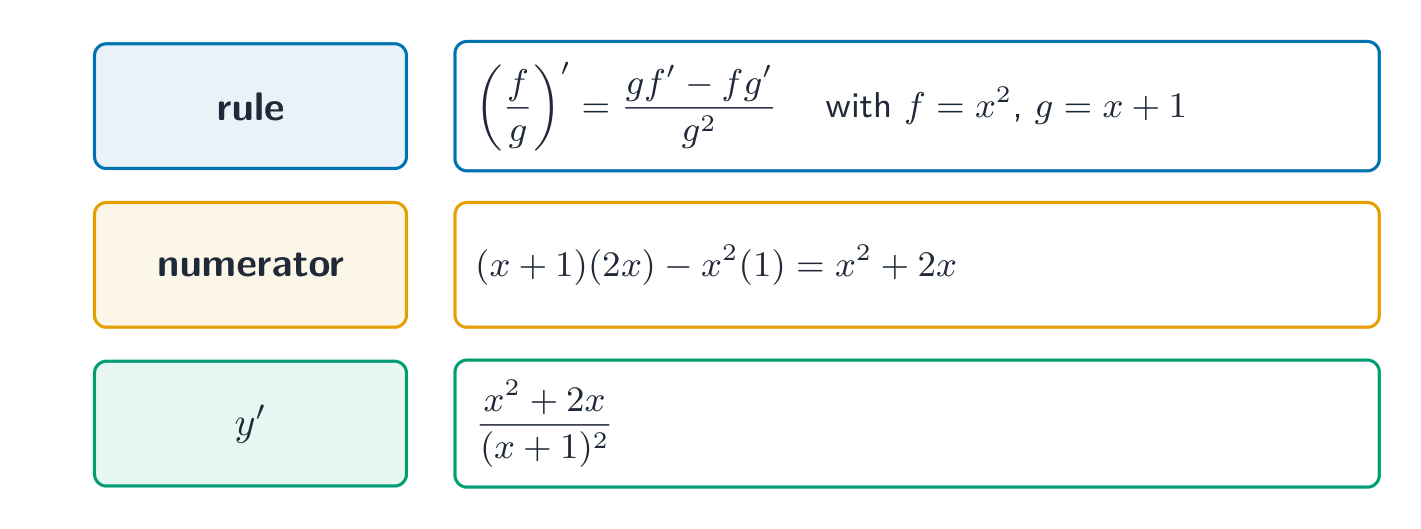
Differentiate $y=\dfrac{x^2}{x+1}$.
- $f=x^2\Rightarrow f'=2x$; $\quad g=x+1\Rightarrow g'=1$.
- $y'=\dfrac{f'g-fg'}{g^2}=\dfrac{2x(x+1)-x^2(1)}{(x+1)^2}$.
- $=\dfrac{2x^2+2x-x^2}{(x+1)^2}=\dfrac{x^2+2x}{(x+1)^2}$.
The Quotient Rule: $\frac{d}{dx}\!\left[\frac{f}{g}\right]=\frac{f'g-fg'}{g^{2}}$ — "low d-high minus high d-low, over low-squared." Keep the numerator's order ($f'g$ first) and square the denominator. For simple cases, rewriting as a product $f g^{-1}$ can be easier.