Determining Limits Using the Squeeze Theorem
Introduit| English | Sens |
|---|---|
| Squeeze Theorem/skwiːz ˈθɪərəm/ | théorème des gendarmes |
| inequality/ɪniːˈkwɒlɪti/ | inégalité |
Trap a wild function between two tame ones
- $\displaystyle\lim_{x\to0}x^2\sin\tfrac1x$ resists substitution and algebra: it wiggles infinitely fast. The way out is to trap it between two friendlier functions.
- If the lower and upper "walls" head to the same height, the trapped function has nowhere else to go. This is the Squeeze Theorem 夹逼定理.
Trapping a function between two others with equal limits uses the ____ Theorem.
Difficulté 1/5 · 100 pièces + un petit bonus lors de la première réussite aujourd'hui
Also called the Sandwich Theorem.
What the theorem says
- If $g(x)\le f(x)\le h(x)$ near $c$ (except perhaps at $c$), and $\displaystyle\lim_{x\to c}g(x)=\lim_{x\to c}h(x)=L$, then $\displaystyle\lim_{x\to c}f(x)=L$.
- You need two things: an inequality 不等式 that holds near $c$, and equal limits for the two bounds.
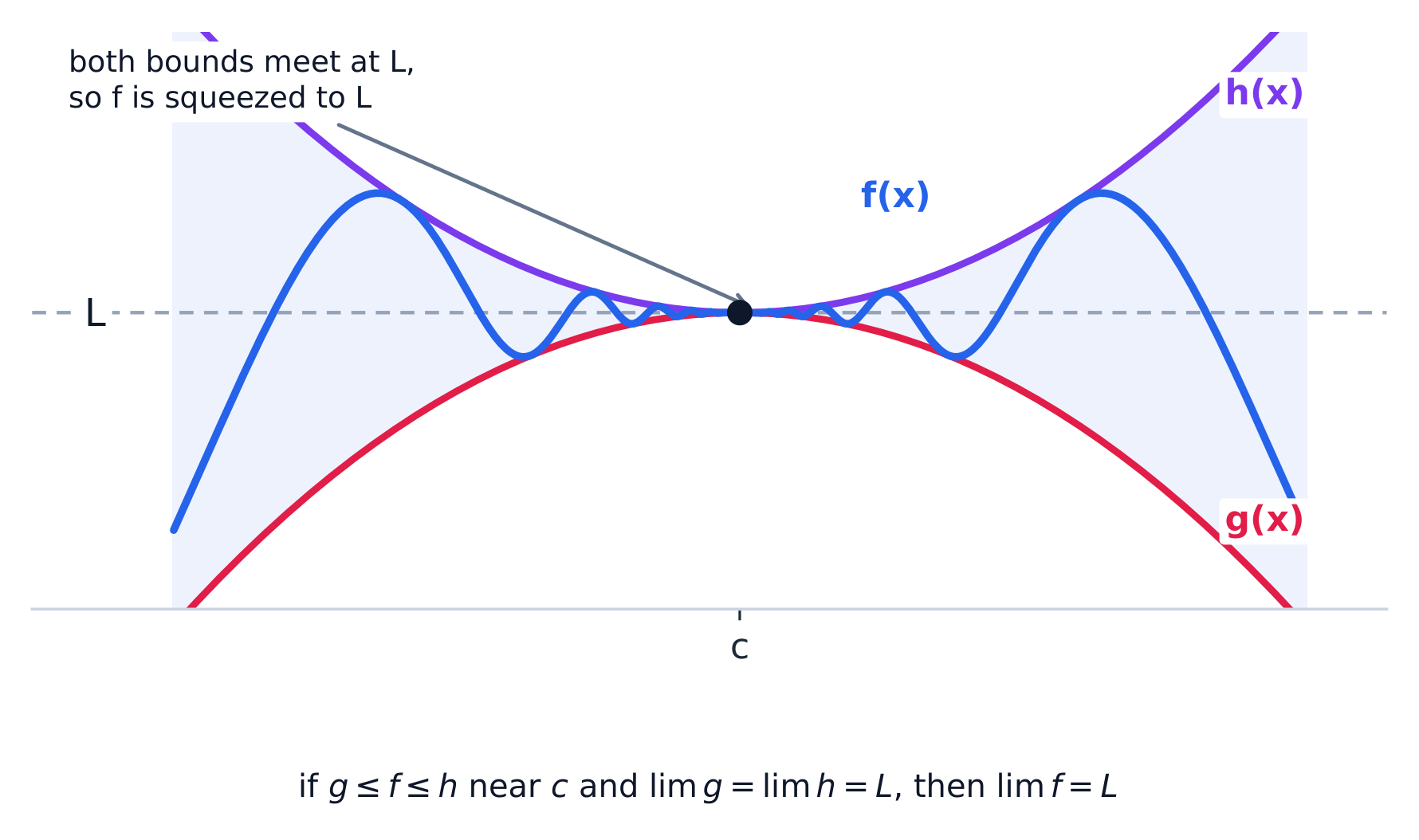
The Squeeze Theorem traps x squared sin(1/x) between minus x squared and x squared
To apply the Squeeze Theorem to $f$ près $c$, you need tout of...
Difficulté 2/5 · 140 pièces + un petit bonus lors de la première réussite aujourd'hui
You need two-sided bounds with equal limits, valid near $c$. $f$ need not be a polynomial — that is the whole point.
The classic wiggle. Find $\displaystyle\lim_{x\to0}x^2\sin\tfrac1x$.
- $-1\le\sin\tfrac1x\le1$. Multiply by $x^2\ge0$: $-x^2\le x^2\sin\tfrac1x\le x^2$.
- Both walls $\to0$ as $x\to0$, so by the Squeeze Theorem the limit is $0$.
Using $-x^2\le x^2\sin\tfrac1x\le x^2$, find $\displaystyle\lim_{x\to0}x^2\sin\tfrac1x$.
Difficulté 2/5 · 140 pièces + un petit bonus lors de la première réussite aujourd'hui
Both walls $\pm x^2\to 0$, so the trapped function $\to 0$.
AP style: bounds given. For all $x$ near 4, $4x-9\le f(x)\le x^2-4x+7$. Find $\displaystyle\lim_{x\to4}f(x)$.
- Lower: $4(4)-9=7$. Upper: $16-16+7=7$. Both bounds are polynomials, so substitute.
- The bounds agree, so $\displaystyle\lim_{x\to4}f(x)=7$ by the Squeeze Theorem. (We never needed a formula for $f$.)
For all $x$ near 1, $2x+3\le f(x)\le x^2+4$. Find $\displaystyle\lim_{x\to1}f(x)$.
Difficulté 2/5 · 140 pièces + un petit bonus lors de la première réussite aujourd'hui
Lower bound: $2(1)+3=5$. Upper bound: $1+4=5$. They agree, so the Squeeze Theorem gives 5.
Checking the setup honestly
- The inequality only has to hold near $c$. Name both bounding functions; they are the heart of the argument.
- Squeeze also proves $\displaystyle\lim_{x\to0}\frac{\sin x}{x}=1$, from $\cos x \le \frac{\sin x}{x}\le 1$ for $0<|x|<\tfrac\pi2$.
The Squeeze Theorem, with $\cos x\le\tfrac{\sin x}{x}\le 1$, gives $\displaystyle\lim_{x\to0}\tfrac{\sin x}{x}=$
Difficulté 1/5 · 100 pièces + un petit bonus lors de la première réussite aujourd'hui
As $x\to0$, $\cos x\to1$ and the upper bound is $1$, so the middle is squeezed to $1$.
Near $x=0$, $-x^2\le f(x)\le x^2$, where $f$ oscillates. What is $\displaystyle\lim_{x\to0}f(x)$, and why?
Equal bounds force the middle function onto that height.
A function is trapped between two functions that both approach 0. Its limit is what?
Difficulté 1/5 · 100 pièces + un petit bonus lors de la première réussite aujourd'hui
The squeeze forces the limit to 0.
- Bound both sides. An upper bound alone proves nothing.
- If the bounds head to different values (like 2 and 5), the theorem says nothing about $f$.
- Multiplying an inequality by a negative number flips it. $x^2$ and $|x|$ are safe multipliers.
Bounding $f$ from above only, with $f(x)\le h(x)$, is enough to apply the Squeeze Theorem.
Difficulté 1/5 · 100 pièces + un petit bonus lors de la première réussite aujourd'hui
You need bounds on les deux sides with equal limits — one bound proves nothing.
If the lower bound heads to $2$ and the upper bound heads to $5$, the Squeeze Theorem tells you the trapped limit is...
Difficulté 1/5 · 100 pièces + un petit bonus lors de la première réussite aujourd'hui
The bounds must have égales limits; unequal walls give no conclusion.
Which bounds prove $\displaystyle\lim_{x\to0}x\cos\tfrac1x=0$?
Difficulté 1/5 · 100 pièces + un petit bonus lors de la première réussite aujourd'hui
$|x\cos\tfrac1x|\le|x|$, and $\pm|x|\to0$. The second option fails for negative $x$ (the inequality flips); the third has bounds $\pm1$, which do not meet; the fourth is false.
Squeeze Theorem: $g\le f\le h$ near $c$ and $\lim g=\lim h=L$ give $\lim f=L$. Use it for oscillating functions, or when only bounds on $f$ are given. Check the inequality and that the two limits are equal.