Defining Limits and Using Limit Notation · Définir les Limites et Utiliser la Notation Limite
| English | Français |
|---|---|
| limit/ˈlɪmɪt/ | limite |
| approaches/əˈprəʊtʃɪz/ | approches |
| one-sided limit/wʌn ˈsaɪdɪd ˈlɪmɪt/ | limite unilatérale |
| left-hand/left hænd/ | gauche |
| right-hand/raɪt hænd/ | droite |
| two-sided limit/tuː ˈsaɪdɪd ˈlɪmɪt/ | limite bilatérale |
Where is the graph heading?
- Forget the single point for a moment — ask where the curve is heading as you slide $x$ toward a value.
- Follow $f(x)=\dfrac{x^2-1}{x-1}$ as $x$ gets close to $1$. Plug in $x=1$ and you get $\tfrac{0}{0}$ — undefined.
- Yet the outputs march steadily toward $2$: $f(0.9)=1.9$, $f(0.99)=1.99$, $f(1.01)=2.01$.
- The function has a hole at $x=1$, but it is clearly aiming at $2$. That target value is the limit 极限.
Où la courbe va-t-elle ?*
- Oubliez le point unique pour un instant — demandez où la courbe est dirigée lorsque vous faites glisser $x$ vers une valeur.
- Suivez $f(x)=\dfrac{x^2-1}{x-1}$ lorsque $x$ se rapproche de $1$. Remplacez $x=1$ et vous obtenez $\tfrac{0}{0}$ — indéfini.
- Pourtant les sorties marchent régulièrement vers $2$ : $f(0.9)=1.9$, $f(0.99)=1.99$, $f(1.01)=2.01$.
- La fonction a un trou à $x=1$, mais elle vise clairement $2$. Cette valeur cible est la limite 极限.
Watch where the curve heads · Observez vers où tend la courbe
y = ax² + bx + c
Drag the coefficients and pick an input $c$ in your mind — the limit is the height the curve approaches near $c$, not the point itself. · Faites glisser les coefficients et choisissez un entrée $c$ dans votre esprit — la limite est la hauteur que la courbe s'approche près de $c$, pas le point lui-même.
Writing it down: limit notation
- We write $\displaystyle\lim_{x \to c} f(x) = L$ and read it "the limit of $f$ of $x$, as $x$ approaches 趋近 $c$, equals $L$."
- $c$ is the input we creep toward; $L$ is the output the function heads for.
- Crucially, $x \to c$ means "gets close to $c$" — never "equals $c$." We stay off the point itself.
- For our example: $\displaystyle\lim_{x \to 1}\dfrac{x^2-1}{x-1} = 2$, even though $f(1)$ does not exist.
Écrire la notation : notation de limite
- Nous écrivons $\displaystyle\lim_{x \to c} f(x) = L$ et le lisons « la limite de $f$ de $x$, quand $x$ approche 趋近 $c$, est égal à $L$."
- $c$ est l'entrée vers laquelle on tend ; $L$ est la sortie vers laquelle la fonction converge.
- Crucialement, $x \to c$ signifie « se rapproche de $c$ » — jamais « est égal à $c$. » Nous restons à l'extérieur du point lui-même.
- Pour notre exemple : $\displaystyle\lim_{x \to 1}\dfrac{x^2-1}{x-1} = 2$, même si $f(1)$ n'existe pas.
The notation $\lim_{x \to c} f(x) = L$ means that as $x$... · La notation $\lim_{x \to c} f(x) = L$ signifie que lorsque $x$...
$x \to c$ means $x$ approaches $c$ without touching it, and $f(x)$ heads toward $L$. · $x \to c$ signifie que $x$ s'approche de $c$ sans le toucher, et $f(x)$ tend vers $L$.
Evaluate · Évaluer $\displaystyle\lim_{x \to 3}\dfrac{x^2-9}{x-3}$. · Évaluez $\displaystyle\lim_{x \to 3}\dfrac{x^2-9}{x-3}$.
Factor: $\frac{(x-3)(x+3)}{x-3}=x+3$ for $x\neq3$, which heads to $3+3=6$. · Factoriser : $\frac{(x-3)(x+3)}{x-3}=x+3$ pour $x\neq3$, qui tend vers $3+3=6$.
Coming from the left and the right
- You can approach $c$ from two directions, and each has its own one-sided limit 单侧极限.
- From below ($x$ slightly less than $c$): the left-hand 左侧 limit, $\displaystyle\lim_{x \to c^-} f(x)$.
- From above ($x$ slightly more than $c$): the right-hand 右侧 limit, $\displaystyle\lim_{x \to c^+} f(x)$.
- The small $-$ and $+$ signs sit up high on $c$ to show the direction of travel.
Venant de la gauche et de la droite
- Vous pouvez approcher $c$ par deux directions, et chacune a sa propre limite unilatérale 单侧极限.
- Par en dessous ($x$ légèrement inférieur à $c$) : la limite à gauche 左侧, $\displaystyle\lim_{x \to c^-} f(x)$.
- D'en haut ($x$ légèrement supérieur à $c$) : la limite droite 右侧, $\displaystyle\lim_{x \to c^+} f(x)$.
- Les petits signes $-$ et $+$ sont placés haut sur $c$ pour indiquer la direction du mouvement.
Which expression is the right-hand limit of $f$ at $c$? · Quelle expression représente la limite latérale droite de $f$ en $c$ ?
The · Le $+$ superscript on $c$ means $x$ approaches from above — the right-hand side. · L'exposant $+$ sur $c$ signifie que $x$ s'approche par dessus — le côté droit.
The two sides must agree
- The ordinary two-sided limit 双侧极限 $\displaystyle\lim_{x \to c} f(x)$ exists only when both one-sided limits exist and are equal.
-
$$\lim_{x \to c^-} f(x) = \lim_{x \to c^+} f(x) = L \iff \lim_{x \to c} f(x) = L$$
- If the left side heads for one value and the right side for another, the two-sided limit does not exist (DNE).
Les deux côtés doivent s'accorder
- La limite bilatérale 双侧极限 ordinaire $\displaystyle\lim_{x \to c} f(x)$ existe uniquement lorsque les deux limites unilatérales existent et sont égales.
-
$$\lim_{x \to c^-} f(x) = \lim_{x \to c^+} f(x) = L \iff \lim_{x \to c} f(x) = L$$
- Si le côté gauche vise une valeur et le côté droit une autre, la limite bilatérale n'existe pas (DNE).
A two-sided limit at $c$ exists only when the left-hand and right-hand limits are both present and ____. · Une limite bilatérale en $c$ n'existe que si les limites unilatérales gauche et droite sont toutes deux présentes et ____.
The two one-sided limits must agree on a single value $L$. · Les deux limites unilatérales doivent coïncider sur une seule valeur $L$.
Select all · tout situations in which $\lim_{x\to c} f(x)$ does · fait not · non exist. · Sélectionnez toutes les situations où $\lim_{x\to c} f(x)$ n'existe pas.
A limit fails when the sides disagree, the value is unbounded, or it oscillates. A mismatch with $f(c)$ alone does not · non kill the limit — it only breaks continuity. · Une limite échoue lorsque les côtés ne s'accordent pas, la valeur est non bornée ou qu'il y a oscillation. Un désaccord avec $f(c)$ seul ne tue pas la limite — il brise seulement la continuité.
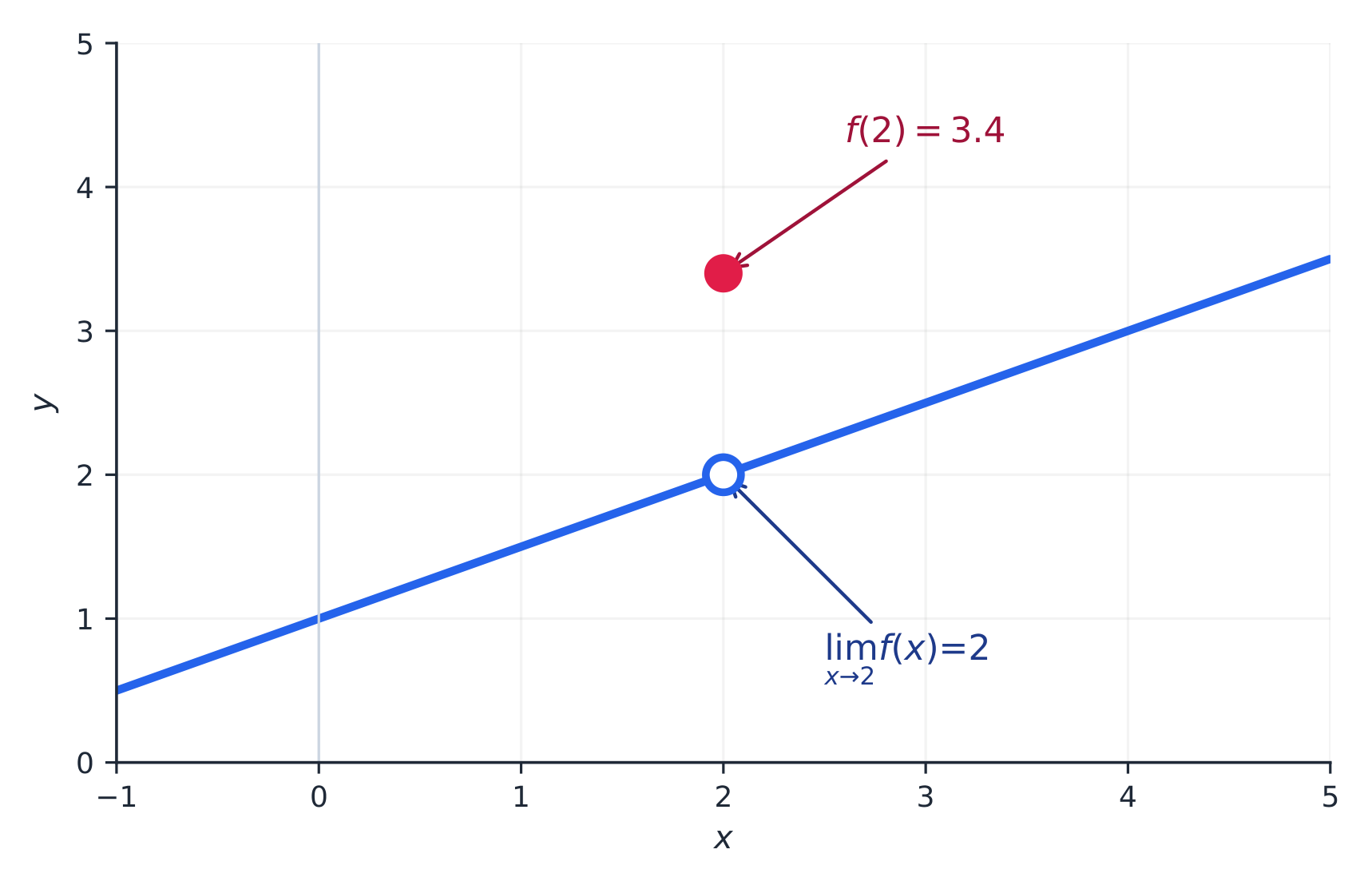
The limit is about the journey, not the destination point. $\lim_{x \to c} f(x)$ can exist even when $f(c)$ is undefined, and it can differ from $f(c)$ when the point is plotted somewhere off the curve. Never assume $\lim_{x\to c} f(x)=f(c)$ — that is a special case (continuity), not a rule.
La limite concerne le voyage, pas le point de destination. $\lim_{x \to c} f(x)$ peut exister même quand $f(c)$ est indéfini, et il peut différer de $f(c)$ quand le point est tracé ailleurs sur la courbe. Ne supposez jamais $\lim_{x\to c} f(x)=f(c)$ — c'est un cas particulier (continuité), pas une règle.
If $f(c)$ is undefined, then $\lim_{x \to c} f(x)$ cannot exist. · Si $f(c)$ n'est pas défini, alors $\lim_{x \to c} f(x)$ ne peut pas exister.
The limit is about the approach, not the point. $\lim_{x\to 1}\frac{x^2-1}{x-1}=2$ even though $f(1)$ is undefined. · La limite concerne l'approche, pas le point. $\lim_{x\to 1}\frac{x^2-1}{x-1}=2$ même si $f(1)$ est indéfini.
For a piecewise function, $\displaystyle\lim_{x\to 2^-} f(x) = 3$ and $\displaystyle\lim_{x\to 2^+} f(x) = 5$.
- The left side heads for $3$; the right side heads for $5$.
- They disagree, so $\displaystyle\lim_{x \to 2} f(x)$ does not exist — the graph jumps at $x=2$.
- This is true no matter what value (if any) is plotted at $x=2$.
Pour une fonction définie par morceaux, $\displaystyle\lim_{x\to 2^-} f(x) = 3$ et $\displaystyle\lim_{x\to 2^+} f(x) = 5$.
- Le côté gauche vise $3$ ; le côté droit vise $5$.
- Ils ne s'accordent pas, donc $\displaystyle\lim_{x \to 2} f(x)$ n'existe pas — le graphique saute à $x=2$.
- C'est vrai peu importe quelle valeur (si elle existe) est tracée à $x=2$.
$\displaystyle\lim_{x\to c} f(x)=L$ says $f(x)$ heads toward $L$ as $x$ nears $c$ from both sides — without ever touching $c$. The two-sided limit exists iff the left-hand and right-hand limits both exist and are equal. The limit describes where the function is going, which need not equal $f(c)$.
$\displaystyle\lim_{x\to c} f(x)=L$ dit que $f(x)$ se dirige vers $L$ quand $x$ se rapproche de $c$ de des deux côtés — sans jamais toucher $c$. La limite bilatérale existe si et seulement si les limites gauche et droite existent et sont égales. La limite décrit où la fonction va, ce qui n'a pas besoin d'être égal à $f(c)$.