Introduction to Signal Transduction
Introduit| English | Sens |
|---|---|
| reception/rɪˈsepʃn/ | réception |
| transduction/trænsˈdʌkʃn/ | transduction |
| response/rɪˈspɒns/ | réponse |
| signal transduction/ˈsɪɡnl trænsˈdʌkʃn/ | transduction du signal |
| ligand-gated channel/ˈlɪɡænd ˈɡeɪtɪd ˈtʃænl/ | canal dépendant des ligands |
| phosphorylation cascade/ˌfɒsfɔːrɪˈleɪʃn kəˈskeɪd/ | cascade de phosphorylation |
| second messenger/ˈsekənd ˈmesɪndʒə/ | second messager |
A message arrives but the cell stays silent
- A hormone reaches two neighbouring cells, but only one responds. The difference may be its receptor or a working internal relay, rather than the amount of hormone nearby.
- Follow reception 接收, transduction 转导 and response 响应, then predict what happens when a particular component is blocked.
Stage 1: reception
- Signal transduction 信号转导 begins with reception.
- The signal molecule binds to a receptor on the cell surface.
- This is the moment the message is picked up.
- The receptor changes shape, ready to pass the message on.
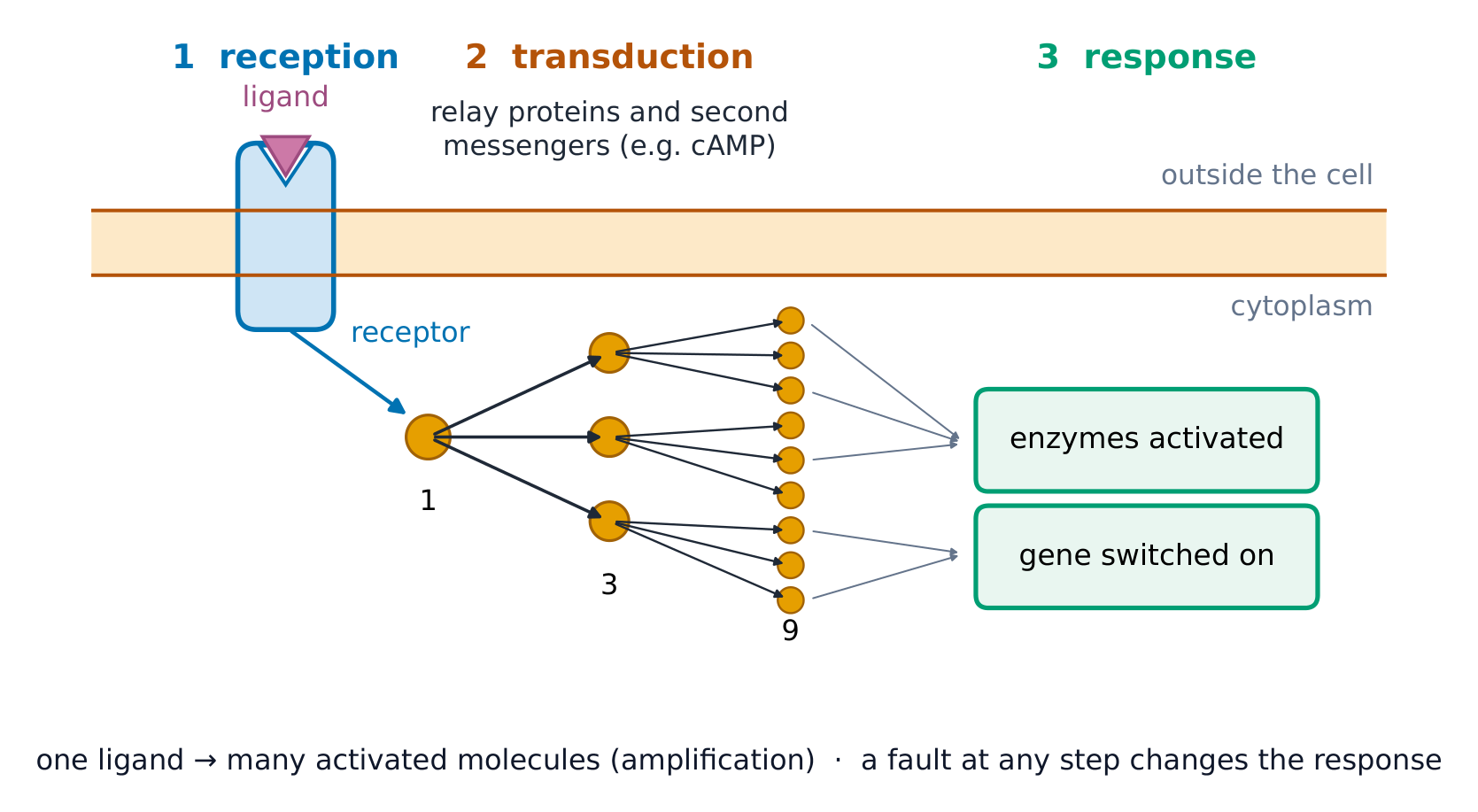
The three stages of cell signalling: reception, transduction and response
Signal transduction is the process of…
Difficulté 1/5 · 100 pièces + un petit bonus lors de la première réussite aujourd'hui
Signal transduction turns a signal arriving outside the cell into a response inside it.
What happens in the first stage, reception?
Difficulté 1/5 · 100 pièces + un petit bonus lors de la première réussite aujourd'hui
In reception, the signal molecule binds its receptor — the message is picked up.
Stage 2: transduction
- Next comes transduction — relaying the message inside.
- The receptor triggers a chain of molecules within the cell.
- Each molecule activates the next, carrying the message onward.
- The outside signal never needs to enter the cell itself.
The three stages are reception, transduction, and ____.
Difficulté 1/5 · 100 pièces + un petit bonus lors de la première réussite aujourd'hui
The final stage is the réponse — the cell actually does something.
In transduction, the receptor carries the signal molecule into the nucleus.
Difficulté 1/5 · 100 pièces + un petit bonus lors de la première réussite aujourd'hui
False. The receptor usually stays at the membrane; inside molecules such as second messengers and kinases relay the message onward.
Stage 3: response
- Finally the response: the cell actually does something.
- It might switch on a gene, activate an enzyme, or start to move.
- The response is the whole point of the signal.
- Three clean stages take a message from surface to action.
The three stages of signalling
Step through reception, transduction, and response — how an outside signal becomes an inside action.
Select tout true statements about signal transduction.
Difficulté 2/5 · 140 pièces + un petit bonus lors de la première réussite aujourd'hui
The outside signal usually does not enter the cell at all — the receptor relays it. The other three are correct.
Receptors can sit outside or inside
- Large or water-soluble signals usually bind a membrane receptor. A lipid-soluble signal can cross the membrane and bind an intracellular receptor in the cytoplasm or nucleus.
- A ligand-gated channel 配体门控通道 opens or closes when its ligand binds, changing ion flow. A G protein-coupled receptor instead activates a relay inside the cell; not every receptor works in the same way.
A lipid-soluble signal enters a cell and binds a protein in the nucleus. Where did reception occur?
Difficulté 1/5 · 100 pièces + un petit bonus lors de la première réussite aujourd'hui
Receptors can be on the surface or inside the cell; location depends on the signal.
Relay and amplify the message
- In a phosphorylation cascade 磷酸化级联, kinases transfer phosphate groups from ATP to proteins, changing their activity. Phosphatases can remove these groups; phosphorylation does not always mean activation.
- A second messenger 第二信使 such as cAMP carries the message inside the cell. One activated component can activate many others, amplifying the response without making the external ligand enter the cell.
Adding a phosphate group always activates every target protein.
Difficulté 1/5 · 100 pièces + un petit bonus lors de la première réussite aujourd'hui
Phosphorylation changes activity; the effect depends on the protein and pathway.
Worked example: a blocked relay
- A ligand binds normally and the receptor changes shape, but an inhibitor blocks the next kinase. Reception succeeds; downstream phosphorylation and the response may still fail.
- Compare three observations separately: ligand binding, relay activity and final output. Failure of the output alone does not prove that the cell lacks a receptor.
Ligand binding is normal, but an inhibitor prevents the next kinase acting. Which stage is directly blocked?
Difficulté 1/5 · 100 pièces + un petit bonus lors de la première réussite aujourd'hui
The internal relay, not initial ligand recognition, is disrupted.
The outside signal usually does not enter the cell. It binds a receptor on the surface, and that receptor sets off inside molecules that carry the message. Think of pressing a doorbell: your finger stays outside, but the sound rings within.
A doorbell for a cell:
- Reception: your finger presses the button (the signal binds the receptor).
- Transduction: wires carry the current inside the house.
- Response: the bell rings — the cell acts. Your finger never went indoors.
Signal transduction converts an outside signal into an inside action in three stages: reception (the signal binds a receptor), transduction (the message is relayed by molecules inside the cell), and response (the cell acts). The signal itself usually stays outside — the receptor relays it in.
Write from this case
- A peptide hormone cannot cross the bilayer.
- The target cell still responds.
Where is the receptor?
Hydrophilic signals bind on the outside.
Where does this peptide hormone bind?
Difficulté 1/5 · 100 pièces + un petit bonus lors de la première réussite aujourd'hui
A signal that cannot cross binds at the surface.