Enzymes
Introduit| English | Sens |
|---|---|
| enzyme/ˈenzaɪm/ | enzyme |
| catalyst/ˈkætəlɪst/ | catalyseur |
| active site/ˈæktɪv saɪt/ | site actif |
| substrate/ˈsʌbstreɪt/ | substrat |
| activation energy/ˌæktɪˈveɪʃn ˈenədʒi/ | énergie d'activation |
Speeding up life's reactions
- Most reactions that keep you alive would happen far too slowly on their own.
- Digesting a meal could take years without help.
- Cells use special proteins to make these reactions fast enough.
- These proteins are enzymes — the catalysts of life.
Enzymes are catalysts
- An enzyme 酶 is a biological catalyst 催化剂.
- A catalyst speeds up a reaction without being used up itself.
- One enzyme molecule can be reused thousands of times.
- Almost every reaction in a cell has its own enzyme.
An enzyme is a biological…
Difficulté 1/5 · 100 pièces + un petit bonus lors de la première réussite aujourd'hui
An enzyme is a biological catalyseur — it speeds up a reaction without being used up.
The active site
- Each enzyme has a pocket called the active site 活性位点.
- The substrate 底物 — the molecule it works on — fits into this pocket.
- The fit is specific, like a key in a lock.
- This is why each enzyme works on only one kind of substrate.
Le substrat binds to which part of the enzyme?
Difficulté 1/5 · 100 pièces + un petit bonus lors de la première réussite aujourd'hui
Le substrat fits into the enzyme's active site, like a key in a lock.
Lowering the activation energy
- Every reaction needs a starting push of energy — the activation energy 活化能.
- An enzyme lowers this energy barrier.
- With a smaller barrier, the reaction happens far faster.
- It can now run quickly at the gentle temperature of a living cell.
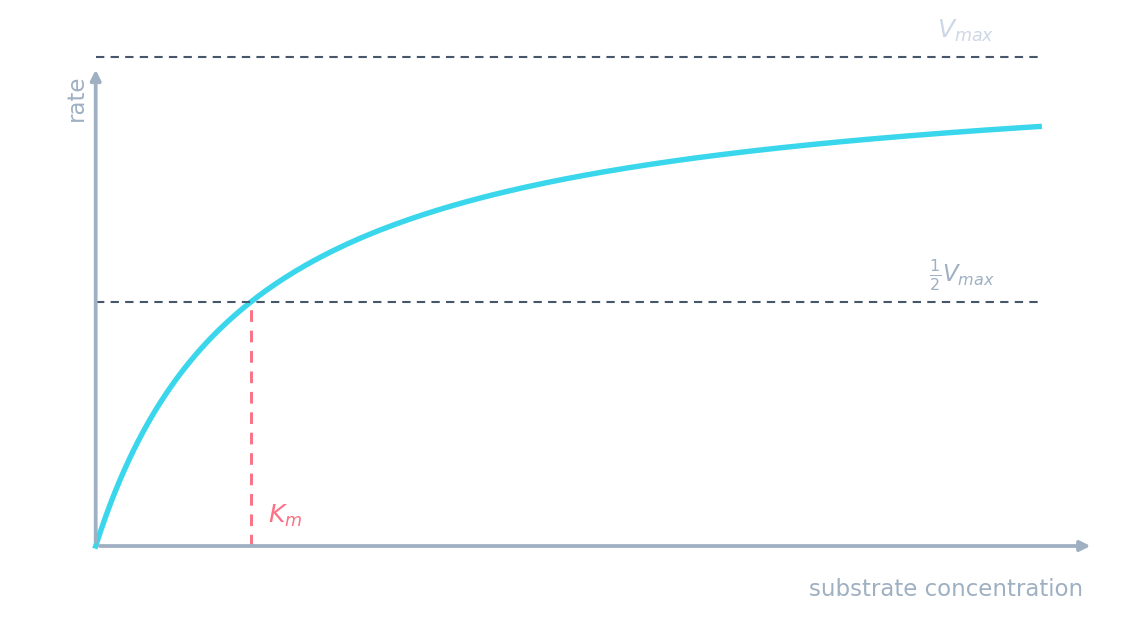
Enzyme rate and substrate
taux = Vmax·[S] / (Km + [S])
Drag the substrate. The rate rises then levels off at Vmax as every active site becomes busy.
Enzymes speed up reactions by raising the activation energy.
Difficulté 1/5 · 100 pièces + un petit bonus lors de la première réussite aujourd'hui
False. Enzymes lower the activation energy, so the reaction happens faster and at body temperature.
Select tout true statements about enzymes.
Difficulté 2/5 · 140 pièces + un petit bonus lors de la première réussite aujourd'hui
Enzymes are non used up — they are reused. The other three are correct.
An enzyme is not used up in the reaction. It grabs the substrate, helps it react, then lets the product go — unchanged and ready to work again. This is why a cell needs only a tiny amount of each enzyme.
Because an enzyme is not used up, one enzyme molecule can be used over and ____.
Difficulté 1/5 · 100 pièces + un petit bonus lors de la première réussite aujourd'hui
A catalyst is reused, so a tiny amount of enzyme can process a huge number of substrate molecules.
Catalase, an incredibly fast enzyme:
- Your cells make hydrogen peroxide, a toxic waste.
- The enzyme catalase breaks it into harmless water and oxygen.
- A single catalase molecule can handle millions of peroxide molecules every second.
An enzyme is a biological catalyst that speeds up a reaction without being used up. The substrate binds to the enzyme's active site (a specific, lock-and-key fit), and the enzyme lowers the reaction's activation energy so it runs fast at body temperature.
Write from the data given
- Without an enzyme the activation energy of a reaction is 80.
- With the enzyme it is 30. The free-energy change of the reaction stays the same.
By how much does activation energy fall?
Enzymes lower activation energy and do not change delta G.
How much does activation energy fall?
Difficulté 1/5 · 100 pièces + un petit bonus lors de la première réussite aujourd'hui
80 minus 30 is the drop in the barrier only.