Temperature scales · Échelles de température
| English | Français |
|---|---|
| thermometer/θɜːˈmɒmɪtə/ | thermomètre |
| thermocouple/ˈθɜːməkʌpl/ | thermocouple |
| thermodynamic/ˌθɜːməʊdaɪˈnæmɪk/ | thermodynamique |
| kelvin/ˈkelvɪn/ | kelvin |
| absolute zero/ˈæbsəluːt ˈzɪərəʊ/ | zéro absolu |
| Celsius/ˈselsɪəs/ | Celsius |
How a thermometer 温度计 works
- A thermometer needs something that changes with temperature.
- A liquid expands, a metal's resistance rises, a gas swells.
- Read that change and you read the temperature.
Comment fonctionne un thermomètre 温度计 works
- Un thermomètre nécessite quelque chose qui change avec la température.
- Un liquide se dilate, la résistance d'un métal augmente, un gaz gonfle.
- Lire ce changement, c'est lire la température.
Temperature scale lab · labo sur les échelles de température
Kelvin index = Celsius index + 2.73 · Indice Kelvin = Indice Celsius + 2.73
Slide Celsius temperature and see the Kelvin scale shift by 273. · Glissez la température Celsius et voyez l'échelle Kelvin changer de 273.
Kinds of thermometer
- Anything that changes repeatably with temperature works:
- expansion of a liquid, resistance of a metal, e.m.f. of a thermocouple 热电偶, volume of a gas.
A thermometer measures temperature on a defined scale
Types de thermomètres
- Tout ce qui change de manière reproductible avec la température fonctionne :
- dilatation d'un liquide, résistance d'un métal, p.e.m. d'un couple thermocouple 热电偶, volume d'un gaz.

Un thermomètre mesure la température sur une échelle définie
Select all · tout the properties that can be used to measure temperature. · Sélectionnez toutes les propriétés pouvant être utilisées pour mesurer la température.
Any property that changes repeatably with temperature works. The fixed colour of the case does not. · Toute propriété changeant de manière reproductible avec la température fonctionne. La couleur fixe de l'enveloppe ne le fait pas.
The absolute scale
- The thermodynamic 热力学 (absolute) scale uses the kelvin 开尔文 (K) and depends on no single substance.
- Absolute zero 绝对零度 ($0\ \text{K}$) is the lowest possible temperature — least internal energy. Nothing is colder.
L'échelle absolue
- L'échelle thermodynamique 热力学 (absolue) utilise le kelvin 开尔文 (K) et ne dépend d'aucune substance particulière.
- Le zéro absolu 绝对零度 ($0\ \text{K}$) est la température la plus basse possible — énergie interne minimale. Rien n'est plus froid.
Absolute zero (0 K) is: · Zéro absolu (0 K) est :
At 0 K a system has its least possible internal energy; nothing can be made colder. · À 0 K, un système a son énergie interne la plus faible possible ; rien ne peut être rendu plus froid.
Kelvin and Celsius 摄氏度
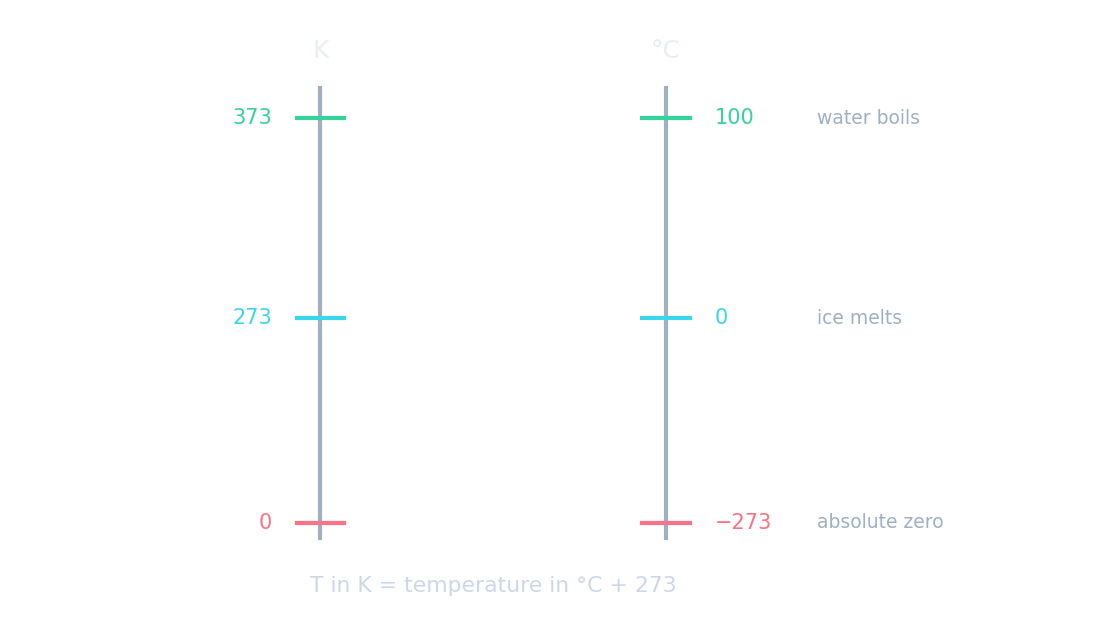
- $T/\text{K} = \theta/°\text{C} + 273.15$. So $0\ °\text{C} = 273\ \text{K}$.
- A kelvin and a Celsius degree are the same size, so a change of $1\ \text{K} = 1\ °\text{C}$.
- Always use kelvin in gas-law calculations.
Extrapolating the pressure-temperature line back to zero pressure gives absolute zero, about -273 degC
Kelvin et Celsius 摄氏度
- $T/\text{K} = \theta/°\text{C} + 273.15$. Donc $0\ °\text{C} = 273\ \text{K}$.
- Un degré kelvin et un degré Celsius ont la même taille, donc une variation de $1\ \text{K} = 1\ °\text{C}$.
- Utilisez toujours le kelvin dans les calculs de loi des gaz.

L'extrapolation de la courbe pression-température vers une pression nulle donne le zéro absolu, environ -273 degC
What is $27\ °\text{C}$ in kelvin? · Quelle est la valeur de $27\ °\text{C}$ en kelvin ?
$T/\text{K} = \theta/°\text{C} + 273 = 27 + 273 = 300\ \text{K}$.
A temperature rise of 1 K is the same as a rise of 1 °C. · Une augmentation de température de 1 K est la même qu'une augmentation de 1 °C.
The two scales have the same size of degree — only their zero points differ (by 273.15). · Les deux échelles ont le même degré — seules leurs origines diffèrent (de 273.15).
In gas-law calculations, the temperature must be in: · Dans les calculs de loi des gaz, la température doit être en :
Gas laws use absolute temperature — kelvin. Using °C gives wrong answers. · Les lois des gaz utilisent la température absolue — kelvin. Utiliser °C donne des résultats erronés.
A temperature is 27 degrees Celsius. What is it in kelvin? · Une température est de 27 degrés Celsius. Quelle est sa valeur en kelvin ?
T = 27 + 273 = 300 K. A temperature DIFFERENCE, though, is the same number in both scales: a rise of 27 C is a rise of 27 K. · T = 27 + 273 = 300 K. Une DIFFÉRENCE de température, cependant, est le même nombre dans les deux échelles : une hausse de 27 C est une hausse de 27 K.
Why the thermodynamic scale is special
- It does not depend on the property of any particular substance — it is defined from the behaviour of an ideal gas, with absolute zero and the triple point of water as its fixed points.
- A liquid-in-glass thermometer assumes its liquid expands uniformly with temperature. That is only approximately true, so it agrees with the thermodynamic scale exactly only at the points where it was calibrated.
- That is the exam's "explain why a liquid-in-glass thermometer does not measure thermodynamic temperature".
Pourquoi l'échelle thermodynamique est spéciale
- Elle ne dépend pas de la propriété d'une substance particulière — elle est définie à partir du comportement d'un gaz idéal, avec le zéro absolu et le point triple de l'eau comme points fixes.
- Un thermomètre à liquide dans du verre suppose que son liquide se dilate uniformément avec la température. Ce n'est vrai qu'approximativement, il coïncide donc avec l'échelle thermodynamique exactement seulement aux points où il a été étalonné.
- C'est là l'explication demandée en examen : "expliquez pourquoi un thermomètre à liquide dans du verre ne mesure pas la température thermodynamique".
What makes the thermodynamic scale special? Select all · tout that apply. · Qu'est-ce qui rend l'échelle thermodynamique spéciale ? Sélectionnez toutes les réponses applicables.
The unit is a consequence, not the defining feature. A mercury thermometer's scale depends on how mercury happens to expand; this one depends on nothing of the sort. · L'unité est une conséquence, pas la caractéristique définissante. L'échelle d'un thermomètre au mercure dépend de l'expansion du mercure ; celle-ci ne dépend de rien de tel.
Choosing a thermometer
- Platinum resistance: resistance varies linearly and repeatably with temperature over a wide range — very accurate. But it has a large thermal capacity, so it is slow and cannot follow a rapidly changing temperature.
- Thermocouple: two metal junctions give an e.m.f.; tiny, fast, wide range, measures at a point — ideal for a changing temperature.
- Liquid in glass: cheap and simple; limited range, slow, and reads only where the bulb is.
Choisir un thermomètre
- Résistance au platine : la résistance varie linéairement et de manière reproductible avec la température sur une large plage — très précis. Mais il a une grande capacité thermique, donc il est lent et ne peut suivre une température qui change rapidement.
- Thermocouple : deux jonctions métalliques produisent une p.e.m. ; petit, rapide, large plage, mesure ponctuelle — idéal pour une température variable.
- Liquide dans du verre : bon marché et simple ; plage limitée, lent, et ne lit qu'à l'endroit où est placée la ampoule.
Match each thermometer to its key feature. · Associez chaque thermomètre à sa caractéristique principale.
A large thermal capacity makes the resistance thermometer accurate but slow; a thermocouple's tiny junction responds fast; the absolute scale is defined from ideal-gas behaviour, not a material. · Une grande capacité thermique rend le thermomètre à résistance précis mais lent ; la jonction minuscule d'un thermocouple répond rapidement ; l'échelle absolue est définie par le comportement des gaz parfaits, non par un matériau.
Match each thermometer to the property it uses. · Associez chaque thermomètre à la propriété physique qu'il utilise.
A thermocouple has a small thermal capacity and responds fast, which is why it is chosen for a rapidly changing temperature. · Un thermocouple a une faible capacité thermique et répond rapidement, c'est pourquoi il est choisi pour les températures variables rapidement.
Worked example: finding absolute zero, then converting
A fixed volume of gas has pressure $100\ \text{kPa}$ at $0\ °\text{C}$ and $136.6\ \text{kPa}$ at $100\ °\text{C}$. Then: a gas is heated from $27\ °\text{C}$ to $742\ °\text{C}$.
- Gradient: $\dfrac{136.6 - 100}{100} = 0.366\ \dfrac{\text{kPa}}{°\text{C}}$; pressure is a straight line in temperature.
- Extrapolate to zero pressure: $\theta = -\dfrac{100}{0.366} = -273\ °\text{C}$ — absolute zero.
- Convert: $27\ °\text{C} = 300\ \text{K}$; $742\ °\text{C} = 1015\ \text{K}$.
- Temperature change: $742 - 27 = 715\ °\text{C} = 715\ \text{K}$ — a difference is the same number on both scales.
- Check: absolute zero is where the pressure of an ideal gas would fall to zero; the gas would liquefy long before, which is why the point is found by extrapolation, not by cooling.
Exemple résolu : trouver le zéro absolu, puis convertir
Un volume fixe de gaz a une pression $100\ \text{kPa}$ à $0\ °\text{C}$ et $136.6\ \text{kPa}$ à $100\ °\text{C}$. Ensuite : un gaz est chauffé de $27\ °\text{C}$ à $742\ °\text{C}$.
- Pente : $\dfrac{136.6 - 100}{100} = 0.366\ \dfrac{\text{kPa}}{°\text{C}}$ ; la pression est une droite en fonction de la température.
- Extrapoler vers une pression nulle : $\theta = -\dfrac{100}{0.366} = -273\ °\text{C}$ — zéro absolu.
- Convertir : $27\ °\text{C} = 300\ \text{K}$ ; $742\ °\text{C} = 1015\ \text{K}$.
- Variation de température : $742 - 27 = 715\ °\text{C} = 715\ \text{K}$ — une différence est le même nombre sur les deux échelles.
- Vérification : le zéro absolu est où la pression d'un gaz idéal tomberait à zéro ; le gaz se liquéfierait bien avant, c'est pourquoi le point est trouvé par extrapolation, pas par refroidissement.
A gas is heated from $20\ °\text{C}$ to · à $95\ °\text{C}$. What is the temperature change, in K? · Un gaz est chauffé de $20\ °\text{C}$ à $95\ °\text{C}$. Quel est le changement de température, en K ?
A change is the same number on both scales: $95 - 20 = 75\ °\text{C} = 75\ \text{K}$. Adding 273 would be wrong here. · Le changement est identique sur les deux échelles : $95 - 20 = 75\ °\text{C} = 75\ \text{K}$. Ajouter 273 serait faux ici.
Add $273$ to convert a Celsius temperature to kelvin, but a temperature difference is the same number on both scales — do not add $273$ to a $\Delta T$. A kelvin temperature can never be negative. And absolute zero is the temperature of minimum internal energy, not zero energy — "the molecules stop moving" is not an accepted answer.
Ajoutez $273$ pour convertir une température en Celsius vers le kelvin, mais une différence de température est le même nombre sur les deux échelles — n'ajoutez pas $273$ à une valeur en $\Delta T$. Une température en kelvin ne peut jamais être négative. Et le zéro absolu est la température de l'énergie interne minimale, pas nulle — "les molécules s'arrêtent de bouger" n'est pas une réponse acceptée.
Absolute zero is the temperature at which a substance has its ____ internal energy. · Le zéro absolu est la température à laquelle une substance possède son énergie interne ____.
Not zero energy — the minimum possible. That is why "the molecules stop moving" is not accepted. · Pas une énergie nulle — le minimum possible. C'est pourquoi « les molécules s'arrêtent » n'est pas accepté.
You've got it
- a thermometer uses any property that changes repeatably with temperature; the thermodynamic scale depends on no substance
- absolute zero $= 0\ \text{K} = -273.15\ °\text{C}$, the lowest possible temperature (minimum internal energy)
- $T/\text{K} = \theta/°\text{C} + 273$; a difference is the same in K and °C; use kelvin in gas laws
Vous avez compris
- un thermomètre utilise toute propriété qui change de manière reproductible avec la température ; l'échelle thermodynamique ne dépend d'aucune substance
- zéro absolu $= 0\ \text{K} = -273.15\ °\text{C}$, la température la plus basse possible (énergie interne minimale)
- $T/\text{K} = \theta/°\text{C} + 273$ ; une différence est la même en K et °C ; utilisez le kelvin dans les lois des gaz