Hypothesis tests · Tests d'hypothèses
| English | Français |
|---|---|
| hypothesis test/haɪˈpɒθəsɪs test/ | test d'hypothèse |
| null hypothesis/nʌl haɪˈpɒθəsɪs/ | hypothèse nulle |
| alternative/ɔːlˈtɜːnətɪv/ | alternative |
| one-tailed/wʌn teɪld/ | unilatéral |
| two-tailed/tuː teɪld/ | bilatéral |
| significance level/sɪɡˈnɪfɪkəns ˈlevl/ | niveau de signification |
| test statistic/test stəˈtɪstɪk/ | statistique de test |
| rejection region/rɪˈdʒekʃn ˈriːdʒn/ | zone de rejet |
| critical value/ˈkrɪtɪkl ˈvæljuː/ | valeur critique |
| Type I error/taɪp aɪ ˈerə/ | erreur de type I |
| Type II error/taɪp ˈtuː ˈerə/ | erreur de type II |
The courtroom of statistics
- A drug company claims their new medicine works better than the old one. How do you decide if the evidence is strong enough?
- Hypothesis testing 假设检验 is the statistical equivalent of a courtroom: you assume the defendant (the null hypothesis 原假设) is innocent until proven guilty beyond reasonable doubt.
Le tribunal de la statistique
- Une entreprise pharmaceutique affirme que son nouveau médicament fonctionne mieux que l'ancien. Comment décider si les preuves sont suffisamment solides ?
- Le test d'hypothèse 假设检验 est l'équivalent statistique d'un tribunal : on présume l'innocence du défendeur (l'hypothèse nulle 原假设) jusqu'à preuve du contraire au-delà de tout doute raisonnable.
Setting up the hypotheses
- A hypothesis test uses sample data to judge a claim.
- The null hypothesis $H_0$ — the default position (usually "no change" or "no effect").
- The alternative 备择假设 $H_1$ — what you suspect is true.
- One-tailed 单尾 if $H_1$ points one way ($\mu > 50$); two-tailed 双尾 if both ($\mu \neq 50$).
Worked example. A machine fills bottles with 500 mL. You suspect it's underfilling. $H_0: \mu = 500$ (machine is correct). $H_1: \mu < 500$ (underfilling). This is a one-tailed test.
A two-tailed 5% test rejects H0 in the shaded tails beyond plus or minus 1.96
Poser les hypothèses
- Un test d'hypothèse utilise des données d'échantillon pour juger d'une affirmation.
- L'hypothèse nulle $H_0$ — la position par défaut (généralement « aucun changement » ou « aucun effet »).
- L'alternative 备择 hypothèse $H_1$ — ce que vous soupçonnez être vrai.
- Unilatéral 单尾 si $H_1$ pointe dans un sens ($\mu > 50$) ; bilatéral 双尾 si les deux ($\mu \neq 50$).
Exemple résolu. Une machine remplit des bouteilles de 500 mL. Vous soupçonnez qu'elle est insuffisante. $H_0: \mu = 500$ (la machine est correcte). $H_1: \mu < 500$ (insuffisance). C'est un test unilatéral.

Un test bilatéral 5% rejette H0 dans les queues ombrées au-delà de plus ou moins 1.96
The rejection region · La région de rejet
reject H₀ if z < −z* · rejeter H₀ si z < −z*
The shaded tail is the rejection region — if the test statistic lands there, reject H₀. · La zone hachurée queue · file d'attente est la région de rejet — si la statistique de test y tombe, rejeter H₀.
The null hypothesis H₀ usually states that: · L'hypothèse nulle H₀ stipule généralement que :
H₀ is the claim being tested, usually "no change"; H₁ is the suspected alternative. · H₀ est la prétention testée, généralement « aucun changement » ; H₁ est l'alternative suspectée.
If H₁ states μ > 50, the test is: · Si H₁ stipule μ > 50, le test est :
H₁ pointing in one direction (μ > 50 or μ < 50) makes it a one-tailed test. · H₁ pointant dans une seule direction (μ > 50 ou μ < 50) en fait un test unilatéral.
Running the test
- Fix a significance level 显著性水平 (often 5%), compute a test statistic 检验统计量, and see if it lands in the rejection region 拒绝域.
- If $|z|$ exceeds the critical value 临界值 (1.96 for 5% two-tailed, 1.645 for 5% one-tailed), reject $H_0$.
A one-tailed test at 5% rejects H₀ only if the test statistic lands in the shaded tail.
Significance level is NOT the probability that $H_0$ is true. A 5% significance level means: if $H_0$ is true, there's a 5% chance of getting data this extreme. It does NOT mean there's a 5% chance $H_0$ is true.
Exécuter le test
- Fixez un niveau de signification 显著性 niveau (souvent 5 %), calculez une statistique de test 检验统计量, et vérifiez si elle tombe dans la zone de rejet 拒绝域.
- Si $|z|$ dépasse la valeur critique 临界值 (1.96 pour 5% bilatérale, 1.645 pour 5% unilatérale), rejeter $H_0$.
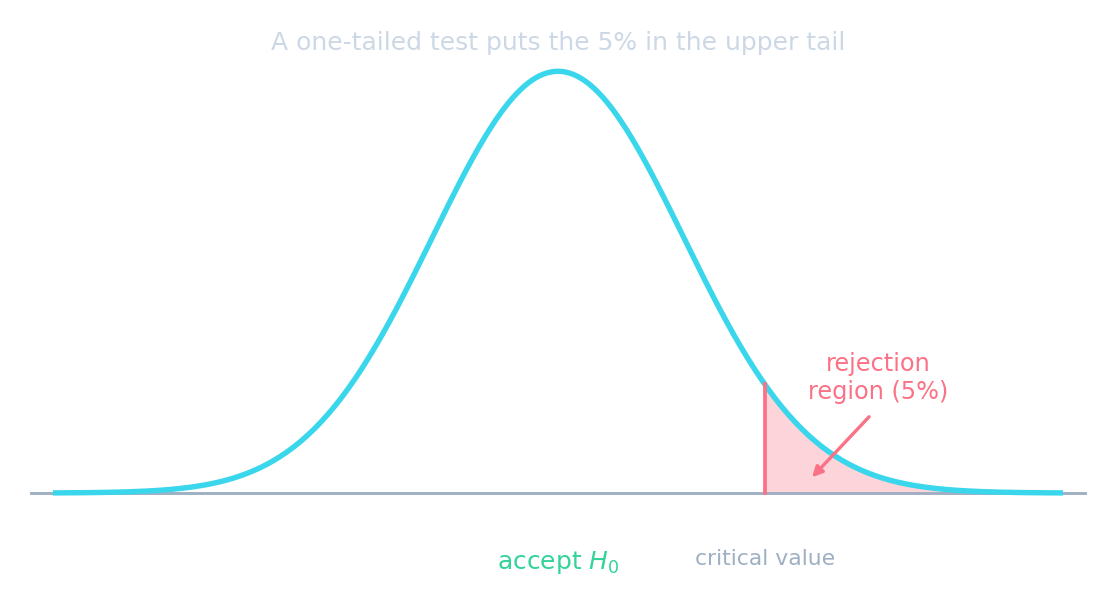
Un test unilatéral à 5 % rejette H₀ uniquement si la statistique de test tombe dans la queue ombragée.
Le niveau de signification N'EST PAS la probabilité que $H_0$ soit vrai. Un niveau de signification de 5 % signifie : si $H_0$ est vrai, il y a 5 % de chances d'obtenir des données aussi extrêmes. Cela NE SIGNIFIE PAS qu'il y a 5 % de chances que $H_0$ soit vrai.
Types of error
- Type I error 第一类错误: rejecting $H_0$ when it is true (false positive). Probability = significance level $\alpha$.
- Type II error 第二类错误: accepting $H_0$ when it is false (false negative).
Types d'erreurs
- Erreur de type I 第一类 erreur : rejeter $H_0$ lorsqu'elle est vraie (positif faux). Probabilité = niveau de signification $\alpha$.
- Erreur de type II 第二类 erreur : accepter $H_0$ lorsqu'elle est fausse (négatif faux).
A Type I error is: · Une erreur de Type I est :
Type I = reject a true H₀; Type II = accept a false H₀. · Type I = rejeter une H₀ vraie ; Type II = accepter une H₀ fausse.
A Type II error means accepting H₀ when it is actually false. · Une erreur de Type II signifie accepter H₀ alors qu'elle est fausse.
Type II = fail to reject a false H₀ (false negative). · Type II = ne pas rejeter une H₀ fausse (faux négatif).
Worked example — z-test
- $H_0: \mu = 50$, $H_1: \mu \neq 50$ (two-tailed, 5% level). $\sigma = 8$, $n = 64$, $\bar{x} = 52$.
- $z = \dfrac{52 - 50}{8/\sqrt{64}} = \dfrac{2}{1} = 2$.
- Critical value for 5% two-tailed: $1.96$. Since $2 > 1.96$, reject $H_0$.
- Set a null and alternative hypothesis; the test statistic falls in the critical region (reject) or the acceptance region. A Type II error is accepting a false $H_0$. Tests may use a binomial or Poisson distribution.
Exemple résolu — test z
- $H_0: \mu = 50$, $H_1: \mu \neq 50$ (bilatéral, niveau de 5 %). $\sigma = 8$, $n = 64$, $\bar{x} = 52$.
- $z = \dfrac{52 - 50}{8/\sqrt{64}} = \dfrac{2}{1} = 2$.
- Valeur critique pour 5 % bilatéral : $1.96$. Puisque $2 > 1.96$, rejeter $H_0$.
- Définir une hypothèse nulle et une alternative ; la statistique de test tombe dans la zone critique (rejet) ou la zone d'acceptation. Une erreur de type II est d'accepter une $H_0$ fausse. Les tests peuvent utiliser une distribution binomiale ou Poisson.
Population mean claimed 50, σ = 8, sample n = 64, x̄ = 52. What is z = (x̄ − μ)/(σ/√n)? · Moyenne de population prétendue 50, σ = 8, échantillon n = 64, x̄ = 52. Quelle est z = (x̄ − μ)/(σ/√n) ?
z = (52 − 50)/(8/√64) = 2/(8/8) = 2/1 = 2.
For a 5% two-tailed test, you reject H₀ if |z| > 1.96. · Pour un test bilatéral à 5%, vous rejetez H₀ si |z| > 1.96.
The critical value for a 5% two-tailed test is 1.96. If |z| exceeds this, reject H₀. · La valeur critique pour un test bilatéral de 5% est 1.96. Si |z| dépasse cette valeur, rejeter H₀.
You've got it
- $H_0$ (no change) vs $H_1$ (suspected); one- or two-tailed
- test statistic $z = \dfrac{\bar{x} - \mu}{\sigma/\sqrt{n}}$; reject $H_0$ if it's in the rejection region
- Type I = reject a true $H_0$; Type II = accept a false $H_0$
Vous avez compris
- $H_0$ (aucun changement) contre $H_1$ (soupçonné) ; unilatéral- ou bilatéral
- statistique de test $z = \dfrac{\bar{x} - \mu}{\sigma/\sqrt{n}}$ ; rejeter $H_0$ si elle est dans la zone de rejet
- Type I = rejeter une $H_0$ vraie ; Type II = accepter une $H_0$ fausse