Proton NMR · RMN du Proton
| English | Français |
|---|---|
| chemical shift/ˈkemɪkl ʃɪft/ | décalage chimique |
| splitting/ˈsplɪtɪŋ/ | multiplet |
| deuterated/ˈdjuːtəreɪtɪd/ | deutéré |
| integration/ˌɪntɪˈɡreɪʃn/ | intégration |
Proton (¹H) NMR
- Proton NMR looks at the hydrogen atoms in a molecule.
- The spectrum gives three kinds of information.
- A few practical tricks make it readable.
RMN des protons (¹H)
- La RMN des protons examine les atomes d'hydrogène d'une molécule.
- Le spectre fournit trois types d'informations.
- Quelques astuces pratiques rendent sa lecture aisée.
Proton NMR lab · Labo RMN des protons
Match proton evidence to chemical environment and neighbours. · Corréler les preuves protoniques à l'environnement chimique et aux voisins.
In proton NMR, the area under each peak is proportional to the number of ______ in that environment. · En RMN des protons, l'aire sous chaque pic est proportionnelle au nombre de ______ dans cet environnement.
Integration gives the ratio of protons. · L'intégration donne le ratio des protons.
What you read off
- chemical environments: protons in different environments appear at different chemical shifts 化学位移 (number of peak groups = number of environments).
- relative numbers: the peak areas give the ratio of each type of proton.
- splitting 裂分: a peak is split by the protons on the neighbouring carbon — the $n+1$ rule.
| Neighbours ($n$) | Pattern |
|---|---|
| 0 | singlet |
| 1 | doublet |
| 2 | triplet |
| 3 | quartet |
A proton NMR spectrum of ethanol
Ce que vous lisez
- environnements chimiques : les protons dans des environnements différents apparaissent à des déplacements chimiques 化学位移 différents (nombre de groupes de pics = nombre d'environnements).
- nombres relatifs : les aires des pics donnent le ratio de chaque type de proton.
- multiplicité / splitting 裂分 : un pic est divisé par les protons du carbone voisin selon la règle $n+1$.
| Voisins ($n$) | Motif |
|---|---|
| 0 | singulet |
| 1 | doublet |
| 2 | triplet |
| 3 | quartet |
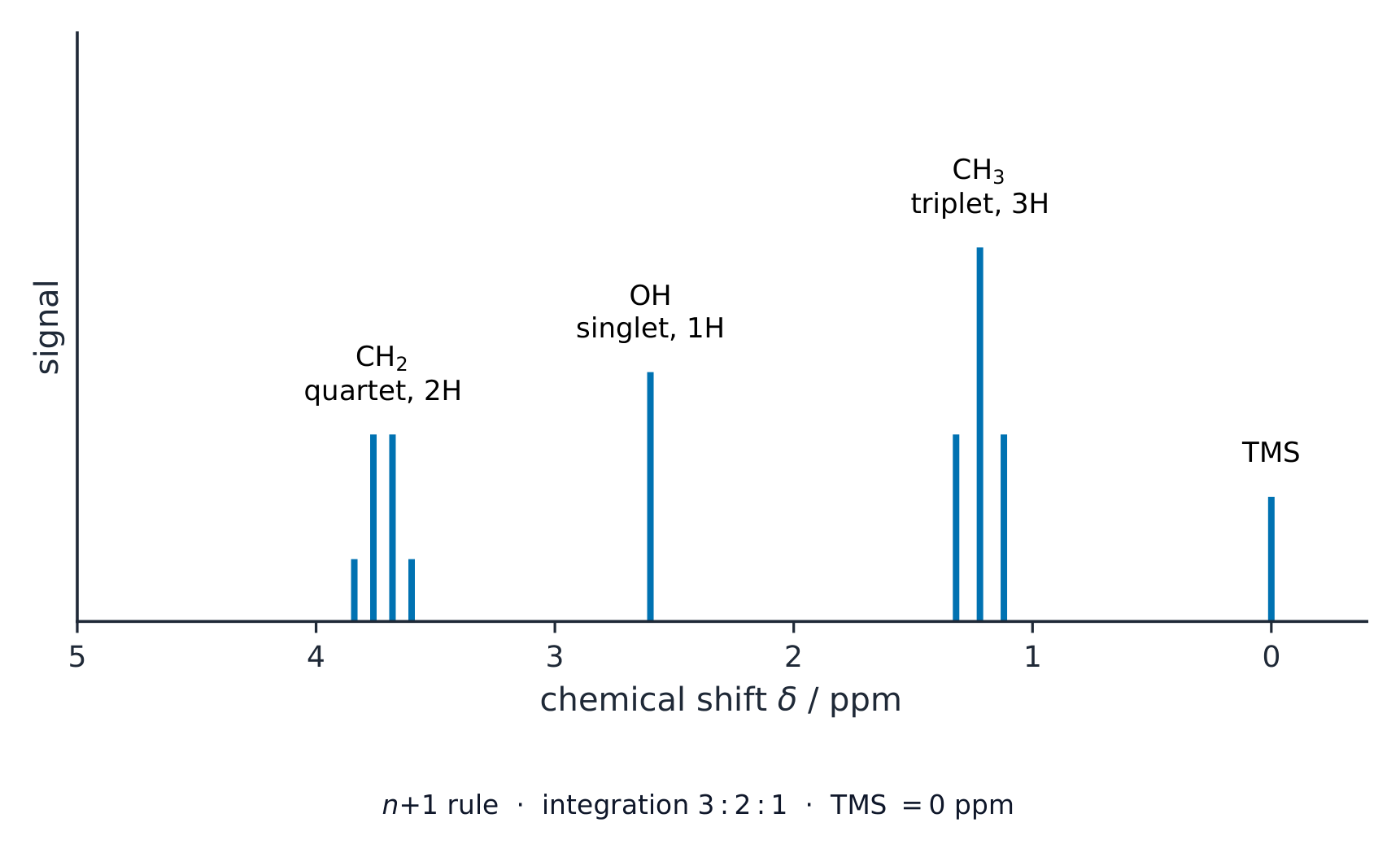
Un spectre RMN des protons de l'éthanol
In proton NMR, the number of groups of peaks tells you: · En RMN des protons, le nombre de groupes de pics vous indique :
Protons in different environments give peaks at different chemical shifts. · Les protons dans des environnements différents donnent des pics à différents déplacements chimiques.
The relative areas of the peaks give: · Les aires relatives des pics donnent :
Peak area is proportional to how many protons of that type there are (e.g. 3:2:1 for ethanol). · L'aire du pic est proportionnelle au nombre de protons de ce type (ex. : 3:2:1 pour l'éthanol).
By the n+1 rule, a CH₃ group next to a CH₂ group appears as a: · Selon la règle n+1, un groupe CH₃ adjacent à un groupe CH₂ apparaît comme un :
The CH₃ has 2 neighbouring protons (on the CH₂), so n+1 = 3 lines — a triplet. · Le CH₃ a 2 protons voisins (sur le CH₂), donc n+1 = 3 raies — un triplet.
Match each term to its meaning. · Reliez chaque terme à sa signification.
Each item links the term to its correct meaning. · Chaque élément relie le terme à sa signification correcte.
Practical points
- TMS (tetramethylsilane) is the standard, set at chemical shift 0.
- a deuterated 氘代 solvent (e.g. $\text{CDCl}_3$) gives no proton signal of its own.
- shaking with D₂O makes O–H and N–H peaks disappear (their H is swapped for D), identifying those protons.
Points pratiques
- Le TMS (tétraméthylsilane) est la référence, placée à un déplacement chimique de 0.
- un solvant deutéré 氘代 (ex. $\text{CDCl}_3$) ne produit pas de signal proton propre.
- agiter avec D₂O fait disparaître les pics O–H et N–H (leur H est échangé contre D), identifiant ainsi ces protons.
Shaking a sample with D₂O makes which peaks disappear? · Agiter un échantillon avec D₂O fait disparaître quels pics ?
The exchangeable O–H and N–H hydrogens swap for deuterium, so their peaks vanish — identifying them. · Les hydrogènes échangeables O–H et N–H échangent contre du deutérium, leurs pics disparaissent — les identifiant.
What proton NMR tells you
- The number of peaks = different hydrogen environments; integration 积分 = ratio of protons.
- Splitting (n+1 rule) shows how many hydrogens are on neighbouring carbons.
Ce que la RMN des protons vous apprend
- Le nombre de pics = environnements d'hydrogène différents ; intégration 积分 = ratio des protons.
- La multiplicité (règle n+1) indique combien d'hydrogènes sont sur les carbones voisins.
You've got it
- ¹H NMR: number of peak groups = proton environments; areas = ratio of protons
- splitting: the $n+1$ rule ($n$ neighbours → $n+1$ lines): 0→singlet, 1→doublet, 2→triplet, 3→quartet
- TMS = reference (shift 0); a deuterated solvent is silent; D₂O removes O–H/N–H peaks
Vous avez compris
- RMN ¹H : nombre de groupes de pics = environnements de protons ; aires = ratio des protons
- multiplicité : la règle $n+1$ ($n$ voisins → $n+1$ lignes) : 0→singulet, 1→doublet, 2→triplet, 3→quartet
- TMS = référence (déplacement 0) ; un solvant deutéré est silencieux ; D₂O élimine les pics O–H/N–H