Gas/liquid chromatography · Chromatographie gaz/liquide
| English | Français |
|---|---|
| carrier gas/ˈkærɪə ɡæs/ | gaz vecteur |
| retention time/rɪˈtenʃn taɪm/ | temps de rétention |
| chromatogram/krəʊˈmætəɡræm/ | chromatogramme |
| mass spectrometer/mæs spekˈtrɒmɪtə/ | spectromètre de masse |
Separating a vapour
- Gas/liquid chromatography (GLC) separates a mixture of volatile components.
- The mobile phase is a carrier gas 载气; the stationary phase is a liquid on a solid.
- Each component leaves a peak at its own retention time 保留时间.
Séparation d'un vapeur
- La chromatographie gaz/liquide (CGL) sépare un mélange de composants volatils.
- La phase mobile est un gaz porteur 载气 ; la phase stationnaire est un liquide sur un solide.
- Chaque composant laisse un pic à son propre temps de rétention 保留时间.
Gas/liquid chromatography route · Voie Chromatographie gaz/liquide
Follow a volatile sample through column separation to a chromatogram. · Suivre un échantillon volatil à travers une séparation en colonne jusqu'à un chromatogramme.
In gas chromatography, the time a component takes to pass through the column is its ______ time. · En chromatographie en phase gazeuse, le temps mis par un composant pour traverser la colonne est son temps de ______.
Used to identify components. · Utilisé pour identifier les composants.
Gas chromatography separates a mixture of volatile substances. · La chromatographie en phase gazeuse sépare un mélange de substances volatiles.
They travel through the column at different speeds. · Ils traversent la colonne à des vitesses différentes.
How it works
- the stationary phase is a high-boiling-point non-polar liquid on a solid support.
- the mobile phase is an unreactive carrier gas (e.g. nitrogen).
- the retention time is how long a component takes to pass through.
- A component that interacts more with the stationary phase has a longer retention time.
A gas-liquid chromatogram 色谱图 with retention times and peak areas
Comment cela fonctionne
- la phase stationnaire est un liquide non polaire à point d'ébullition élevé sur un support solide.
- la phase mobile est un gaz porteur inerte (ex. azote).
- le temps de rétention est la durée qu'un composant met à passer à travers.
- Un composant qui interagit davantage avec la phase stationnaire a un temps de rétention plus long.
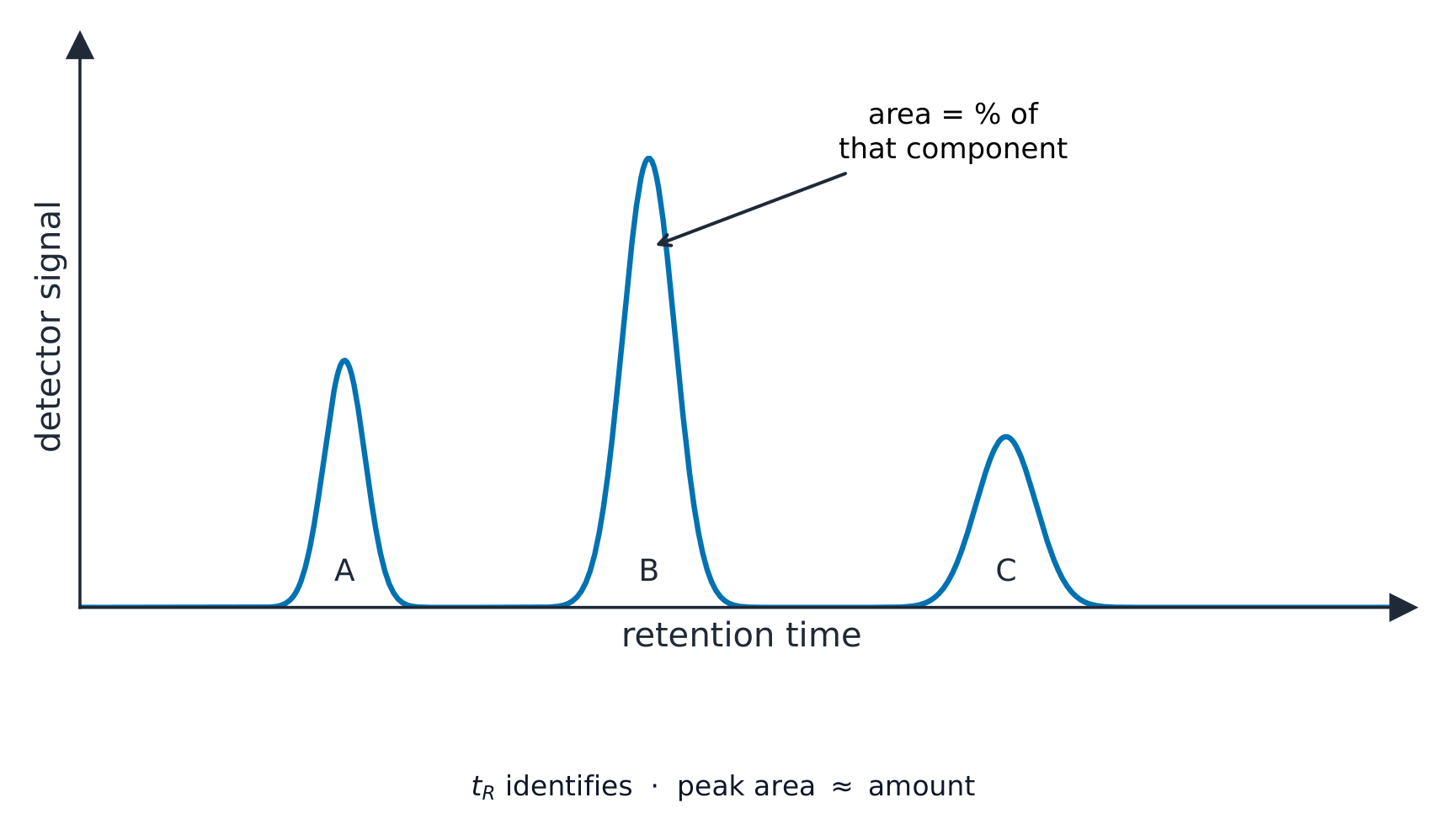
Un chromatogramme gaz-liquide 色谱图 avec des temps de rétention et des aires de pics
In GLC, the mobile phase is: · En CGC, la phase mobile est :
A carrier gas moves the components past the liquid stationary phase. · Un gaz vecteur déplace les composants devant la phase stationnaire liquide.
A component that interacts more strongly with the stationary phase has a: · Un composant qui interagit plus fortement avec la phase stationnaire a :
More interaction slows it down, so it takes longer to pass through (longer retention time). · Plus d'interaction le ralentit, donc il met plus de temps à passer (temps de rétention plus long).
Reading the chromatogram
- The area of each peak gives the proportion of that component in the mixture.
A chromatogram shows two peaks with areas in the ratio 3 : 1.
- Total = 3 + 1 = 4 parts.
- So the mixture is 75% of the first component and 25% of the second.
(Peak height can mislead — always use the area.)
Lire le chromatogramme
- L'aire de chaque pic donne la proportion de ce composant dans le mélange.
Un chromatogramme montre deux pics dont les aires sont dans le rapport 3 : 1.
- Total = 3 + 1 = 4 parties.
- Le mélange contient donc 75 % du premier composant et 25 % du second.
(La hauteur du pic peut induire en erreur — utilisez toujours l'aire.)
The area of each peak in a chromatogram gives: · L'aire de chaque pic dans un chromatogramme donne :
Peak area is proportional to the amount, so it gives the percentage composition. · L'aire du pic est proportionnelle à la quantité, donc elle donne la composition en pourcentage.
Identifying the components
- A peak's retention time matches a known standard run in the same conditions → that names the component.
- Coupling GLC to a mass spectrometer 质谱仪 (GC–MS) confirms each component's identity from its mass spectrum.
- GC–MS is the workhorse of forensics, drug testing and airport security.
Identifier les composants
- Le temps de rétention d'un pic correspond à un standard connu run dans les mêmes conditions → cela nomme le composant.
- Coupler la CGL à un spectromètre de masse 质谱仪 (CG-MS) confirme l'identité de chaque composant via son spectre de masse.
- La CG-MS est l'outil principal de la criminalistique, des tests antidopage et de la sécurité aéroportuaire.
You've got it
- GLC: mobile phase = carrier gas; stationary phase = a non-polar liquid on a solid
- each component has a retention time; more interaction → longer retention
- the peak area = the proportion of that component (areas 3:1 → 75% : 25%)
- match retention time to a standard to identify; GC–MS confirms it
Vous avez compris
- CGL : phase mobile = gaz porteur ; phase stationnaire = un liquide non polaire sur un solide
- chaque composant a un temps de rétention ; plus d'interaction → rétention plus longue
- l'aire du pic = la proportion de ce composant (aires 3:1 → 75% : 25%)
- faire correspondre le temps de rétention à un standard pour identifier ; CG-MS confirme