Primary and secondary amines
Introduit| English | Sens |
|---|---|
| amine/ˈæmaɪn/ | amine : amine |
| amino acid/əˈmiːnəʊ ˈæsɪd/ | acide aminé |
| lone pair/ləʊn peə/ | paire d'électrons non liante |
| basicity/beɪˈsɪsɪti/ | basicité |
| phenylamine/ˌfiːˈnaɪləmiːn/ | phénylamine |
Nitrogen-based bases
- Amines 胺 are everywhere — in amino acids 氨基酸, proteins, medicines and dyes.
- An amine has an –NH₂ group (primary) or –NH– (secondary).
- The nitrogen keeps a lone pair 孤对电子, and that lone pair is what makes amines bases.
Amine type lab
Classify amines by substitution at nitrogen and basic behaviour.
A primary amine has the group:
Difficulté 1/5 · 100 pièces + un petit bonus lors de la première réussite aujourd'hui
A primary amine has –NH₂; a secondary amine has –NH– between two carbons.
Amines act as bases because the nitrogen has a lone ______.
Difficulté 1/5 · 100 pièces + un petit bonus lors de la première réussite aujourd'hui
It accepts a proton.
Making amines
- a halogenoalkane + NH₃ (in ethanol, under pressure) → a primary amine.
- that primary amine + more halogenoalkane → a secondary, then tertiary amine.
- reduction of an amide or nitrile with $\text{LiAlH}_4$ → an amine.
- (and an amine or ammonia + an acyl chloride → an amide.)
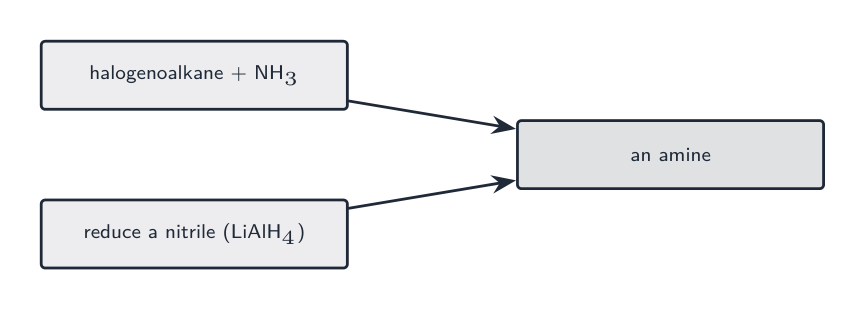
Two routes to an amine: from a halogenoalkane, or by reducing a nitrile
A primary amine is made by heating a halogenoalkane with:
Difficulté 1/5 · 100 pièces + un petit bonus lors de la première réussite aujourd'hui
Ammonia substitutes the halogen to give the amine (excess NH₃ favours the primary amine).
Reducing a nitrile or amide with LiAlH₄ gives:
Difficulté 1/5 · 100 pièces + un petit bonus lors de la première réussite aujourd'hui
LiAlH₄ reduces both nitriles and amides to amines.
Match each term to its meaning.
Difficulté 2/5 · 140 pièces + un petit bonus lors de la première réussite aujourd'hui
Each item links the term to its correct meaning.
Why amines are bases
- The nitrogen lone pair accepts an $\text{H}^+$ — so an amine is a base (a proton acceptor).
- The more available that lone pair, the stronger the base.
- Alkyl groups push electrons onto N, making the pair more available; a benzene ring pulls it away.
Basicity order: ethylamine > ammonia > phenylamine 苯胺.
- Ethylamine (CH₃CH₂NH₂): the ethyl group donates electrons, so the lone pair is more available — the strongest base here.
- Ammonia (NH₃): no help, no hindrance — the baseline.
- Phenylamine (C₆H₅NH₂): the lone pair is drawn into the benzene ring, so it is least available — the weakest base.
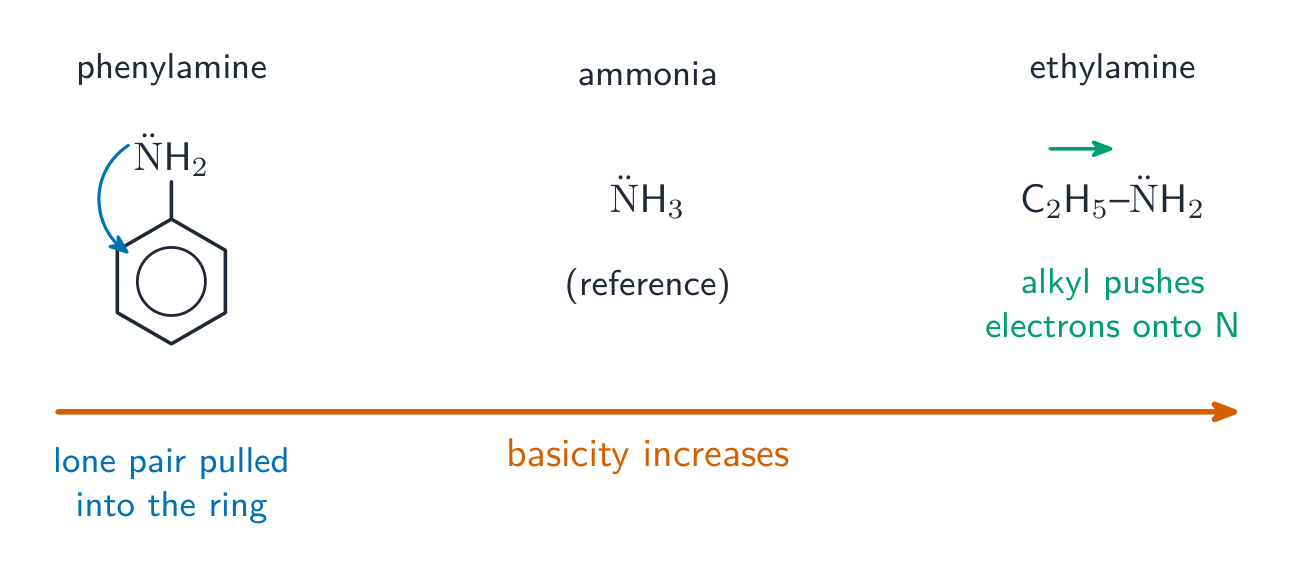
Amine basicity 碱性 depends on the availability of the nitrogen lone pair
Amines are bases because:
Difficulté 1/5 · 100 pièces + un petit bonus lors de la première réussite aujourd'hui
The nitrogen lone pair accepts H⁺, making the amine a base.
Primary, secondary, tertiary
- Amines are classed by how many carbon groups are attached to the nitrogen.
- 1° = one (e.g. CH₃NH₂); 2° = two (e.g. (CH₃)₂NH); 3° = three (e.g. (CH₃)₃N).
- All act as bases, because the nitrogen still keeps its lone pair in each case.
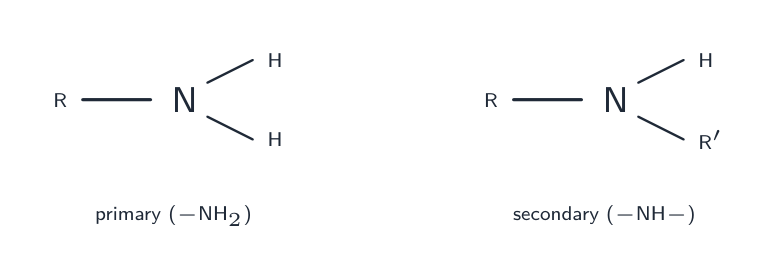
A primary amine has –NH₂; a secondary amine has –NH–
Worked example: choose a route to propylamine
Make propylamine, CH₃CH₂CH₂NH₂, (a) from 1-bromopropane, and (b) from bromoethane.
- (a) Heat 1-bromopropane with excess ammonia in ethanol in a sealed tube. Excess NH₃ makes it more likely that each bromopropane meets NH₃, not the amine already made, so less secondary and tertiary amine forms.
- (b) Bromoethane has only 2 carbons. React it with KCN in ethanol to make propanenitrile (3 carbons), then reduce with LiAlH₄ or H₂/Ni: CH₃CH₂CN + 4[H] → CH₃CH₂CH₂NH₂. The nitrile route gives only the primary amine and adds one carbon.
Which route makes butylamine, CH₃CH₂CH₂CH₂NH₂, from 1-bromopropane?
Difficulté 1/5 · 100 pièces + un petit bonus lors de la première réussite aujourd'hui
Butylamine has 4 carbons. The CN group adds one carbon to the 3-carbon chain, and reduction turns –CN into –CH₂NH₂.
Why is excess ammonia used to make a primary amine from a halogenoalkane?
Difficulté 1/5 · 100 pièces + un petit bonus lors de la première réussite aujourd'hui
The primary amine is itself a nucleophile. With NH₃ in excess, the halogenoalkane is more likely to meet NH₃ than the amine.
- Halogenoalkane + NH₃ gives a mixture of 1°, 2°, 3° amines (and a quaternary salt); use excess NH₃ for the primary amine.
- Basicity is about how available the N lone pair is, not about how many H atoms are on N.
- Amines are named from the longest chain: CH₃CH₂NH₂ is ethylamine (or ethanamine).
You've got it
- amine = –NH₂ (1°), –NH– (2°), or three carbons on N (3°)
- made from halogenoalkane + NH₃, or by reducing a nitrile/amide ($\text{LiAlH}_4$)
- amines are bases — the nitrogen lone pair accepts $\text{H}^+$
- basicity: ethylamine > ammonia > phenylamine (alkyl donates to N; a ring pulls the pair away)