Stability constants
Introduit| English | Sens |
|---|---|
| stability constant/stəˈbɪlɪti ˈkɒnstənt/ | constante de stabilité |
| ligand exchange/ˈlɪɡænd eksˈtʃeɪndʒ/ | échange de ligand |
| chelate effect/ˈtʃeleɪt ɪˈfekt/ | effet chélate |
| multidentate/ˌmʌltɪˈdenteɪt/ | polydentate |
| entropy/ˈentrəpi/ | entropie |
How stable is the complex?
- The stability constant 稳定常数 $K_{\text{stab}}$ measures how stable a complex is.
- It is the equilibrium constant for forming the complex in solution.
- It decides the direction of ligand exchange 配体交换 — which complex wins.
Stability constant lab
larger Kstab favours complex
Increase ligand binding strength and see complex formation become more complete.
The stability constant K_stab is:
Difficulté 1/5 · 100 pièces + un petit bonus lors de la première réussite aujourd'hui
K_stab is the equilibrium constant for the complex-forming reaction; water is omitted.
The equilibrium constant for the formation of a complex from its aqua ion is the ______ constant.
Difficulté 1/5 · 100 pièces + un petit bonus lors de la première réussite aujourd'hui
A larger value means a more stable complex.
A larger stability constant means the complex is less stable than the aqua ion.
Difficulté 1/5 · 100 pièces + un petit bonus lors de la première réussite aujourd'hui
False. A larger stability constant means the complex is more stable than the aqua ion, so ligand exchange to form it is favoured.
What $K_{\text{stab}}$ tells you
- $K_{\text{stab}}$ is the equilibrium constant for forming a complex from the metal ion and its ligands (water is left out of the expression).
- A large $K_{\text{stab}}$ means a very stable complex.
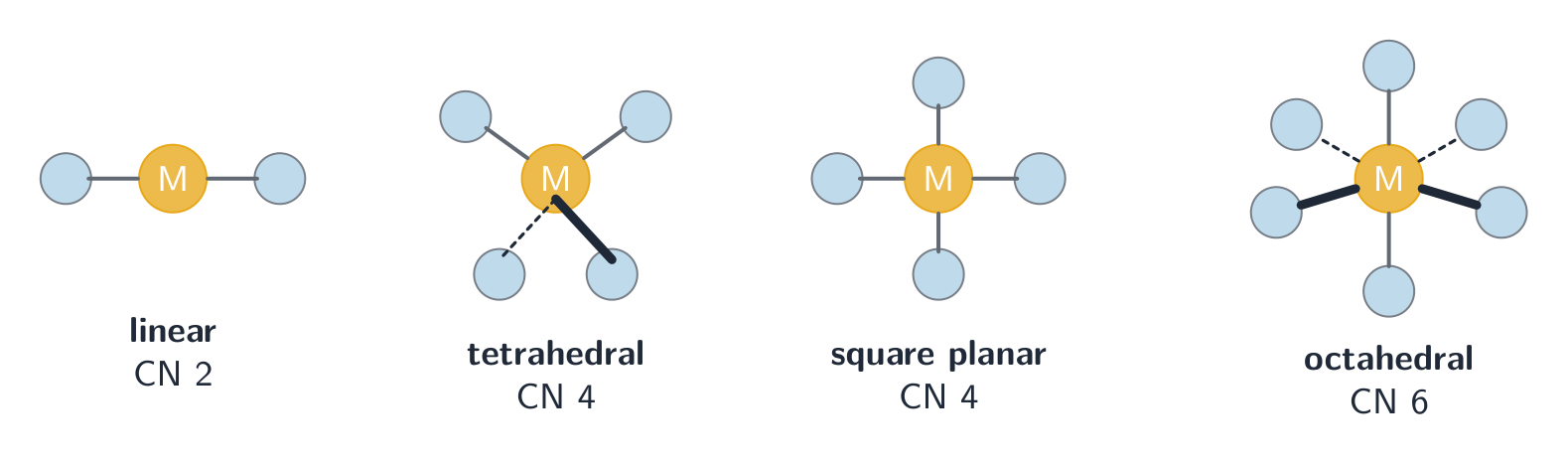
Complex shapes by coordination number
A large K_stab means the complex is:
Difficulté 1/5 · 100 pièces + un petit bonus lors de la première réussite aujourd'hui
A large stability constant indicates a strongly favoured, stable complex.
Direction of ligand exchange
- In a ligand exchange, the equilibrium shifts towards the complex with the larger $K_{\text{stab}}$.
- So a ligand that forms a more stable complex can push out a weaker one.
In a ligand exchange, the equilibrium shifts towards the complex with the:
Difficulté 1/5 · 100 pièces + un petit bonus lors de la première réussite aujourd'hui
The more stable complex (larger K_stab) is favoured, so a stronger ligand can displace a weaker one.
The chelate effect 螯合效应
- A multidentate 多齿 (chelating) ligand forms a far more stable complex than several separate ligands.
- The reason is entropy 熵: swapping many small ligands for a few big ones increases the number of free particles.
[Ni(H₂O)₆]²⁺ + 3 en (a bidentate ligand) → [Ni(en)₃]²⁺ + 6 H₂O.
- 4 particles become 7 free particles — a big entropy rise.
- So $K_{\text{stab}}$ is huge, and the en complex easily displaces the water (or ammonia) ligands.
- This chelate effect is why EDTA (which grabs a metal ion at six points) binds so tightly.
[Cu(H₂O)₆]²⁺ + EDTA⁴⁻ → [Cu(EDTA)]²⁻ + 6H₂O. How many particles are on the right for every 2 on the left?
Difficulté 2/5 · 140 pièces + un petit bonus lors de la première réussite aujourd'hui
1 complex + 6 water molecules = 7 particles from 2. The big rise in entropy makes the EDTA complex very stable.
Writing the expression
- Write the complex on top and the aqueous metal ion and free ligand below, each ligand raised to its number in the equation.
- Leave water out: it is the solvent, so its concentration hardly changes.
- Data books often give $\lg K_{\text{stab}}$: each 1 more in $\lg K$ means a $K$ 10 times larger.
Cu²⁺(aq) + 4 NH₃(aq) ⇌ [Cu(NH₃)₄(H₂O)₂]²⁺(aq)
- Units: $\dfrac{\text{dm}^{12}}{\text{mol}^{4}}$ (one concentration on top, five multiplied below).
- $\lg K_{\text{stab}}$ is about 13 for this ammonia complex and about 19 for the EDTA complex, so EDTA displaces ammonia: its $K$ is about $10^6$ times larger.
Ni²⁺(aq) + 6 NH₃(aq) ⇌ [Ni(NH₃)₆]²⁺(aq). In the $K_{\text{stab}}$ expression, to what power is [NH₃] raised?
Difficulté 2/5 · 140 pièces + un petit bonus lors de la première réussite aujourd'hui
Each ligand concentration is raised to its coefficient: six NH₃ molecules, so [NH₃]⁶.
For copper(II): $\lg K_{\text{stab}}$ is 5.6 for [CuCl₄]²⁻, 13.1 for the ammonia complex and 18.8 for the EDTA complex. Which ligand can displace all the others?
Difficulté 1/5 · 100 pièces + un petit bonus lors de la première réussite aujourd'hui
Ligand exchange moves towards the complex with the larger $K_{\text{stab}}$; EDTA's is about 10⁵·⁷ times the ammonia complex's.
Complex P has $\lg K_{\text{stab}} = 18$ and complex Q has $\lg K_{\text{stab}} = 15$. How many times larger is $K_{\text{stab}}$ for P?
Difficulté 2/5 · 140 pièces + un petit bonus lors de la première réussite aujourd'hui
A difference of 3 in lg K means 10³ = 1000 times larger.
- Leave water out of the $K_{\text{stab}}$ expression, and raise each ligand to its number in the equation.
- Compare stabilities with $\lg K_{\text{stab}}$: a difference of 1 means a factor of 10.
- The chelate effect is explained by entropy (more free particles), not by stronger bonds.
You've got it
- $K_{\text{stab}}$ = equilibrium constant for forming a complex (water omitted)
- a large $K_{\text{stab}}$ = a very stable complex
- ligand exchange moves towards the complex with the larger $K_{\text{stab}}$
- the chelate effect: multidentate ligands give a bigger $K_{\text{stab}}$, driven by the entropy rise