Aldehydes and ketones
Introduit| English | Sens |
|---|---|
| carbonyl compound/ˈkɑːbənaɪl ˈkɒmpaʊnd/ | carbonyl compound : composé carbonyle |
| aldehyde/ˈældɪhaɪd/ | aldehyde : aldéhyde |
| ketone/ˈketəʊn/ | ketone : cétone |
| reduction/rɪˈdʌkʃn/ | réduction |
| hydroxynitrile/haɪˈdrɒksɪnaɪtraɪl/ | hydroxynitrile : hydroxynitrile |
| nucleophilic addition/ˌnjuːklɪəˈfɪlɪk əˈdɪʃn/ | addition nucléophile |
The carbonyl compounds 羰基化合物
- The smell of vanilla comes from vanillin, an aldehyde. Nail-polish remover is propanone, a ketone. Both contain the C=O (carbonyl) group.
- In an aldehyde 醛 the C=O is at the end of the chain (–CHO). In a ketone 酮 it is in the middle, between two carbons.
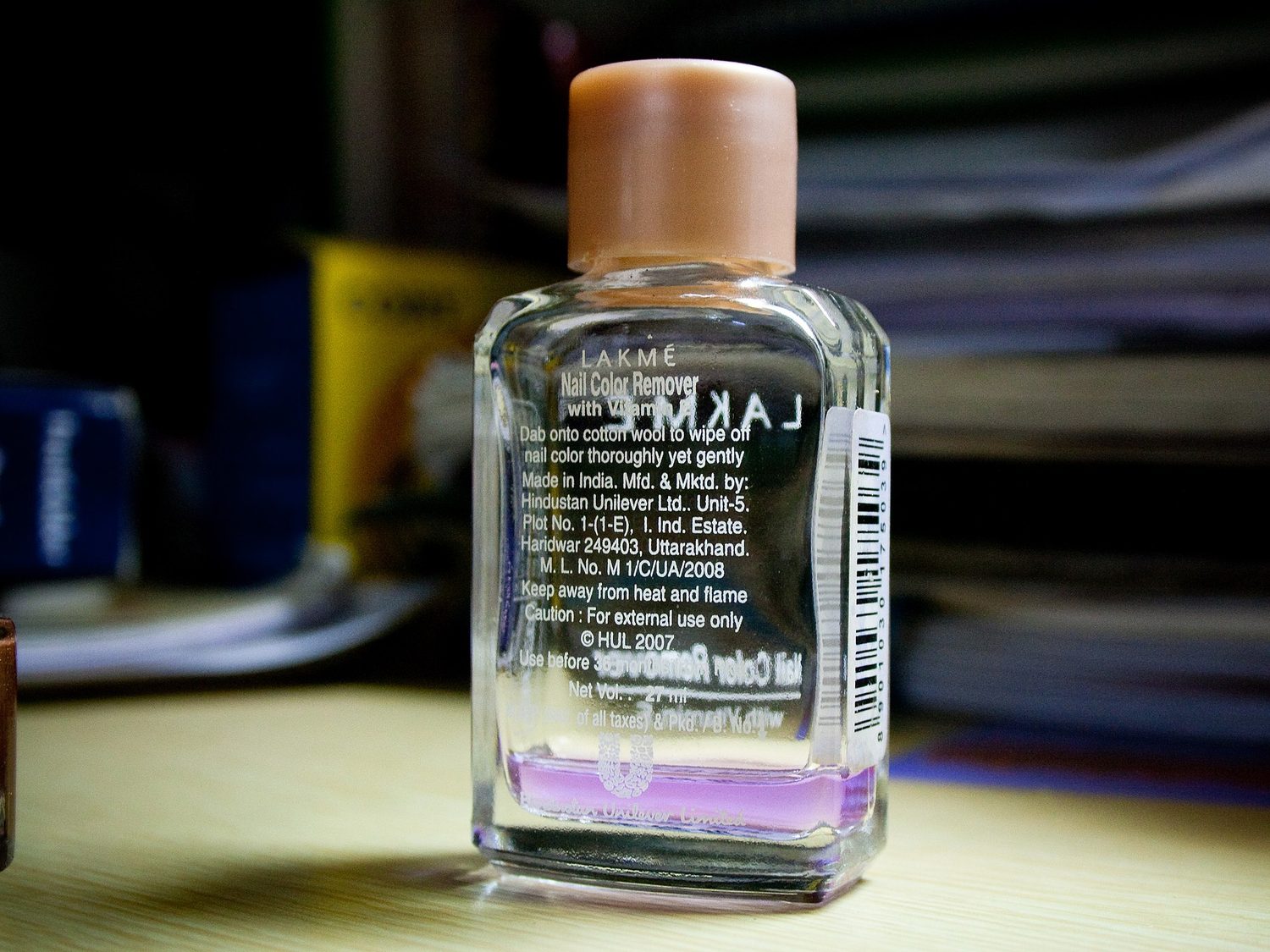
Propanone (acetone), the simplest ketone, is the solvent in nail-polish remover.
Names and boiling points
| Compound | Formula | Type | Boiling point / °C |
|---|---|---|---|
| methanal | HCHO | aldehyde | −19 |
| ethanal | CH₃CHO | aldehyde | 21 |
| propanal | CH₃CH₂CHO | aldehyde | 49 |
| propanone | CH₃COCH₃ | ketone | 56 |
| propan-1-ol (for comparison) | CH₃CH₂CH₂OH | alcohol | 97 |
- C=O is polar, so there are dipole–dipole forces, but no hydrogen bonds between carbonyl molecules. They boil lower than alcohols of similar size.
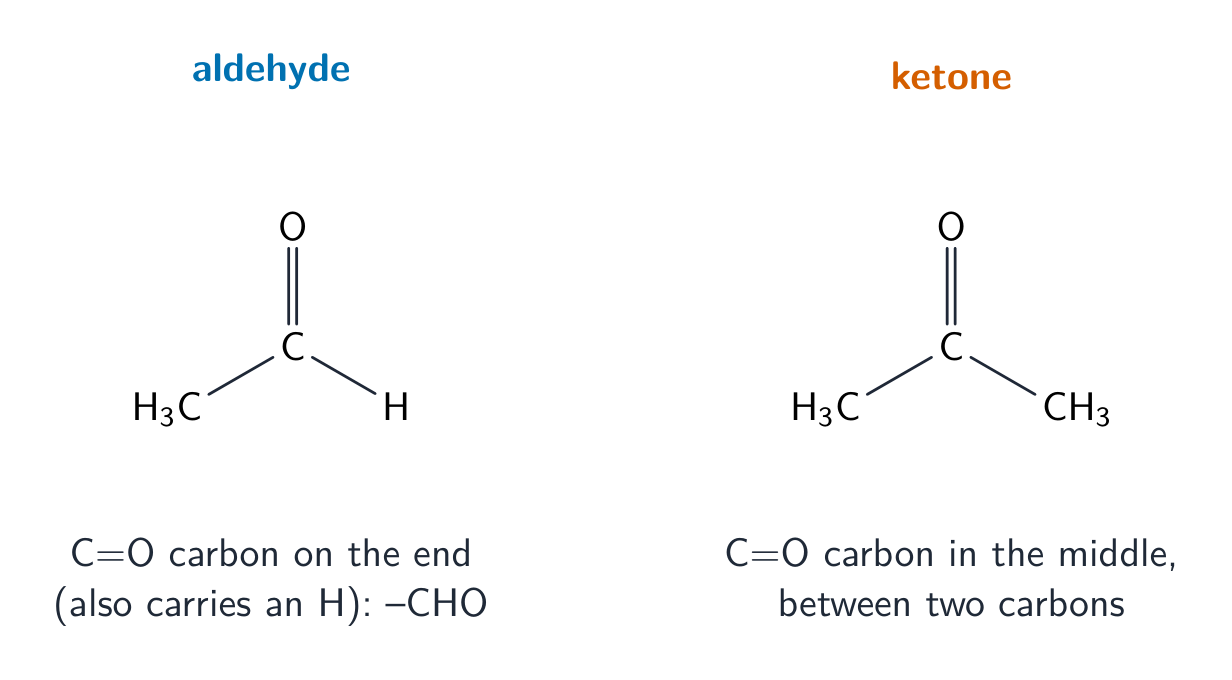
In an aldehyde the C=O is on the end; in a ketone it is in the middle
The difference between an aldehyde and a ketone is that:
Difficulté 1/5 · 100 pièces + un petit bonus lors de la première réussite aujourd'hui
Both have the carbonyl C=O; in an aldehyde it is terminal (–CHO), in a ketone it is between two carbons.
Ketones have the carbonyl group at the end of the carbon chain.
Difficulté 1/5 · 100 pièces + un petit bonus lors de la première réussite aujourd'hui
False. Aldehydes have the carbonyl group at the end of the chain; ketones have it in the middle, bonded to two carbons.
Propanal (bp 49 °C) boils much lower than propan-1-ol (bp 97 °C). Why?
Difficulté 1/5 · 100 pièces + un petit bonus lors de la première réussite aujourd'hui
Propanal has no O–H, so only dipole–dipole and London forces act between its molecules. Its Mᵣ (58) is about the same as propan-1-ol (60).
Making them
- Oxidise an alcohol with acidified K₂Cr₂O₇: a primary alcohol, distilled at once, gives an aldehyde.
- A secondary alcohol, heated under reflux, gives a ketone.
Oxidising a secondary alcohol gives:
Difficulté 1/5 · 100 pièces + un petit bonus lors de la première réussite aujourd'hui
Secondary alcohols oxidise to ketones; primary alcohols (with distillation) give aldehydes.
Reduction 还原
- NaBH₄ (in water or methanol, warm) or LiAlH₄ (in dry ether) supplies H⁻, written [H]. An aldehyde gives a primary alcohol; a ketone gives a secondary alcohol.
- $\text{CH}_3\text{CHO}+2[\text{H}]\rightarrow\text{CH}_3\text{CH}_2\text{OH}$. This is the reverse of the oxidation.
Reducing a carbonyl compound (with NaBH₄) gives:
Difficulté 1/5 · 100 pièces + un petit bonus lors de la première réussite aujourd'hui
Reduction turns a carbonyl back into an alcohol (aldehyde → primary, ketone → secondary).
Match each carbonyl fact.
Difficulté 2/5 · 140 pièces + un petit bonus lors de la première réussite aujourd'hui
Each item links the term to its correct meaning.
How many [H] are needed to reduce one molecule of propanone to propan-2-ol?
Difficulté 2/5 · 140 pièces + un petit bonus lors de la première réussite aujourd'hui
CH₃COCH₃ + 2[H] → CH₃CH(OH)CH₃. One H goes to the carbon and one to the oxygen.
Adding HCN: nucleophilic addition 亲核加成
- HCN with a little KCN adds across the C=O to give a hydroxynitrile 羟基腈 with one more carbon. KCN supplies CN⁻, because HCN is a weak acid.
- Mechanism: CN⁻ attacks the δ+ carbon; the C=O π bond breaks, so O becomes O⁻; the O⁻ takes H⁺ (from HCN or water).
Carbonyl compound lab
Sort carbonyl reactions by what they reveal.
In the nucleophilic addition of HCN, the first step is:
Difficulté 1/5 · 100 pièces + un petit bonus lors de la première réussite aujourd'hui
The cyanide nucleophile attacks the δ+ carbon, breaking the C=O; the O⁻ then takes an H⁺.
Name the product of each reaction: (a) butanal with $\text{NaBH}_4$; (b) butanone with $\text{NaBH}_4$; (c) propanone with HCN and a little KCN.
- (a) An aldehyde is reduced to a primary alcohol: butan-1-ol. (b) A ketone gives a secondary alcohol: butan-2-ol. $\text{NaBH}_4$ supplies $\text{H}^-$, written $[\text{H}]$:
- (c) $\text{CN}^-$ adds to the carbonyl carbon and $\text{H}^{+}$ to the O: $(\text{CH}_3)_2\text{C(OH)CN}$, 2-hydroxy-2-methylpropanenitrile. The chain grows from 3 to 4 carbons.
Butanal reacts with HCN (KCN catalyst). How many carbon atoms are in the hydroxynitrile formed?
Difficulté 2/5 · 140 pièces + un petit bonus lors de la première réussite aujourd'hui
Butanal has 4 carbons and the CN group adds one: 2-hydroxypentanenitrile.
Propanal is reduced with $\text{NaBH}_4$. What forms?
Difficulté 1/5 · 100 pièces + un petit bonus lors de la première réussite aujourd'hui
Reducing an aldehyde gives a primary alcohol, with the OH on the end carbon.
- The curly arrow goes from the lone pair on C of CN⁻ to the carbonyl carbon, and from the C=O bond to the O.
- HCN is very toxic: it is made in the flask from KCN and acid.
- NaBH₄ does not reduce C=C bonds; it only reduces C=O.
You've got it
- Carbonyl = C=O; aldehyde (–CHO, end) or ketone (middle). Polar, but no hydrogen bonds between molecules.
- Made by oxidising alcohols; reduced back by NaBH₄ or LiAlH₄ (aldehyde → primary, ketone → secondary).
- HCN/KCN → hydroxynitrile (+1 carbon) by nucleophilic addition: CN⁻ attacks δ+ C, O⁻ takes H⁺.