Tests for carbonyl compounds
Introduit| English | Sens |
|---|---|
| iodoform/ˈaɪədɒfɔːm/ | iodoforme |
| precipitate/prɪˈsɪpɪteɪt/ | précipité |
| Fehling/ˈfeɪlɪŋ/ | Fehling |
| Tollens/ˈtəʊlənz/ | Tollens |
| silver mirror/ˈsɪlvə ˈmɪrə/ | miroir d'argent |
| tri-iodomethane/traɪ ˈaɪədəʊmθeɪn/ | CHI3, the yellow precipitate formed in the iodoform test for methyl carbonyls and some alcohols. |
Telling carbonyls apart
- Mirrors were once made by warming an aldehyde with a silver solution: a bright layer of silver coated the glass. That is Tollens' test.
- One test detects any carbonyl; two tell an aldehyde from a ketone; the iodoform 碘仿 test spots a CH₃CO– group.
Carbonyl test lab
Match observations to aldehydes and ketones.
Detecting any carbonyl: 2,4-DNPH
- Add 2,4-dinitrophenylhydrazine (Brady's reagent). An orange precipitate 沉淀 means an aldehyde or a ketone.
- To find which one, filter and recrystallise the orange solid, measure its melting point, and compare it with a data book. Each carbonyl gives a different value.
An orange precipitate with 2,4-DNPH shows the compound is:
Difficulté 1/5 · 100 pièces + un petit bonus lors de la première réussite aujourd'hui
2,4-DNPH gives an orange precipitate with any carbonyl (aldehyde or ketone).
Two unknowns both give an orange precipitate with 2,4-DNPH. How can you find which carbonyl each one is?
Difficulté 1/5 · 100 pièces + un petit bonus lors de la première réussite aujourd'hui
Each carbonyl gives a 2,4-DNPH derivative with its own sharp melting point, which identifies it.
Aldehyde or ketone?
| Test (warm in a water bath) | Aldehyde | Ketone |
|---|---|---|
| Fehling's 斐林 (blue, Cu²⁺) | brick-red precipitate of Cu₂O | stays blue |
| Tollens' 托伦斯 (colourless, [Ag(NH₃)₂]⁺) | silver mirror 银镜 | no change |
- An aldehyde is oxidised (to a carboxylic acid or its salt). It reduces Cu²⁺ to Cu⁺ (Cu₂O) or Ag⁺ to Ag. Ketones have no H on the C=O carbon, so they are not oxidised.
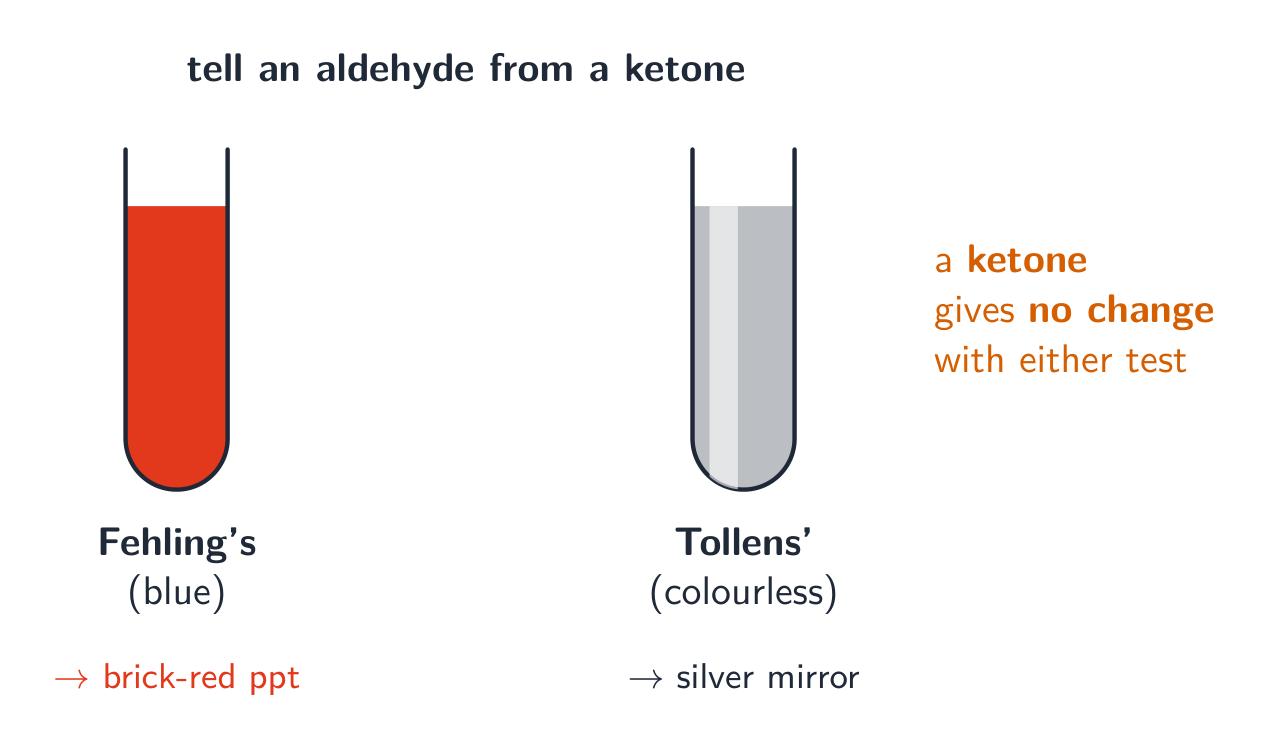
Fehling's 斐林 and Tollens 托伦斯' tests tell an aldehyde from a ketone
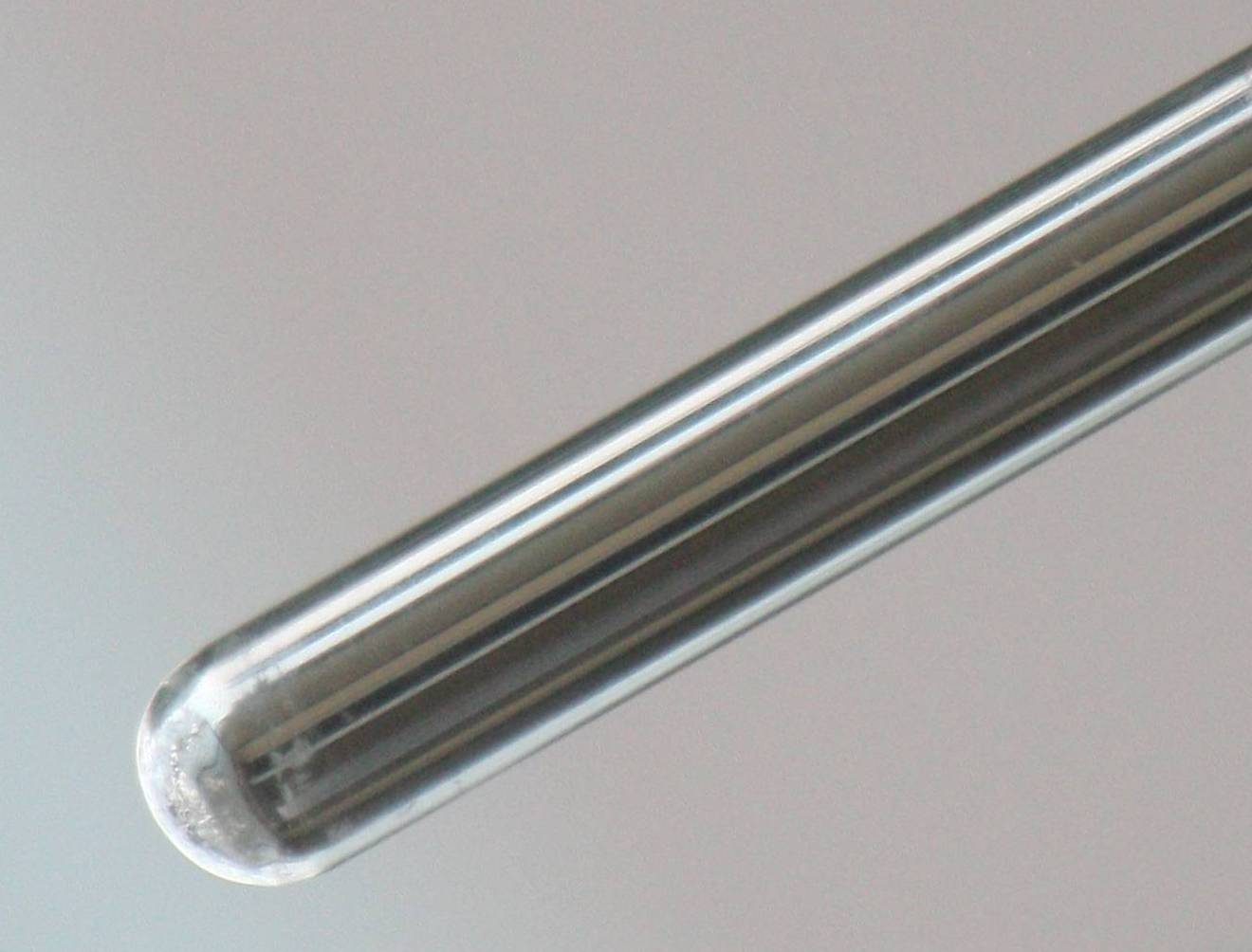
Tollens' reagent gives a bright silver mirror with an aldehyde.
A silver mirror with Tollens' reagent indicates:
Difficulté 1/5 · 100 pièces + un petit bonus lors de la première réussite aujourd'hui
Aldehydes are oxidised and reduce Tollens' to silver (a mirror); ketones give no change.
Fehling's solution turns from blue to a brick-red precipitate with:
Difficulté 1/5 · 100 pièces + un petit bonus lors de la première réussite aujourd'hui
An aldehyde reduces Fehling's to a brick-red precipitate; a ketone does not react.
Tollens' reagent gives a silver ______ with an aldehyde but not a ketone.
Difficulté 1/5 · 100 pièces + un petit bonus lors de la première réussite aujourd'hui
Aldehydes are oxidised; ketones are not.
Match each carbonyl test to its result.
Difficulté 2/5 · 140 pièces + un petit bonus lors de la première réussite aujourd'hui
Each item links the term to its correct meaning.
In a positive Tollens' test, which species is reduced?
Difficulté 1/5 · 100 pièces + un petit bonus lors de la première réussite aujourd'hui
Ag⁺ gains an electron to become silver metal (the mirror). The aldehyde is oxidised to a carboxylic acid.
The iodoform test
- Warm the compound with alkaline aqueous iodine. A pale-yellow precipitate of tri-iodomethane 三碘甲烷, $\text{CHI}_3$, shows a $\text{CH}_3\text{CO}-$ group: a methyl group joined directly to the C=O. Ethanal and methyl ketones such as propanone are positive; propanal and pentan-3-one are not.
- Alcohols with a $\text{CH}_3\text{CH(OH)}-$ group (ethanol, propan-2-ol) are also positive, because the iodine first oxidises them to a $\text{CH}_3\text{CO}-$ compound.
A pale-yellow precipitate of CHI₃ in the iodoform test shows the compound has the:
Difficulté 1/5 · 100 pièces + un petit bonus lors de la première réussite aujourd'hui
The iodoform (CHI₃) test is positive for compounds containing the CH₃CO– group (and CH₃CH(OH)–).
Which compound gives a yellow precipitate when warmed with alkaline aqueous iodine?
Difficulté 1/5 · 100 pièces + un petit bonus lors de la première réussite aujourd'hui
Only butanone has a methyl group joined directly to the C=O. Propan-1-ol has no $\text{CH}_3\text{CH(OH)}-$ group, so it cannot be oxidised to one.
Compound Y, $\text{C}_5\text{H}_{10}\text{O}$, gives an orange precipitate with 2,4-DNPH, no silver mirror with Tollens' reagent and a yellow precipitate with alkaline aqueous iodine.
- 2,4-DNPH: Y is a carbonyl. No silver mirror: it is a ketone, not an aldehyde. Iodoform positive: it has $\text{CH}_3\text{CO}-$.
- So Y is a methyl ketone: pentan-2-one, $\text{CH}_3\text{COCH}_2\text{CH}_2\text{CH}_3$, or 3-methylbutan-2-one, $\text{CH}_3\text{COCH(CH}_3)_2$. Pentan-3-one, $\text{CH}_3\text{CH}_2\text{COCH}_2\text{CH}_3$, is ruled out: its C=O has an ethyl group on each side.
A compound $\text{C}_3\text{H}_6\text{O}$ gives an orange precipitate with 2,4-DNPH and a brick-red precipitate with Fehling's solution. What is it?
Difficulté 1/5 · 100 pièces + un petit bonus lors de la première réussite aujourd'hui
2,4-DNPH shows a carbonyl; Fehling's is positive only for an aldehyde, so it is propanal, $\text{CH}_3\text{CH}_2\text{CHO}$.
- 2,4-DNPH cannot tell an aldehyde from a ketone. Use Tollens' or Fehling's next.
- In Tollens' and Fehling's tests the aldehyde is oxidised; the metal ion is reduced.
- Heat in a water bath, not a flame: many carbonyls are flammable.
You've got it
- 2,4-DNPH → orange precipitate = any carbonyl; its melting point identifies which.
- Fehling's (brick-red Cu₂O) and Tollens' (silver mirror) are positive only for an aldehyde.
- Iodoform (yellow CHI₃) shows CH₃CO– (or CH₃CH(OH)–). Work through an unknown one test at a time.