Reaction and mechanism types
Introduit| English | Sens |
|---|---|
| curly arrow/ˈkɜːli ˈærəʊ/ | flèche courbe |
| addition/əˈdɪʃn/ | addition |
| substitution/ˌsʌbstɪˈtjuːʃn/ | substitution |
| elimination/ɪˌlɪmɪˈneɪʃn/ | élimination |
| hydrolysis/haɪˈdrɒləsɪs/ | hydrolyse |
| condensation/kɒndenˈseɪʃn/ | condensation |
| homolytic fission/ˌhɒməˈlɪtɪk ˈfɪʃn/ | Breaking a covalent bond so that each fragment receives one electron from the bonding pair. |
| free radical/friː ˈrædɪkl/ | A species containing one or more unpaired electrons. |
| heterolytic fission/ˌhetrəˈlɪtɪk ˈfɪʃn/ | Breaking a covalent bond so that both electrons in the bonding pair go to the same fragment. |
| nucleophile/ˈnjuːklɪɒfaɪl/ | An electron-pair donor that forms a covalent bond to an electron-deficient centre. |
| electrophile/ɪˌlektrəʊˈfaɪl/ | A species that accepts an electron pair to form a covalent bond. |
| initiation/ɪˌnɪʃɪˈeɪʃn/ | initiation |
| propagation/ˌprɒpəˈɡeɪʃn/ | propagation |
| termination/ˌtɜːmɪˈneɪʃn/ | terminaison |
How reactions actually happen
- Hundreds of organic reactions fit a handful of named types and mechanisms. Learn the patterns once and new reactions become predictable.
- A mechanism shows, step by step, how electrons move. A curly arrow 弯箭头 tracks each electron pair.
Organic reaction type lab
Classify reaction examples by the pattern of bonds changing.
A species that is attracted to an electron-poor site and donates a pair of electrons is a:
Difficulté 1/5 · 100 pièces + un petit bonus lors de la première réussite aujourd'hui
Nucleophiles donate an electron pair.
Types of reaction
| Reaction | What happens |
|---|---|
| addition 加成 | two molecules join into one |
| substitution 取代 | one atom/group is swapped for another |
| elimination 消去 | a small molecule is removed, making a double bond |
| hydrolysis 水解 | a molecule is split apart by water |
| condensation 缩合 | two molecules join, losing a small molecule (e.g. water) |
- For organic redox, $[\text{O}]$ means one oxygen atom from an oxidising agent and $[\text{H}]$ one hydrogen atom from a reducing agent: $\text{CH}_3\text{CH}_2\text{OH}+[\text{O}]\rightarrow\text{CH}_3\text{CHO}+\text{H}_2\text{O}$.
Match each reaction type to what happens.
Difficulté 2/5 · 140 pièces + un petit bonus lors de la première réussite aujourd'hui
Addition joins; substitution swaps; elimination removes a small molecule to form a double bond.
In an addition reaction:
Difficulté 1/5 · 100 pièces + un petit bonus lors de la première réussite aujourd'hui
Addition combines two molecules into a single product (e.g. across a C=C bond).
Breaking a bond: two ways
- Homolytic fission 均裂: each atom takes one electron of the bond, making two free radicals 自由基 (species with an unpaired electron, e.g. Cl•). UV light does this to Cl–Cl.
- Heterolytic fission 异裂: one atom takes both electrons, making ions. A nucleophile 亲核试剂 then donates a lone pair to a δ+ atom; an electrophile 亲电试剂 accepts a pair from an electron-rich site such as C=C.
In homolytic fission of a covalent bond:
Difficulté 1/5 · 100 pièces + un petit bonus lors de la première réussite aujourd'hui
Homo- means "the same": each atom gets one electron. Heterolytic fission gives both to one atom, forming ions.
Select tout the species that can act as nucleophiles.
Difficulté 2/5 · 140 pièces + un petit bonus lors de la première réussite aujourd'hui
Nucleophiles have a lone pair to donate. NO₂⁺ has none to give; it is an electrophile.
Types of mechanism
- A free-radical reaction has three steps: initiation 引发 (radicals made), propagation 增长 (radicals react, make new radicals), termination 终止 (radicals join, chain stops).
- Main mechanisms: free-radical substitution (alkanes), electrophilic addition (alkenes), nucleophilic substitution (halogenoalkanes), nucleophilic addition (carbonyls).
- A curly arrow shows a pair of electrons moving (from a bond or a lone pair).
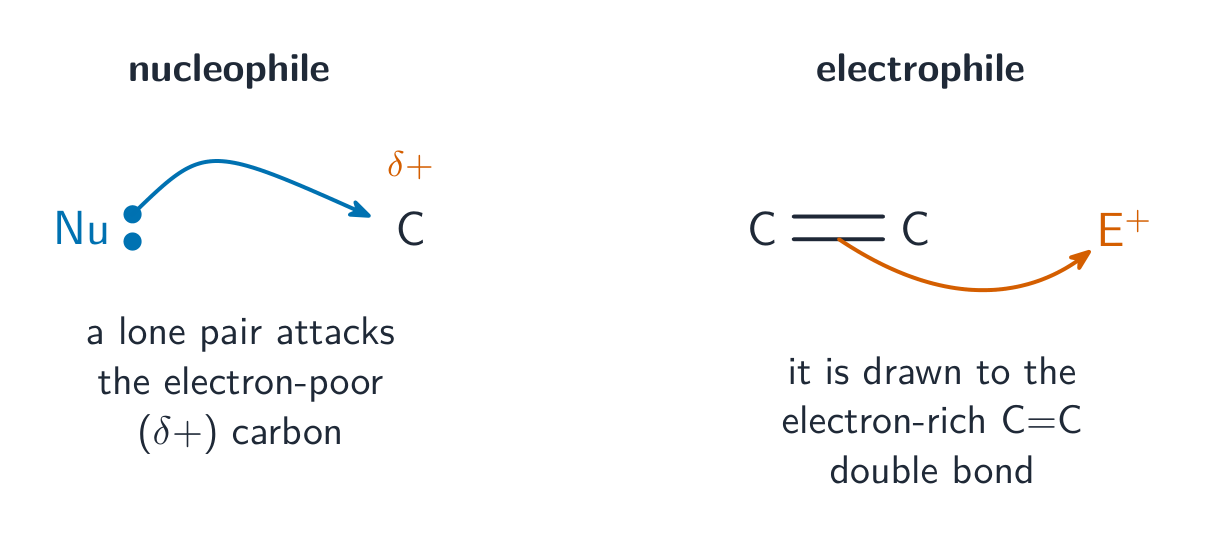
The attacking species names the mechanism: nucleophilic or electrophilic.
Put the steps of a free-radical mechanism in order.
Difficulté 3/5 · 200 pièces + un petit bonus lors de la première réussite aujourd'hui
Initiation makes radicals, propagation keeps the chain going, termination joins radicals to stop it.
In a mechanism, a curly arrow shows:
Difficulté 1/5 · 100 pièces + un petit bonus lors de la première réussite aujourd'hui
A curly arrow represents the movement of a pair of electrons, starting from a bond or a lone pair.
Free-radical substitution step by step. Write the three stages for $\text{CH}_4+\text{Cl}_2\rightarrow\text{CH}_3\text{Cl}+\text{HCl}$ in UV light.
- Initiation: $\text{Cl}_2\rightarrow2\text{Cl}\bullet$ (homolytic fission by UV).
- Propagation: $\text{Cl}\bullet+\text{CH}_4\rightarrow\text{HCl}+\bullet\text{CH}_3$, then $\bullet\text{CH}_3+\text{Cl}_2\rightarrow\text{CH}_3\text{Cl}+\text{Cl}\bullet$. A Cl• is made again, so the chain continues.
- Termination: two radicals join, e.g. $\bullet\text{CH}_3+\bullet\text{CH}_3\rightarrow\text{C}_2\text{H}_6$ (which is why traces of ethane form).
Which equation is a propagation step in the chlorination of methane?
Difficulté 1/5 · 100 pièces + un petit bonus lors de la première réussite aujourd'hui
A propagation step uses a radical and makes a new one. Cl₂ → 2Cl• is initiation; the radical + radical steps are termination.
Worked example: classify four reactions
Give the reaction type and mechanism for each.
- $\text{CH}_4 + \text{Cl}_2 \rightarrow \text{CH}_3\text{Cl} + \text{HCl}$ in UV light: free-radical substitution. $\text{C}_2\text{H}_4 + \text{Br}_2 \rightarrow \text{C}_2\text{H}_4\text{Br}_2$: electrophilic addition (the electron-rich C=C attracts $\text{Br}^{\delta+}$).
- $\text{C}_2\text{H}_5\text{Br} + \text{OH}^- \rightarrow \text{C}_2\text{H}_5\text{OH} + \text{Br}^-$: nucleophilic substitution ($\text{OH}^-$ attacks the $\delta+$ carbon). $\text{C}_2\text{H}_5\text{Br}$ with hot ethanolic KOH giving $\text{C}_2\text{H}_4$: elimination of HBr.
HCN adds across the C=O of ethanal. What is the mechanism?
Difficulté 1/5 · 100 pièces + un petit bonus lors de la première réussite aujourd'hui
$\text{CN}^-$, a nucleophile, attacks the $\delta+$ carbonyl carbon, and the two molecules join into one.
- A curly arrow starts at the electrons (a bond or lone pair) and points to where they go, never from an atom's nucleus or a positive charge.
- A nucleophile is electron-rich and attacks δ+ carbon; an electrophile is electron-poor and attacks C=C. Don't swap them.
- In propagation a radical is used and made; in termination radicals are only used up.
You've got it
- reaction types: addition, substitution, elimination, hydrolysis, condensation; $[\text{O}]$ / $[\text{H}]$ for redox
- a free-radical mechanism runs initiation → propagation → termination
- main mechanisms: free-radical substitution, electrophilic addition, nucleophilic substitution/addition
- a curly arrow = a moving electron pair