Physical properties of the halogens
Introduit| English | Sens |
|---|---|
| halogen/ˈhælədʒn/ | halogène |
| diatomic/ˌdaɪəˈtɒmɪk/ | diatomique |
| volatility/ˌvɒləˈtɪlɪti/ | volatilité |
| bond energy/bɒnd ˈenədʒi/ | énergie de liaison |
| reactivity/rɪəkˈtɪvɪti/ | réactivité |
Meet the salt-formers
- The chlorine in tap water kills bacteria; iodine solution cleans cuts. Both are halogens 卤素, the Group 17 elements.
- Halogens exist as diatomic 双原子 molecules: $\text{Cl}_2$, $\text{Br}_2$, $\text{I}_2$. Down the group their colour darkens and their volatility 挥发性 falls.
Halogen physical trend lab
Follow halogens down the group and link state, colour and volatility.
The halogens exist as diatomic molecules.
Difficulté 1/5 · 100 pièces + un petit bonus lors de la première réussite aujourd'hui
They form X₂ molecules: Cl₂, Br₂, I₂.
Colour, state and boiling point
| Element | At room temperature | Boiling point / °C |
|---|---|---|
| chlorine, Cl₂ | pale green gas | −34 |
| bromine, Br₂ | red-brown liquid (orange vapour) | 59 |
| iodine, I₂ | grey-black solid (purple vapour) | 184 |
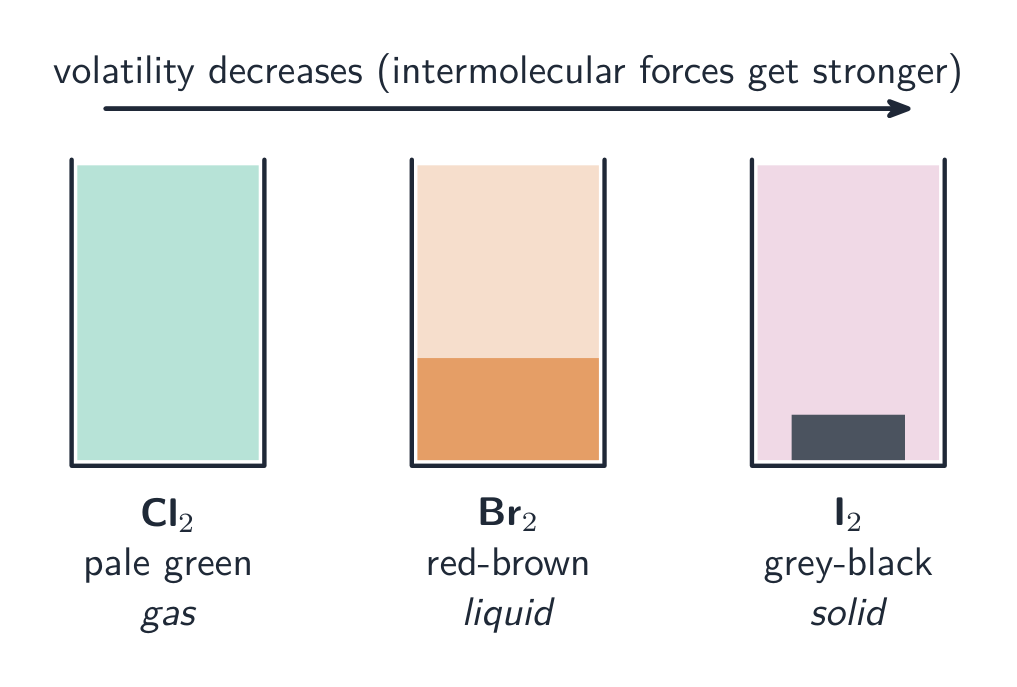
The halogens change from gas to liquid to solid down the group as volatility falls
At room temperature, the states of chlorine, bromine and iodine are:
Difficulté 1/5 · 100 pièces + un petit bonus lors de la première réussite aujourd'hui
Chlorine is a gas, bromine a liquid and iodine a solid — volatility falls down the group.
Match each halogen to its state at room temperature.
Difficulté 2/5 · 140 pièces + un petit bonus lors de la première réussite aujourd'hui
Each item links the term to its correct meaning.
Why volatility falls
- Down the group the molecules have more electrons, so the London (dispersion) forces between molecules are stronger.
- More energy is needed to separate the molecules, so the boiling point rises and volatility falls. The covalent X–X bond is not broken when a halogen boils.
Volatility decreases down Group 17 because:
Difficulté 1/5 · 100 pièces + un petit bonus lors de la première réussite aujourd'hui
More electrons give stronger instantaneous/induced dipole (London) forces, raising the boiling point.
Bond energy 键能
| Bond | F–F | Cl–Cl | Br–Br | I–I |
|---|---|---|---|---|
| Bond energy / kJ/mol | 158 | 242 | 193 | 151 |
- From Cl₂ to I₂ the bond gets weaker: the atoms are larger, so the shared pair is further from the nuclei.
- F–F is unusually weak: the atoms are so small that lone pairs on the two atoms repel each other.
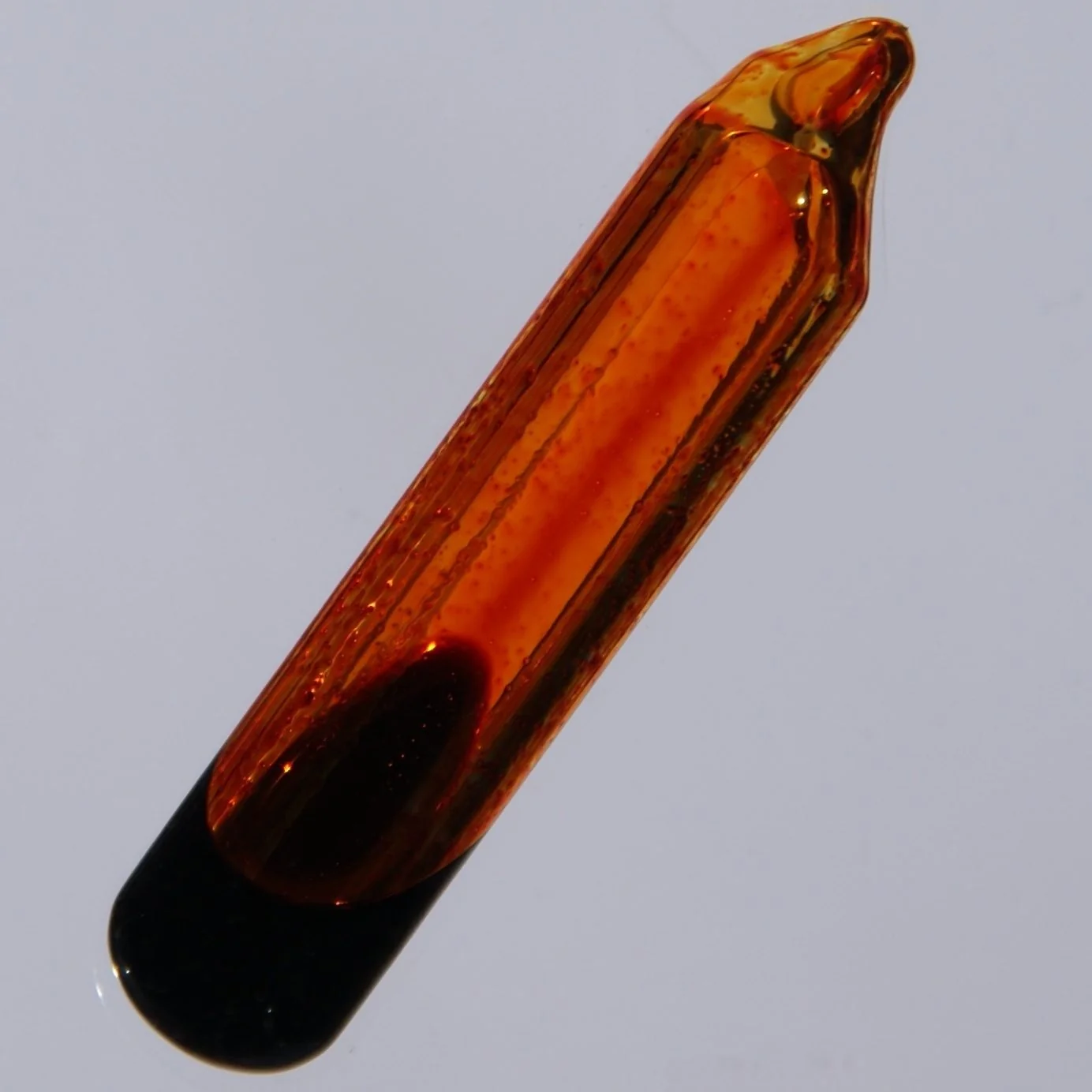
Bromine is a Group 17 halogen: a dark liquid giving an orange vapour
The X–X bond energy generally falls from Cl₂ to I₂ because:
Difficulté 1/5 · 100 pièces + un petit bonus lors de la première réussite aujourd'hui
In bigger atoms the bonding electrons are further from the nuclei, so the bond is weaker.
Iodine has a higher boiling point than chlorine because the I–I covalent bond is stronger than the Cl–Cl bond.
Difficulté 1/5 · 100 pièces + un petit bonus lors de la première réussite aujourd'hui
Boiling breaks only the London forces between molecules, which are stronger for I₂ (more electrons). The I–I bond is actually weaker.
Which halogen has the weakest X–X bond?
Difficulté 1/5 · 100 pièces + un petit bonus lors de la première réussite aujourd'hui
I–I is 151 kJ/mol, just below F–F (158). Iodine atoms are the largest, so the shared pair is furthest from the nuclei.
Colours in solution
| Halogen | in water | in hexane (organic layer) |
|---|---|---|
| Cl₂ | very pale green | pale green |
| Br₂ | orange / yellow | orange-red |
| I₂ | brown | violet |
- Shaking with hexane makes the halogen easier to identify: violet means iodine. This helps in displacement tests (1102).
An aqueous solution is shaken with hexane. The top (hexane) layer turns violet. Which halogen is present?
Difficulté 1/5 · 100 pièces + un petit bonus lors de la première réussite aujourd'hui
Iodine dissolves in hexane to give a violet colour. Bromine would give orange-red.
Astatine (At) is below iodine. Predict its state, its X–X bond energy compared with iodine's, and whether $\text{At}_2$ could oxidise $\text{I}^-$.
- $\text{At}_2$ has even more electrons than $\text{I}_2$, so stronger London forces: a black solid, less volatile than iodine. Its larger atoms hold the shared pair further from the nuclei, so the At–At bond is weaker than the I–I bond.
- Oxidising power decreases down the group, so $\text{At}_2$ is a weaker oxidising agent than $\text{I}_2$ and cannot take electrons from $\text{I}^-$; instead $\text{I}_2$ would oxidise $\text{At}^-$. Reactivity decreases down the group because the larger atom attracts an extra electron less strongly.
The halogens become more reactive down Group 17.
Difficulté 1/5 · 100 pièces + un petit bonus lors de la première réussite aujourd'hui
False. They become less reactive: the outer shell is further from the nucleus and more shielded, so gaining an electron is harder.
Chlorine water is added to colourless potassium iodide solution. What do you see, and why?
Difficulté 1/5 · 100 pièces + un petit bonus lors de la première réussite aujourd'hui
$\text{Cl}_2 + 2\text{I}^- \rightarrow 2\text{Cl}^- + \text{I}_2$; chlorine is the stronger oxidising agent.
- Boiling a halogen overcomes London forces between molecules, not the X–X bond. A stronger bond does not explain a higher boiling point.
- Iodine in water is brown, not violet; it is violet in hexane and as a vapour.
- Bond energy falls from Cl₂ to I₂, but F₂ breaks the pattern.
You've got it
- Halogens are diatomic: Cl₂ green gas, Br₂ red-brown liquid, I₂ grey-black solid.
- Volatility decreases down the group: more electrons → stronger London forces → higher boiling point.
- The X–X bond energy falls from Cl₂ to I₂ (F₂ is an exception).