Temperature and activation energy
Introduit| English | Sens |
|---|---|
| activation energy/ˌæktɪˈveɪʃn ˈenədʒi/ | énergie d'activation |
| Boltzmann distribution/ˈbɒltsmən ˌdɪstrɪˈbjuːʃn/ | distribution de Boltzmann |
Why heat speeds things up
- Milk lasts a week in the fridge but sours in a day on a warm table. For many reactions near room temperature, a 10 °C rise roughly doubles the rate.
- To see why, look at how much energy the molecules have.
Activation energy
- The activation energy 活化能, $E_A$, is the minimum energy a collision needs to be effective, so that bonds start to break.
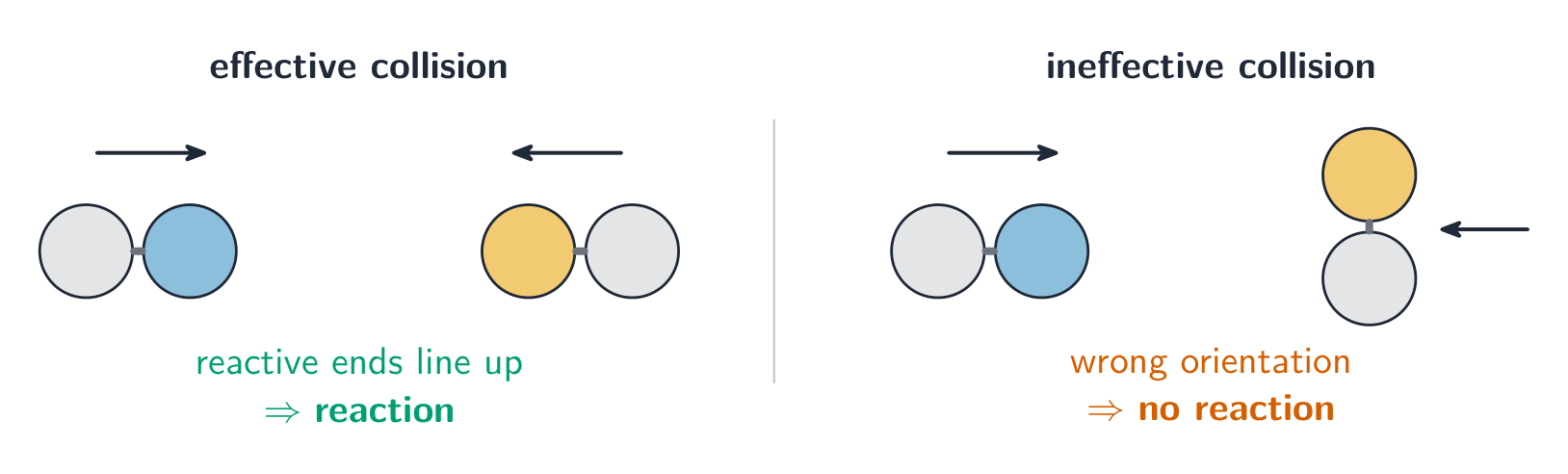
- Collisions with less energy than $E_A$ just bounce apart, even with the right orientation.
The activation energy is:
Difficulté 1/5 · 100 pièces + un petit bonus lors de la première réussite aujourd'hui
Only collisions with at least the activation energy can react.
The Boltzmann distribution 玻尔兹曼分布
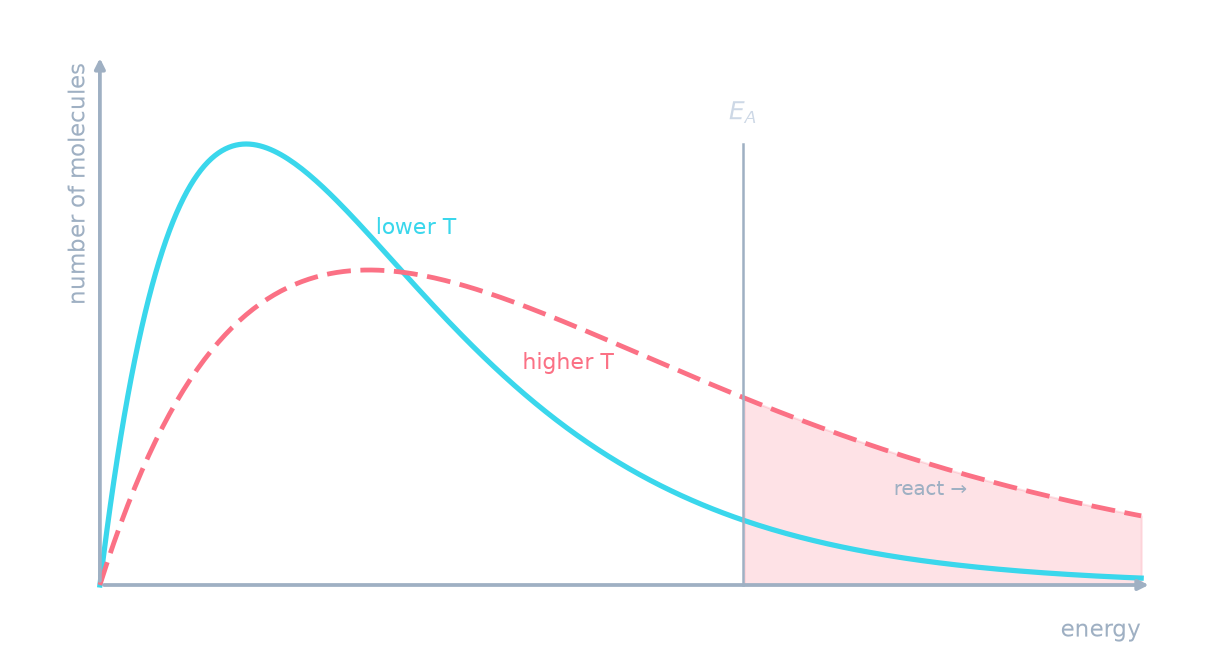
- The curve shows how many molecules have each energy. It starts at the origin, peaks, then has a long tail that never reaches the axis. The area is the total number of molecules.
- Only molecules to the right of $E_A$ can react.
Activation energy & temperature
la fraction avec E ≥ Ea augmente avec T
Heating shifts the energy spread right — far more molecules now exceed Ea, so the rate soars.
On the Boltzmann distribution, the molecules that can react are those:
Difficulté 1/5 · 100 pièces + un petit bonus lors de la première réussite aujourd'hui
Molecules with energy greater than Eₐ (right of the line) have enough energy to react.
What a higher temperature does
- The curve spreads to the right, so a much larger fraction of molecules have energy above $E_A$. This is the main effect.
- The molecules also move faster and collide more often, but that adds only a little.
The main reason a higher temperature speeds up a reaction is that:
Difficulté 1/5 · 100 pièces + un petit bonus lors de la première réussite aujourd'hui
The curve spreads right, so far more molecules exceed Eₐ; this matters more than the increased collision rate.
Increasing temperature increases the proportion of molecules with energy above the activation energy.
Difficulté 1/5 · 100 pièces + un petit bonus lors de la première réussite aujourd'hui
So more collisions are successful.
Match each idea to its meaning.
Difficulté 2/5 · 140 pièces + un petit bonus lors de la première réussite aujourd'hui
Each item links the term to its correct meaning.
Describe how the Boltzmann curve for a gas changes when it is heated, and why the rate rises.
- The curve flattens and spreads right: the peak (most likely energy) moves to a higher energy and becomes lower. The area stays the same, because the number of molecules has not changed, and the curve still starts at the origin and never meets the energy axis.
- $E_A$ does not move. The shaded area to the right of $E_A$ grows a lot, so a much larger fraction of collisions have enough energy. This, more than the extra collision frequency, is why the rate rises sharply.
At a higher temperature the area under the Boltzmann curve is larger, because the molecules have more energy.
Difficulté 1/5 · 100 pièces + un petit bonus lors de la première réussite aujourd'hui
The area is the total number of molecules, which does not change; the curve only changes shape.
When a reaction mixture is heated, what happens to the activation energy?
Difficulté 1/5 · 100 pièces + un petit bonus lors de la première réussite aujourd'hui
$E_A$ belongs to the reaction route. Heating changes the energies of the molecules, not the barrier. Only a catalyst gives a route with a lower $E_A$.
Reading rate data. Sodium thiosulfate and acid make a cloudy precipitate. The time for a cross to disappear was 120 s at 20 °C, 61 s at 30 °C and 31 s at 40 °C.
- Rate is proportional to $\dfrac{1}{\text{time}}$. Halving the time means doubling the rate.
- From 20 °C to 30 °C, the time halves (120 → 61 s), and again from 30 °C to 40 °C (61 → 31 s). So each 10 °C rise roughly doubles the rate.
A small rise in temperature can give a large rise in reaction rate.
Difficulté 1/5 · 100 pièces + un petit bonus lors de la première réussite aujourd'hui
Because the reacting fraction grows sharply with temperature, even a small increase greatly speeds the reaction.
A reaction takes 80 s at 25 °C. If a 10 °C rise doubles its rate, how long does it take at 35 °C, in seconds?
Difficulté 2/5 · 140 pièces + un petit bonus lors de la première réussite aujourd'hui
Rate ∝ 1/time. Double the rate means half the time: 80 ÷ 2 = 40 s.
- $E_A$ does not change with temperature. Only the distribution of energies changes.
- The area under the curve stays the same: the number of molecules is unchanged.
- Name the main reason: more molecules with energy ≥ $E_A$, not "more collisions".
You've got it
- Activation energy: the minimum energy for an effective collision.
- On the Boltzmann distribution only molecules beyond $E_A$ react; the area is the number of molecules.
- Higher temperature → curve spreads right → far more molecules exceed $E_A$ → much faster rate (often about double per 10 °C).