Entrepreneuriat et ajout de valeur
Introduit| English | Sens |
|---|---|
| carpenter/ˈkɑːpəntə/ | menuisier |
| value added/ˈvæljuː ˈædɪd/ | valeur ajoutée |
| enterprise/ˈentəpraɪz/ | esprit d'entreprise |
| willingness/ˈwɪlɪŋnəs/ | disponibilité |
| risk/rɪsk/ | risque |
| entrepreneur/ˌɒntrɪprəˈnjʊə/ | entrepreneur |
| bear/beə/ | supporter |
| profit/ˈprɒfɪt/ | bénéfice |
| selling price/ˈselɪŋ praɪs/ | prix de vente |
| cost of bought-in materials/kɒst ɒv bɔːt ɪn məˈtɪərɪəlz/ | coût des matières premières achetées |
| branding/ˈbrændɪŋ/ | image de marque |
| reputation/ˌrepjuːˈteɪʃn/ | réputation |
| convenience/kənˈviːnɪəns/ | convenance |
| premium/ˈpriːmɪəm/ | prime |
| efficiency/ɪˈfɪʃənsi/ | efficacité |
Turning 30 into 80
- A carpenter 木匠 buys 30 worth of wood and screws, and a day later sells a chair for 80.
- That extra 50 didn't appear by magic — it's value added 附加值, the whole point of being in business.
L'entrepreneuriat est mieux décrit comme :
Difficulté 1/5 · 100 pièces + un petit bonus lors de la première réussite aujourd'hui
L'entrepreneuriat est le facteur de prise de risque et d'organisation — l'entrepreneur.
Un entrepreneur assume des risques dans l'espoir de réaliser un profit.
Difficulté 1/5 · 100 pièces + un petit bonus lors de la première réussite aujourd'hui
La prise de risque pour un profit est centrale à l'entrepreneuriat.
What enterprise 创业精神 is
- Enterprise is the willingness 意愿 to take a risk 风险 and combine resources to make goods or services.
- The person who does it — the entrepreneur 企业家 — spots an opportunity, organises the other factors, and bears 承担 the risk for profit 利润.
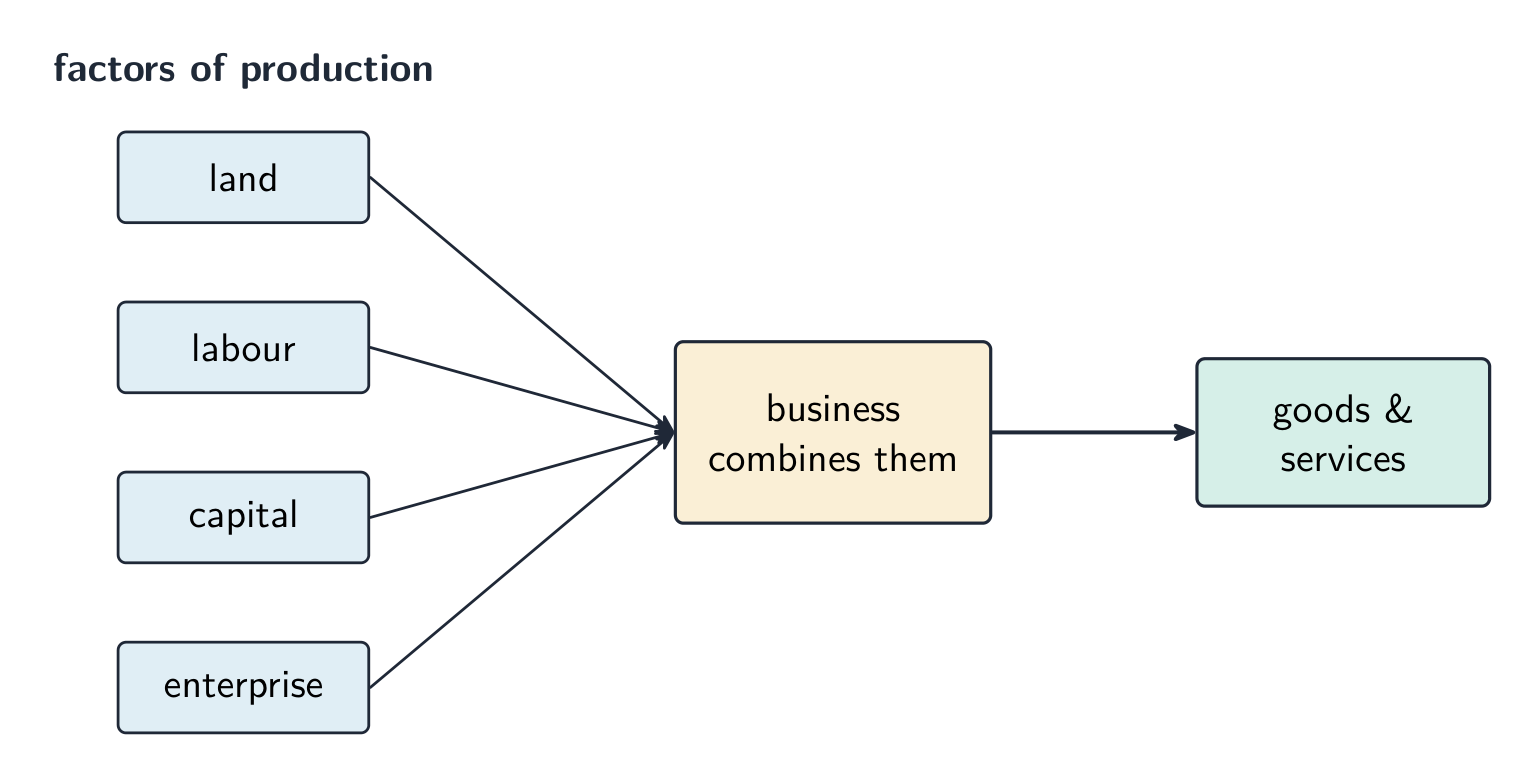
Land, labour, capital and enterprise are combined to make goods and services
| Factor | What it is | Carpenter |
|---|---|---|
| Land | natural resources | the wood |
| Labour | people's work | the hours spent making the chair |
| Capital | man-made tools and machines | saws, drills, the workshop |
| Enterprise | the person who organises and takes the risk | the carpenter deciding to make and sell chairs |
- Successful entrepreneurs usually show initiative (they act without being told), self-confidence, hard work, creativity and the resilience to keep going after a failure.
Laboratoire sur la valeur ajoutée
Modifiez le coût d'achat, le prix de vente et autres coûts pour voir exactement où proviennent la valeur ajoutée — et le profit.
Une entreprise achète des matériaux pour 25 et vend le bien fini pour 70. Quelle est la valeur ajoutée ?
Difficulté 2/5 · 140 pièces + un petit bonus lors de la première réussite aujourd'hui
Valeur ajoutée = 70 − 25 = 45.
La valeur ajoutée est :
Difficulté 1/5 · 100 pièces + un petit bonus lors de la première réussite aujourd'hui
C'est la différence entre le prix de sortie et le coût d'entrée.
La différence entre le prix de sortie et le coût d'entrée est la valeur ______.
Difficulté 1/5 · 100 pièces + un petit bonus lors de la première réussite aujourd'hui
La valeur ajoutée finance les salaires, le loyer et le profit.
Adding value
- Value added = the selling price 售价 minus the cost of bought-in materials 外购材料成本.
- It is how a business covers its other costs (wages, rent) and earns a profit.
Value added is not profit. The carpenter's 50 of value added must still pay for rent, electricity and the carpenter's own time. If those cost 35 per chair, profit is only 50 − 35 = 15.
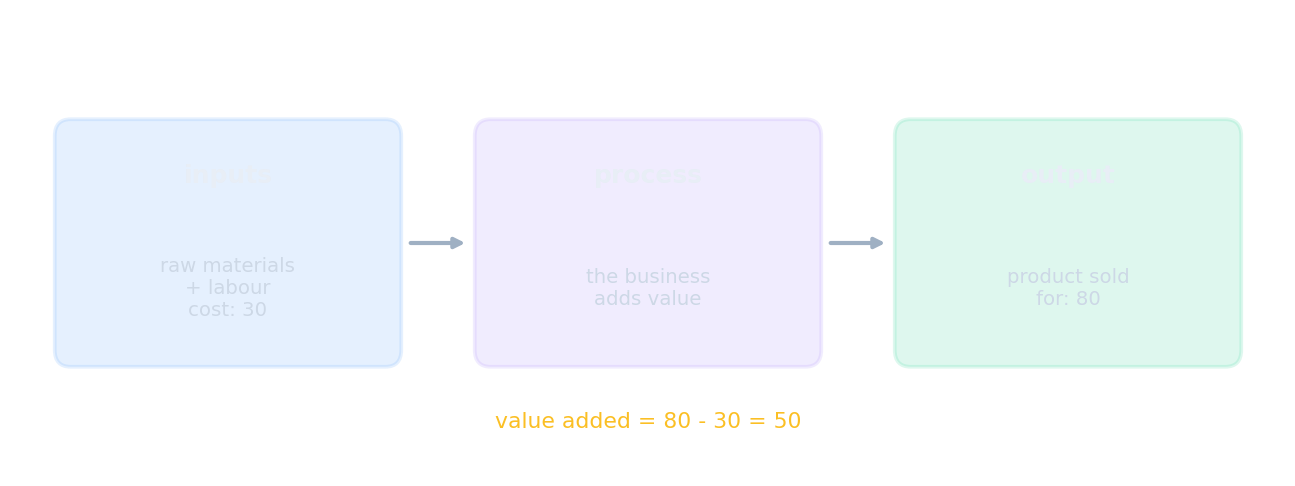
Value added is the difference between the cost of inputs and the price of the finished output.
Quel facteur peut augmenter la valeur ajoutée ? (Sélectionnez toutes les options applicables.)
Difficulté 2/5 · 140 pièces + un petit bonus lors de la première réussite aujourd'hui
La notoriété de marque, la qualité et les coûts d'entrée inférieurs élargissent tous la valeur ajoutée.
How firms add more value
- Branding 品牌 and reputation 声誉 let a firm charge more.
- Quality, design and convenience 便利 make customers willing to pay a premium 溢价.
- Efficiency 效率 (lower input costs) widens the gap from the other side.
Worked example. A coffee shop buys beans, milk and a cup for 0.60 and sells a latte for 3.50. Value added per cup = 3.50 − 0.60 = 2.90 — which must cover staff, rent and profit.
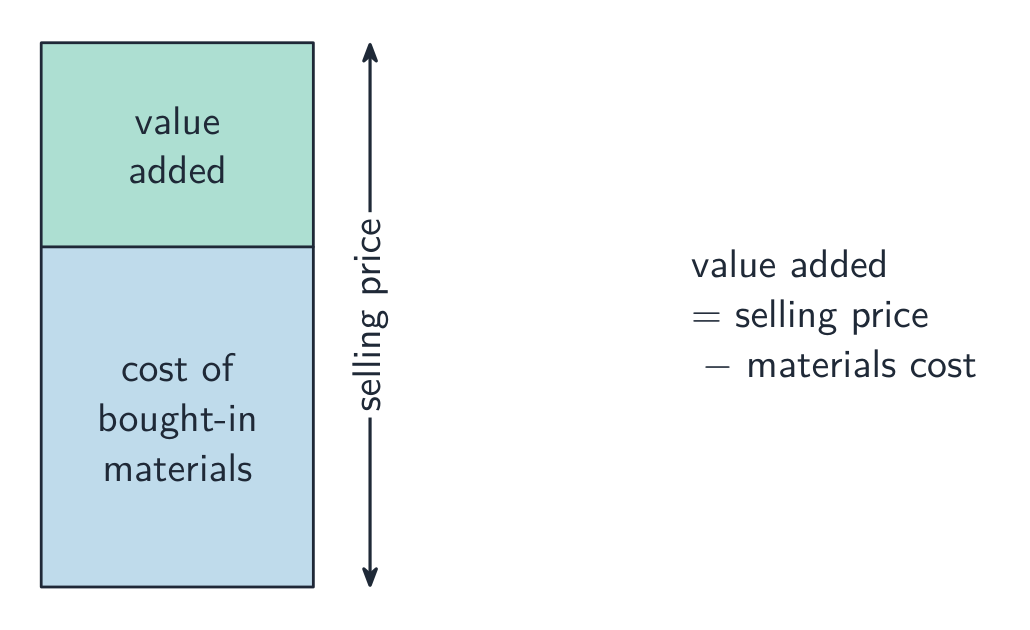
Value added is the selling price minus the cost of bought-in materials
Exam-style question: Explain two ways a coffee shop could increase its value added. [4]
- Build a brand: a well-known name and a pleasant shop let it charge 4.20 instead of 3.50. Materials still cost 0.60, so value added rises from 2.90 to 3.60 a cup.
- Cut the cost of bought-in materials: buying beans in bulk could lower inputs from 0.60 to 0.45, so value added rises to 3.05 a cup at the same price.
Why it scores: each way is named, applied to the coffee shop, and linked to the value-added formula with a number.
You've got it
- enterprise = taking a risk to combine resources; the entrepreneur bears it for profit
- value added = selling price − cost of bought-in materials
- firms add value through branding, quality, design and efficiency
Write from the data: find the value added
- Bought-in materials cost 35. The finished good sells for 90.
- Find the value added.
Une entreprise achète des matières premières pour 35 et vend le bien fini pour 90. Quelle est la valeur ajoutée ?
90 moins 35 égale 55.
Quelle est la valeur ajoutée ?
Difficulté 1/5 · 100 pièces + un petit bonus lors de la première réussite aujourd'hui
Le prix de vente moins les matières premières achetées est 55. Les autres options — 45 (la valeur ajoutée de la leçon) ; 90 (le prix de vente sans déduction des matières premières).