CVP: the flight simulator
Introducido| English | Significado |
|---|---|
| contribution margin | contribution margin |
| break-even point/breɪk ˈiːvən pɔɪnt/ | break-even point |
| margin of safety/ˈmɑːdʒɪn ɒv ˈseɪfti/ | The amount by which actual or forecast sales exceed break-even sales. |
| operating leverage | operating leverage |
How many meals before the kitchen pays for itself?
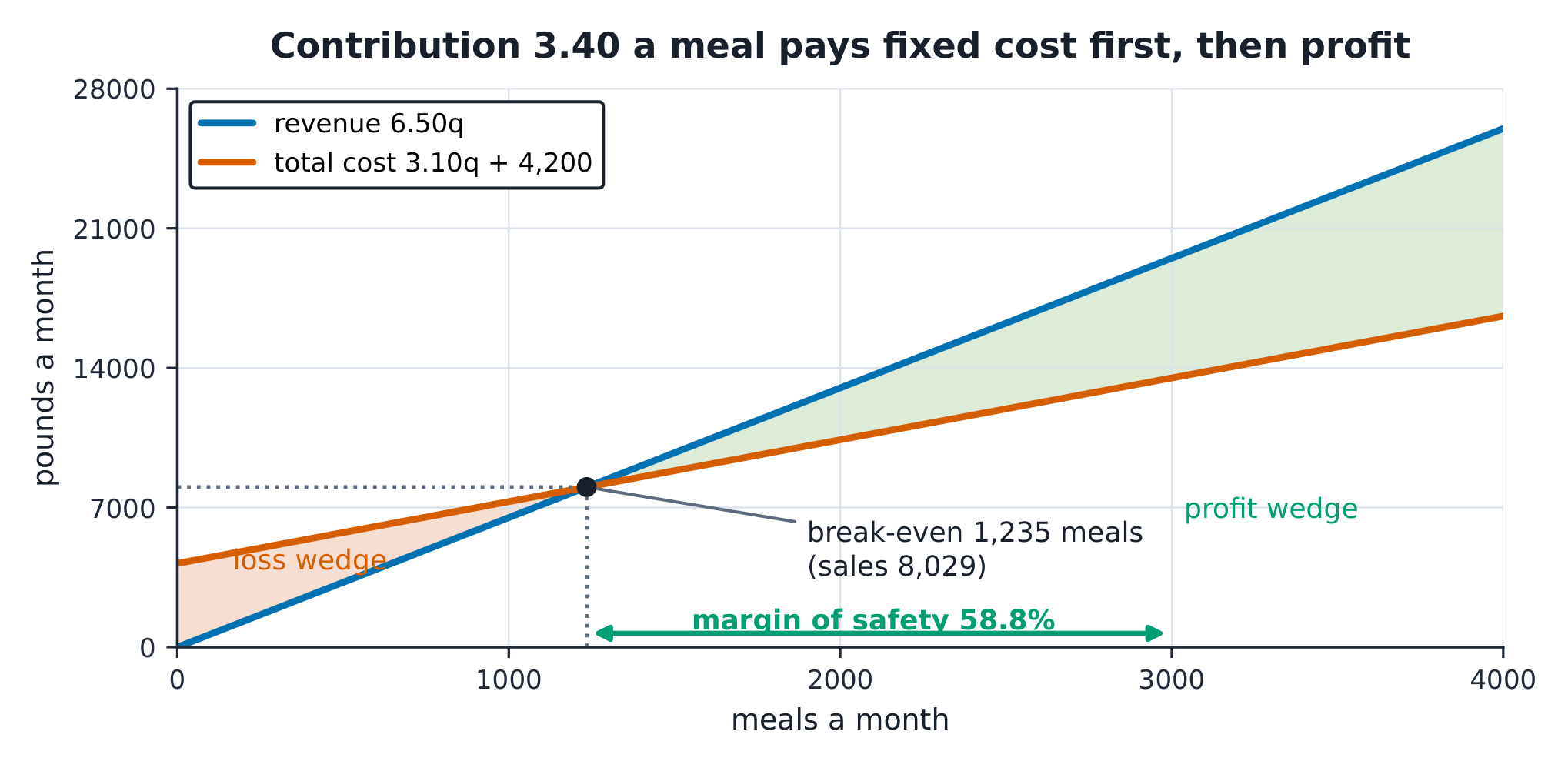
- Fixed costs of £4,200 stand between the first meal and the first pound of profit. Contribution margin 边际贡献 — £3.40 a meal — is the shovel.
- CVP is the manager's flight simulator: linear behaviour in the relevant range, and answers in seconds.
The one ratio that matters
- $CM = 6.50 - 3.10 = £3.40$ a meal, 52.3% of price. Contribution pays fixed cost first; what's left is profit.
- The break-even point 保本点: $q^* = 4{,}200/3.40 = 1{,}235$ meals = £8,029 of sales ✓.
F = 4,200, CM = 3.40. Break-even in meals (nearest whole)?
Dificultad 2/5 · 140 monedas + un pequeño bono en el primer intento de hoy
$4{,}200/3.40 = 1{,}235.3 \approx 1{,}235$ meals, or £8,029 of sales.
CVP should use the full unit cost of 2.50 (3.10 variable plus a share of fixed), not the 3.10 variable cost.
Dificultad 1/5 · 100 monedas + un pequeño bono en el primer intento de hoy
CVP separates contribution from fixed: the £3.10 variable cost enters the per-meal arithmetic and the £4,200 enters once, whole. Spreading fixed into unit cost double-counts it.
Targets, with and without tax
- Profit target £5,000: $q = (4{,}200 + 5{,}000)/3.40 = 2{,}706$ meals ✓.
- Target £6,000 AFTER 25% tax: pre-tax $6{,}000/0.75 = £8{,}000$ → $q = 3{,}588$ meals ✓ — and 3,588 sits inside the 6,000-meal range, so the model still holds.
Target profit 5,000. The required volume, nearest whole meals?
Dificultad 2/5 · 140 monedas + un pequeño bono en el primer intento de hoy
$(4{,}200 + 5{,}000)/3.40 = 2{,}705.9 \approx 2{,}706$ meals.
Target 6,000 AFTER a 25% tax. Required volume, nearest whole meals?
Dificultad 2/5 · 140 monedas + un pequeño bono en el primer intento de hoy
Pre-tax $6{,}000/0.75 = 8{,}000$; $q = (4{,}200 + 8{,}000)/3.40 = 3{,}588$ meals - inside the 6,000 range.
Margin of safety and leverage
- At the 3,000-meal plan: $MoS = (3{,}000 - 1{,}235)/3{,}000 = 58.8$% ✓ — sales can fall by more than half before losses.
- Operating leverage 经营杠杆 at 3,000 meals: $CM/\text{profit} = 10{,}200/6{,}000 = 1.7$ — a 10% volume rise lifts profit about 17%. Leverage cuts both ways.
Which CVP quantity answers which question?
Route each management question to break-even, margin of safety, operating leverage or the mix.
Margin of safety at the 3,000-meal plan, in % (one decimal)?
Dificultad 2/5 · 140 monedas + un pequeño bono en el primer intento de hoy
$(3{,}000 - 1{,}235)/3{,}000 = 58.8$%. Sales can fall 58.8% before losses begin.
Operating leverage at 3,000 meals (CM total 10,200, profit 6,000), two decimals?
Dificultad 2/5 · 140 monedas + un pequeño bono en el primer intento de hoy
$10{,}200/6{,}000 = 1.70$: a 10% volume rise lifts profit about 17% - and a 10% fall cuts it as hard.
The mix is a margin in disguise
- Alpha £5.00 (CM £2.60) and Beta £4.00 (CM £1.80) in a 60:40 mix: bundle price £4.60, bundle CM £2.28 ✓.
- Break-even: $4{,}200/2.28 = 1{,}842$ bundles = 1,105 Alpha + 737 Beta ✓. Drift to 50:50 and the bundle CM FALLS to £2.20 — Beta carries the lower margin. State the mix; watch the mix.
Alpha CM 2.60, Beta CM 1.80, mix 60:40. The bundle CM, two decimals?
Dificultad 2/5 · 140 monedas + un pequeño bono en el primer intento de hoy
$0.6 \times 2.60 + 0.4 \times 1.80 = £2.28$; break-even bundles $4{,}200/2.28 = 1{,}842$.
The mix drifts to 50:50. What happens to break-even?
Dificultad 1/5 · 100 monedas + un pequeño bono en el primer intento de hoy
Bundle CM $= 0.5 \times 2.60 + 0.5 \times 1.80 = £2.20 < 2.28$: break-even rises to $4{,}200/2.20 = 1{,}909$ bundles.
Three CVP slips
- Using unit cost (fixed spread in) instead of £3.10. CVP eats variable cost only.
- Crossing the step. A plan past 6,000 meals must re-base fixed cost at £5,100.
- Quoting break-even without its mix. The 1,235 answer belongs to the one-product world.
Recap
- $q^* = F/CM$; targets add profit to the numerator (pre-tax).
- $MoS$ is the runway; leverage is the swing.
- Mix shifts move the bundle CM — the silent variable.