El espectro electromagnético
Introducido| English | Significado |
|---|---|
| electromagnetic spectrum/ɪˌlektrəʊməɡˈnetɪk ˈspektrəm/ | espectro electromagnético |
| radio waves/ˈreɪdɪəʊ weɪvz/ | ondas de radio |
| microwaves/ˈmaɪkrəʊweɪvz/ | microondas |
| infrared/ˌɪnfrəˈred/ | infrarrojo |
| ultraviolet/ˌʊltrəˈvaɪəlɪt/ | ultravioleta |
| X-rays/eks reɪz/ | rayos X |
| gamma rays/ˈɡæmə reɪz/ | rayos gamma |
One family of waves
- Radio, the warmth of a heater, the light you see, the X-ray at a hospital — all the same kind of wave.
- Together they make the electromagnetic spectrum 电磁波谱.
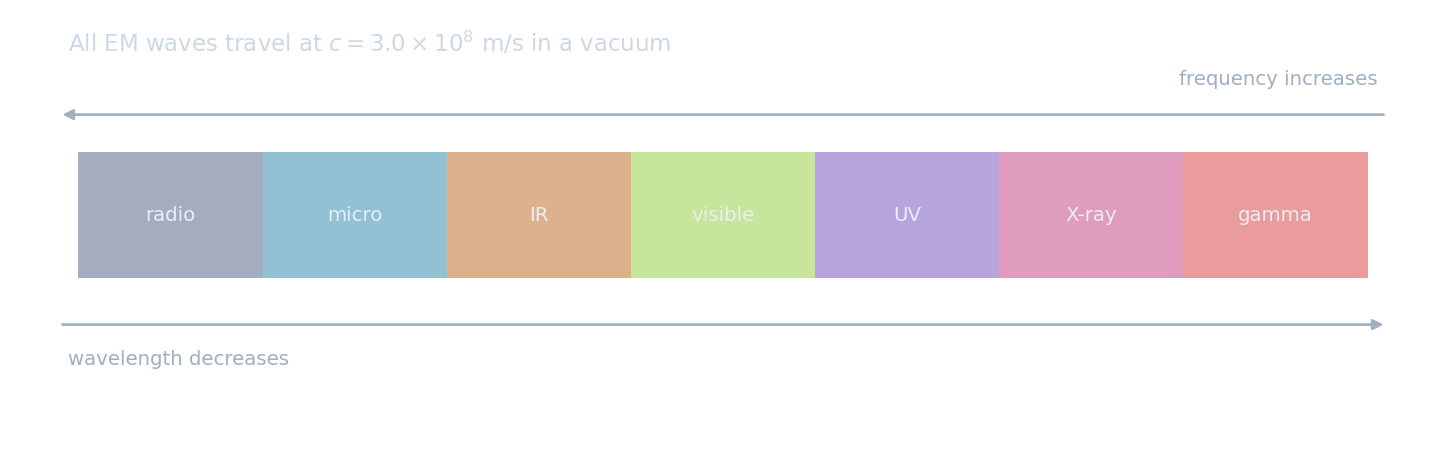
- They all travel at the same high speed in a vacuum: $3.0 \times 10^8\ \text{m/s}$.
The order of the spectrum
- From longest wavelength to shortest: radio waves 无线电波, microwaves 微波, infrared 红外线, visible light, ultraviolet 紫外线, X-rays X射线, gamma rays 伽马射线.
- As you go that way: the wavelength falls, the frequency rises, and the energy rises.
- Visible light is just a thin slice in the middle.
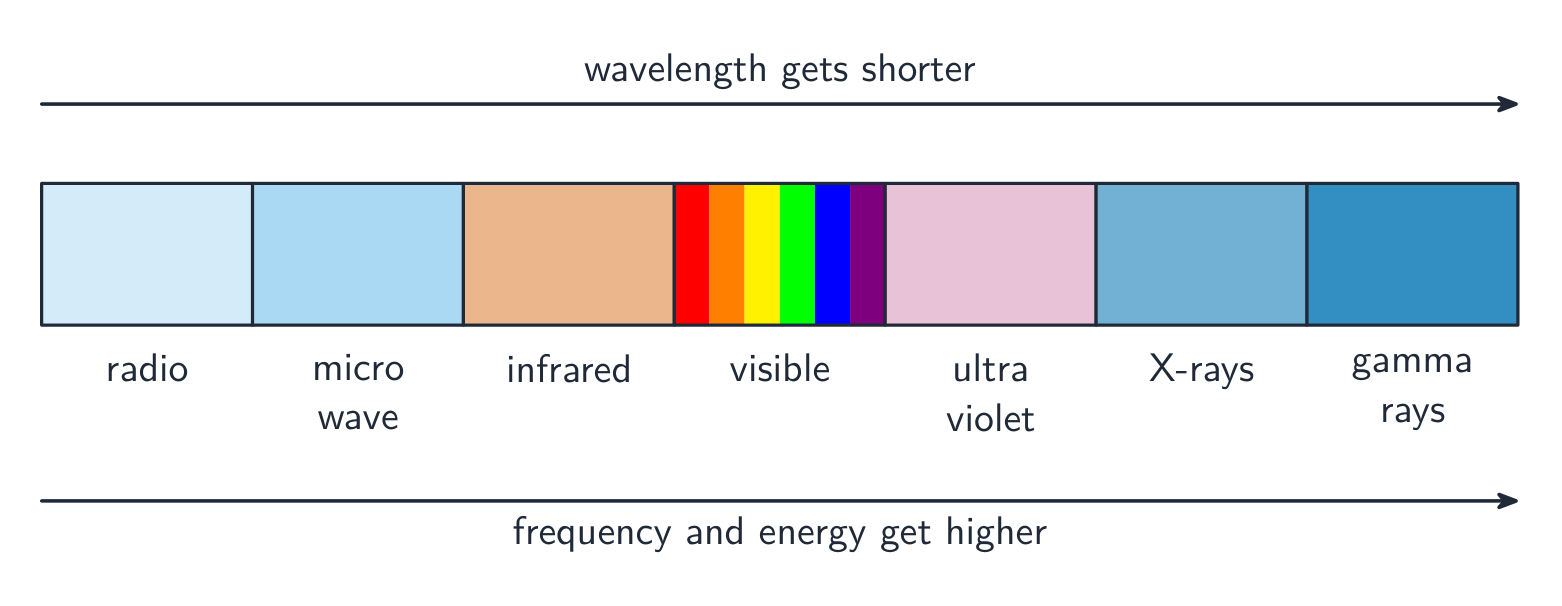
The electromagnetic spectrum
Desliza por el espectro
Las ondas de radio, la luz visible y los rayos gamma son todas la misma onda; solo cambia la longitud de onda, y con ella la frecuencia, la energía del fotón y su uso cotidiano.
En el vacío, ¿cómo se comparan las velocidades de las ondas de radio, la luz y los rayos gamma?
Dificultad 1/5 · 100 monedas + un pequeño bono en el primer intento de hoy
Todas las ondas electromagnéticas viajan a la misma velocidad en el vacío, $3.0 \times 10^8\ \text{m/s}$.
Ordena estas ondas EM según su longitud de onda, de mayor a menor.
Dificultad 3/5 · 200 monedas + un pequeño bono en el primer intento de hoy
Las ondas de radio tienen la mayor longitud de onda y los rayos gamma la menor: radio, microondas, infrarrojo, visible, UV, rayos X, gamma.
Al pasar de las ondas de radio hacia los rayos gamma, la frecuencia:
Dificultad 1/5 · 100 monedas + un pequeño bono en el primer intento de hoy
A medida que la longitud de onda disminuye (radio → gamma), tanto la frecuencia como la energía aumentan.
What each one is used for
- Radio waves — radio and TV broadcasts.
- Microwaves — mobile phones, satellite TV, cooking.
- Infrared — remote controls, thermal imaging, grills.
- Visible light — seeing and photography.
- Ultraviolet — sterilising water, checking banknotes.
- X-rays — medical and security scans.
- Gamma rays — sterilising equipment, treating cancer.
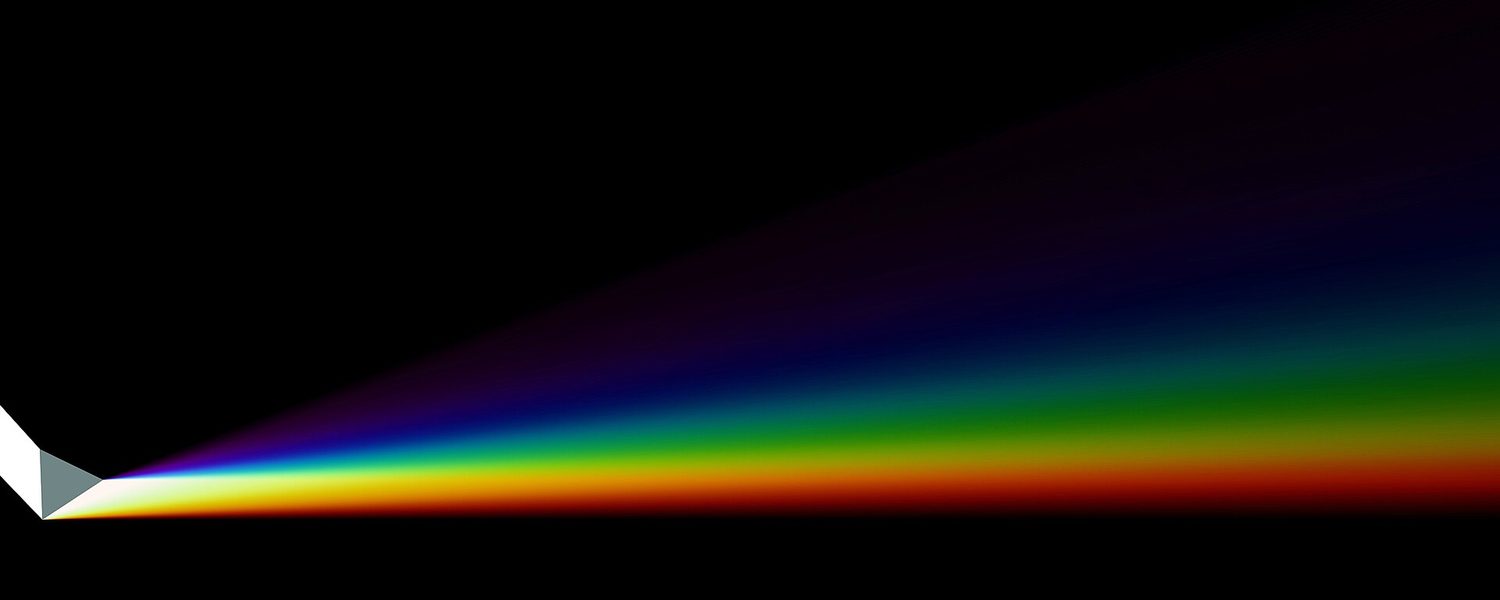
A glass prism splits white light into the colours of the spectrum
Empareja cada onda con un uso común.
Dificultad 2/5 · 140 monedas + un pequeño bono en el primer intento de hoy
Los microondas transmiten señales telefónicas, el infrarrojo funciona en controles remotos y los rayos X permiten visualizar huesos.
The dangers
- The shorter, higher-energy waves are the dangerous ones.
- Microwaves — heat the water in body cells.
- Infrared — skin burns.
- Ultraviolet — skin cancer and eye damage.
- X-rays and gamma rays — damage cells and cause mutations.
¿Qué tipo de onda causa quemaduras solares y cáncer de piel en exceso?
Dificultad 1/5 · 100 monedas + un pequeño bono en el primer intento de hoy
La radiación ultravioleta tiene suficiente energía para dañar las células de la piel, causando quemaduras solares y cáncer de piel.
Worked examples
1. Wi-Fi uses microwaves of frequency $2.4\ \text{GHz} = 2.4 \times 10^9\ \text{Hz}$. Wavelength $\lambda = \dfrac{v}{f} = \dfrac{3.0 \times 10^8}{2.4 \times 10^9} = 0.125\ \text{m}$, about $12.5\ \text{cm}$.
2. Which has the higher frequency, ultraviolet or X-rays? X-rays: they come after ultraviolet in the order radio → microwave → infrared → visible → ultraviolet → X-ray → gamma.
All electromagnetic waves travel at the same speed in a vacuum, $3.0 \times 10^8\ \text{m/s}$. Gamma rays are not faster than radio waves; they have a higher frequency and a shorter wavelength.
You've got it
- all EM waves travel at $3.0 \times 10^8\ \text{m/s}$ in a vacuum
- order (long → short wavelength): radio · micro · infrared · visible · UV · X-ray · gamma
- going that way: frequency and energy rise, wavelength falls
- higher energy → more dangerous (UV cancer, X/gamma cell damage)
Write from the data given
- A radio wave in a vacuum has wavelength 3.0 m. The vacuum speed is 3.0 times 10 to the 8 metres per second.
- Find the frequency. Gamma radiation does not travel faster in a vacuum.
Una onda de radio de longitud de onda 3.0 m viaja en el vacío a 3.0 veces 10 por los 8 metros por segundo. ¿Cuál es su frecuencia y cómo se compara esa velocidad con la radiación gamma?
3.0 veces 10 a la 8 dividido por 3.0 es igual a 1.0 veces 10 a la 8 hertz.
¿Cuál es la frecuencia de esta onda de radio?
Dificultad 1/5 · 100 monedas + un pequeño bono en el primer intento de hoy
La velocidad dividida por la longitud de onda es igual a 1.0 veces 10 a la 8 hertz.