Pressure · Presión
| English | Español |
|---|---|
| pressure/ˈpreʃə/ | presión |
| pascal/ˈpæskl/ | pascal |
| fluids/ˈfluːɪdz/ | fluidos |
Why a sharp knife cuts
- Press a blunt stick into your hand — nothing happens. A sharp pin at the same push hurts.
- The force is the same; what changed is the area it acts on.
- That idea is pressure 压强 — and it explains knives, snowshoes, and the deep sea.
¿Por qué un cuchillo afilado corta?
- Presiona un palo romo contra tu mano — no sucede nada. Un alfiler afilado, con el mismo empuje, duele.
- La fuerza es la misma; lo que cambió es el área sobre la que actúa.
- Esa idea es la presión 压强 — y explica los cuchillos, las raquetas de nieve y las profundidades del mar.
What is pressure?
- Pressure is the force pressing on each unit of area:
- The unit is the pascal 帕斯卡 (Pa); $1\ \text{Pa} = 1\ \text{N/m}^2$.
- Same force, smaller area → bigger pressure.
¿Qué es la presión?
- La presión es la fuerza que presiona sobre cada unidad de área:
- La unidad es el pascal 帕斯卡 (Pa); $1\ \text{Pa} = 1\ \text{N/m}^2$.
- Misma fuerza, área más pequeña → mayor presión.
Pressure · Presión
p = ρg·h
Pressure in a liquid is proportional to depth. · La presión en un líquido es proporcional a la profundidad.
A box pushes down with a force of $200\ \text{N}$ over an area of $0.50\ \text{m}^2$. What is the pressure, in Pa? · Una caja ejerce una fuerza de $200\ \text{N}$ sobre un área de $0.50\ \text{m}^2$. ¿Cuál es la presión, en Pa?
$p = \dfrac{F}{A} = \dfrac{200}{0.50} = 400\ \text{Pa}$.
Why area matters
- A sharp knife or a drawing pin has a tiny area, so it makes a huge pressure and cuts or pierces easily.
- Snowshoes and tractor tyres have a large area, so they make a small pressure and do not sink in.
- Camels' wide feet work the same way on soft sand.
Same force, different area → different pressure. The narrow base sinks; the wide base stays on top.
Worked example. A 600 N person stands on one foot (area $0.02\ \text{m}^2$). Pressure $= \dfrac{600}{0.02} = 30\,000\ \text{Pa}$. On both feet (area $0.04\ \text{m}^2$): pressure $= 15\,000\ \text{Pa}$ — half as much.
Pressure acts in all directions in fluids 流体. When you dive deep, water pushes on your ears from every side — not just from above. The formula $\Delta p = \rho g\,\Delta h$ gives the pressure at that depth in all directions.
Por qué importa el área
- Un cuchillo afilado o un alfiler tienen un área muy pequeña, por lo que generan una gran presión y cortan o perforan fácilmente.
- Las raquetas de nieve y los neumáticos de tractores tienen un área grande, por lo que generan una baja presión y no se hunden.
- Los pies anchos de los camellos funcionan de la misma manera sobre la arena blanda.

Misma fuerza, diferente área → diferente presión. La base estrecha se hunde; la base ancha permanece encima.
Ejemplo resuelto. Una persona de 600 N se para sobre un pie (área $0.02\ \text{m}^2$). Presión $= \dfrac{600}{0.02} = 30\,000\ \text{Pa}$. Sobre ambos pies (área $0.04\ \text{m}^2$): presión $= 15\,000\ \text{Pa}$ — la mitad.
La presión actúa en todas direcciones en los fluidos 流体. Cuando buceas profundamente, el agua empuja tus oídos desde todos los lados — no solo desde arriba. La fórmula $\Delta p = \rho g\,\Delta h$ da la presión a esa profundidad en todas las direcciones.
Why does a sharp knife cut better than a blunt one (with the same push)? · ¿Por qué un cuchillo afilado corta mejor que uno sin filo (con el mismo empuje)?
Same force on a tiny area means a very large pressure ($p = F/A$), so it cuts easily. · Una misma fuerza sobre un área muy pequeña significa una presión muy grande ($p = F/A$), por lo que corta fácilmente.
Snowshoes stop you sinking into snow because they: · Las raquetas de nieve evitan que te hundas en la nieve porque:
A larger area means a smaller pressure for the same weight, so you do not sink in. · Un área mayor significa una menor presión para el mismo peso, por lo que no te hundes.
Pressure in a liquid
- In a liquid, pressure increases with depth and with the liquid's density:
- It acts in all directions, not just downward.
- This is why a dam is built thicker at the bottom, where the water pressure is greatest, and why your ears hurt deep underwater.
The deeper the liquid, the greater the pressure, so the outward push on the wall grows with depth
Presión en un líquido
- En un líquido, la presión aumenta con la profundidad y con la densidad del líquido:
- Actúa en todas las direcciones, no solo hacia abajo.
- Por eso una presa se construye más gruesa en la parte inferior, donde la presión del agua es mayor, y por qué te duelen los oídos bajo el agua profunda.
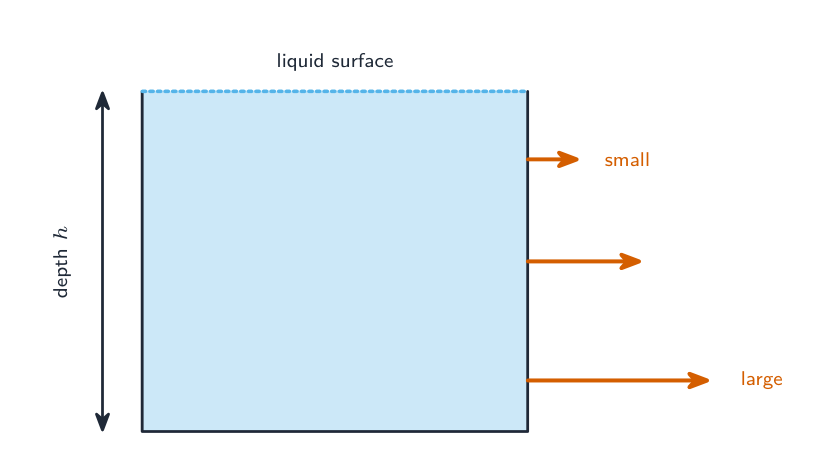
Cuantó más profundo está el líquido, mayor es la presión, por lo que el empuje hacia afuera sobre la pared aumenta con la profundidad.
Pressure in a liquid acts in all directions, not just downward. · La presión en un líquido actúa en todas direcciones, no solo hacia abajo.
A liquid pushes equally in all directions at a given depth — that is why it presses on the sides of a container too. · Un líquido ejerce presión igual en todas las direcciones a una profundidad dada — por eso también presiona contra las paredes de un recipiente.
Find the extra pressure $2.0\ \text{m}$ deep in water ($\rho = 1000\ \text{kg/m}^3$, $g = 9.8\ \text{N/kg}$), in Pa. · Calcula la presión adicional a $2.0\ \text{m}$ de profundidad en agua ($\rho = 1000\ \text{kg/m}^3$, $g = 9.8\ \text{N/kg}$), en Pa.
$\Delta p = \rho g\,\Delta h = 1000 \times 9.8 \times 2.0 = 19\,600\ \text{Pa}$.
You've got it
- pressure $p = \dfrac{F}{A}$, unit the pascal ($1\ \text{Pa} = 1\ \text{N/m}^2$)
- small area → big pressure (knife); large area → small pressure (snowshoes)
- in a liquid, pressure rises with depth and density: $\Delta p = \rho g\,\Delta h$, acting in all directions
Ya lo tienes
- presión $p = \dfrac{F}{A}$, unidad el pascal ($1\ \text{Pa} = 1\ \text{N/m}^2$)
- área pequeña → gran presión (cuchillo); área grande → baja presión (raquetas de nieve)
- en un líquido, la presión sube con la profundidad y la densidad: $\Delta p = \rho g\,\Delta h$, actuando en todas las direcciones