The kinetic particle model · El modelo cinético de partículas
| English | Español |
|---|---|
| particles/ˈpɑːtɪklz/ | partículas |
| kinetic particle model/kɪˈnetɪk ˈpɑːtɪkl ˈmɒdl/ | modelo cinético de partículas |
| solid/ˈsɒlɪd/ | sólido |
| liquid/ˈlɪkwɪd/ | líquido |
| gas/ɡæs/ | gas |
| temperature/ˈtemprɪtʃə/ | temperatura |
| absolute zero/ˈæbsəluːt ˈzɪərəʊ/ | cero absoluto |
| kelvin/ˈkelvɪn/ | kelvin |
| Brownian motion/ˈbraʊnɪən ˈməʊʃn/ | Movimiento browniano |
Everything is made of particles 粒子
- Look closely enough and all matter is tiny particles that never stop moving.
- This one idea — the kinetic particle model 分子动理论 — explains solids 固体, liquids 液体, gases 气体, heat and pressure.
- Let's see what the particles are doing.
Todo está hecho de partículas
- Si observas con suficiente detalle, toda la materia está formada por diminutas partículas que nunca dejan de moverse.
- Esta idea — el modelo cinético de partículas — explica los sólidos, líquidos, gases, el calor y la presión.
- Veamos qué están haciendo las partículas.
The three states of matter
- Solid — particles packed in a regular pattern, only vibrating. Fixed shape and volume.
- Liquid — particles still close but jumbled; they slide past each other. Fixed volume, takes the container's shape.
- Gas — particles far apart, fast and random. Fills the whole container.
Los tres estados de la materia
- Sólido — partículas empaquetadas en un patrón regular, solo vibran. Forma y volumen fijos.
- Líquido — partículas aún juntas pero desordenadas; se deslizan unas sobre otras. Volumen fijo, adopta la forma del recipiente.
- Gas — partículas muy separadas, rápidas y aleatorias. Llena todo el recipiente.

Squeeze a gas (Boyle's law) · Comprimir un gas (Ley de Boyle)
Slide the piston in to shrink the volume. The same particles get crammed into less space, so they hit the walls more often and the pressure climbs — while pressure × volume stays constant. · Deslice el émbolo hacia adentro para reducir el volumen. Las mismas partículas se apretujan en menos espacio, por lo que chocan con las paredes con más frecuencia y la presión aumenta — mientras que presión × volumen permanece constante.
In which state are the particles far apart, fast, and moving in random directions? · ¿En qué estado se encuentran las partículas separadas, rápidas y moviéndose en direcciones aleatorias?
Gas particles are far apart and move quickly in random directions, filling the container. Solids only vibrate; liquids slide past each other. · Las partículas de gas están separadas y se mueven rápidamente en direcciones aleatorias, llenando el recipiente. Los sólidos solo vibran; los líquidos se deslizan unos sobre otros.
Temperature 温度 and particle energy
- Heat a substance and its particles move faster — they gain kinetic energy.
- Temperature is a measure of the average kinetic energy of the particles.
- The lowest possible temperature is absolute zero 绝对零度, $-273\ {}^{\circ}\text{C}$ — particles have the least energy.
The particle model of solids, liquids and gases
Temperatura y energía de las partículas
- Calienta una sustancia y sus partículas se mueven más rápido; ganan energía cinética.
- La temperatura es una medida de la energía cinética promedio de las partículas.
- La temperatura más baja posible es el cero absoluto, $-273\ {}^{\circ}\text{C}$ — las partículas tienen la menor energía.
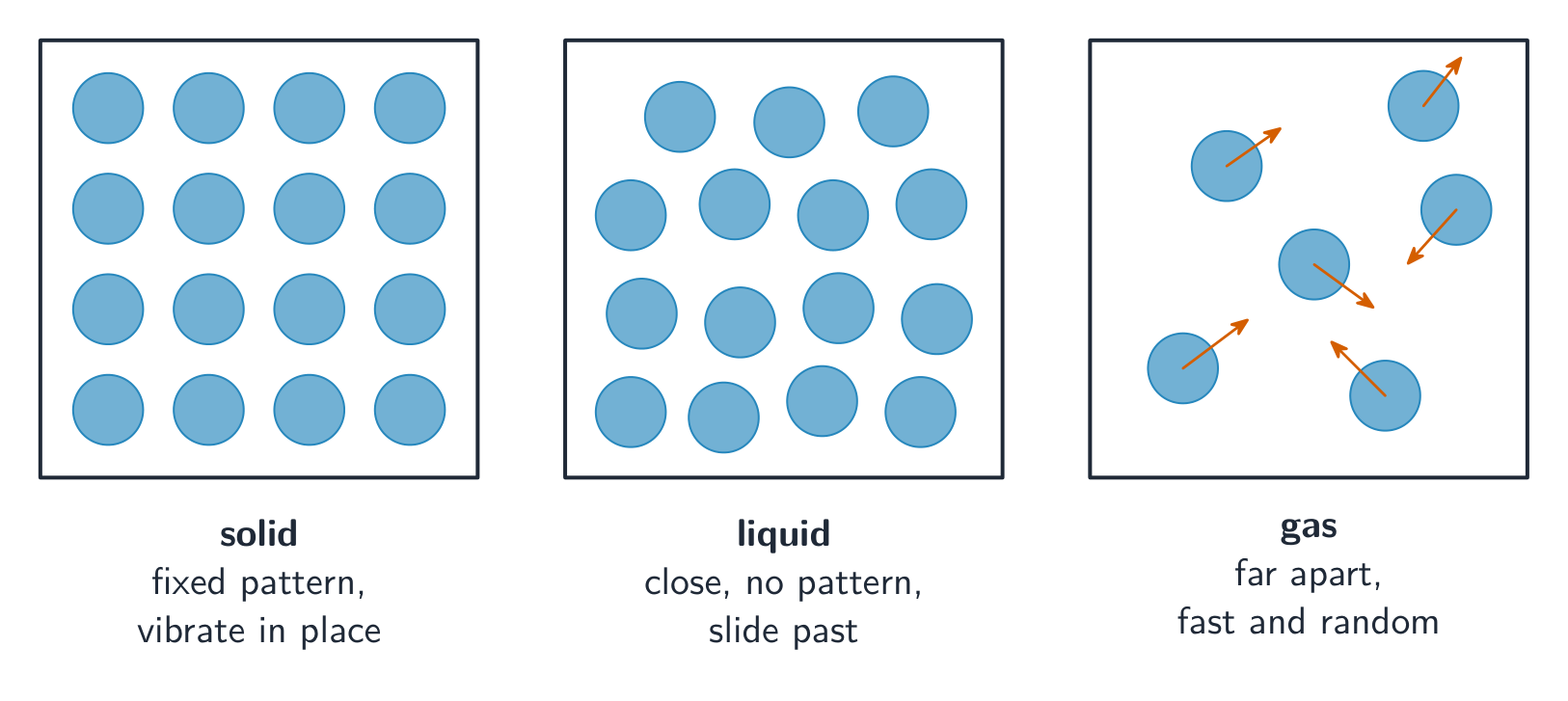
El modelo de partículas de sólidos, líquidos y gases
Temperature is a measure of: · La temperatura es una medida de:
Hotter means the particles move faster, so temperature measures their average kinetic energy. · Que esté más caliente significa que las partículas se mueven más rápido, por lo que la temperatura mide su energía cinética promedio.
The kelvin 开尔文 scale
- Scientists often measure temperature in kelvin (K), starting from absolute zero.
- To convert:
- So $0\ {}^{\circ}\text{C} = 273\ \text{K}$ and $27\ {}^{\circ}\text{C} = 300\ \text{K}$.
La escala kelvin
- Los científicos suelen medir la temperatura en kelvin (K), partiendo del cero absoluto.
- Para convertir:
- Así, $0\ {}^{\circ}\text{C} = 273\ \text{K}$ y $27\ {}^{\circ}\text{C} = 300\ \text{K}$.

Convert $27\ {}^{\circ}\text{C}$ to kelvin. · Convierta $27\ {}^{\circ}\text{C}$ a kelvin.
$T = \theta + 273 = 27 + 273 = 300\ \text{K}$.
Gas pressure
- Gas particles constantly hit the walls of their container. Each hit is a tiny push.
- The pressure is the total force of these hits on each unit of area.
- Heat the gas (fixed volume) → faster, harder, more frequent hits → higher pressure.
- Squeeze it smaller (fixed temperature) → more hits per second on each area → higher pressure.
- For a fixed mass of gas at constant temperature, $pV = \text{constant}$ (halve the volume → double the pressure).
Presión de los gases
- Las partículas de gas golpean constantemente las paredes de su recipiente. Cada golpe es un pequeño empuje.
- La presión es la fuerza total de estos golpes por cada unidad de área.
- Calienta el gas (volumen fijo) → golpes más rápidos, fuertes y frecuentes → mayor presión.
- Comprime el gas a menor tamaño (temperatura fija) → más golpes por segundo en cada área → mayor presión.
- Para una masa fija de gas a temperatura constante, $pV = \text{constant}$ (si reduces el volumen a la mitad → duplicas la presión).

A gas has a volume of $200\ \text{cm}^3$ at $100\ \text{kPa}$. It is squeezed to $100\ \text{cm}^3$ at constant temperature. What is the new pressure, in kPa? · Un gas tiene un volumen de $200\ \text{cm}^3$ a $100\ \text{kPa}$. Se comprime hasta $100\ \text{cm}^3$ a temperatura constante. ¿Cuál es la nueva presión, en kPa?
$pV$ is constant: $100 \times 200 = p \times 100$, so $p = 200\ \text{kPa}$. Halving the volume doubles the pressure. · $pV$ es constante: $100 \times 200 = p \times 100$, por lo tanto $p = 200\ \text{kPa}$. Al reducir a la mitad el volumen, la presión se duplica.
Heating a gas in a sealed, fixed-volume can increases its pressure. · Calentar un gas en una lata sellada de volumen fijo aumenta su presión.
Hotter particles move faster and hit the walls harder and more often, so the pressure rises. · Las partículas más calientes se mueven más rápido y chocan contra las paredes con mayor fuerza y frecuencia, por lo que la presión aumenta.
Brownian motion 布朗运动
- Under a microscope, smoke specks in air jiggle along jerky, random paths.
- This is Brownian motion: the big specks are knocked about by fast, invisible air particles.
- It is strong evidence that matter really is made of moving particles.
Random hits from fast, invisible air particles push a smoke grain along a jerky, random path
Movimiento browniano
- Bajo un microscopio, las partículas de humo en el aire se mueven en trayectorias irregulares y aleatorias.
- Esto es el movimiento browniano: las partículas grandes son empujadas por las rápidas e invisibles partículas de aire.
- Es una fuerte evidencia de que la materia realmente está hecha de partículas en movimiento.
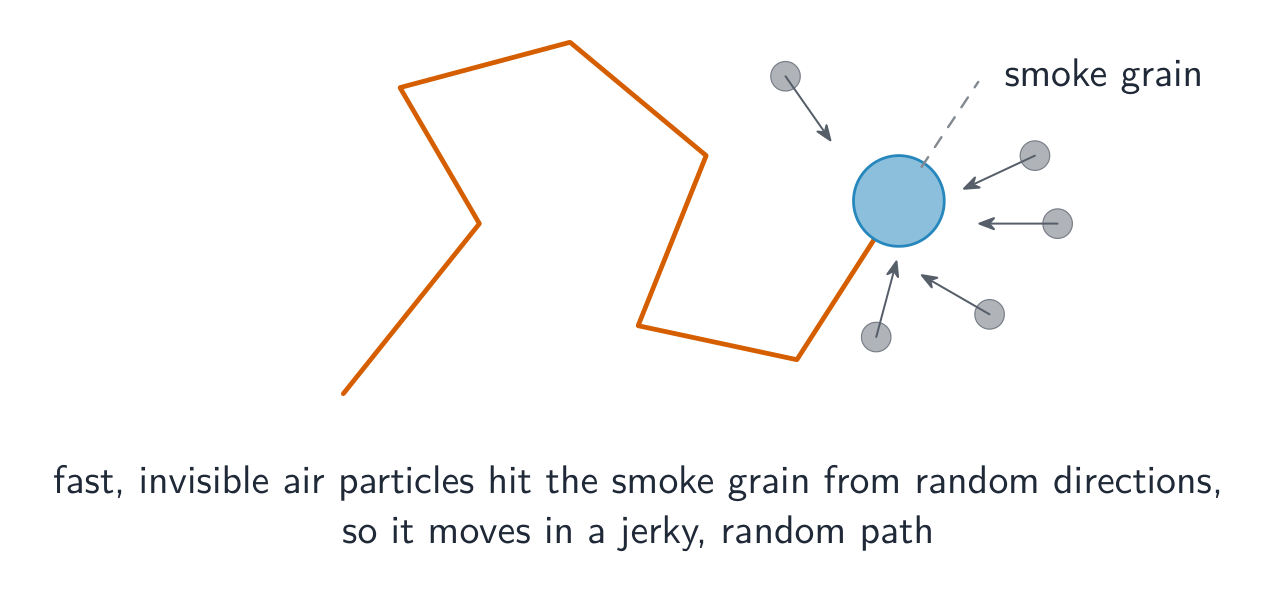
Los golpes aleatorios de partículas de aire rápidas e invisibles empujan un grano de humo a lo largo de un camino irregular y aleatorio
Smoke specks seen under a microscope jiggle randomly. This is because: · Los granos de humo observados bajo un microscopio tiemblan aleatoriamente. Esto se debe a que:
Brownian motion: tiny fast air particles knock the larger smoke specks about, evidence for moving particles. · Movimiento browniano: pequeñas partículas de aire rápidas golpean los granos de humo más grandes, evidencia del movimiento de partículas.
You've got it
- solid (fixed, vibrating) · liquid (close, sliding) · gas (far apart, fast)
- temperature = average kinetic energy of particles; absolute zero $= -273\ {}^{\circ}\text{C}$
- $T\,(\text{K}) = \theta\,({}^{\circ}\text{C}) + 273$
- gas pressure = particle hits per unit area; at constant temperature $pV = \text{constant}$
Ya lo dominas
- sólido (fijo, vibrando) · líquido (cerca, deslizándose) · gas (separados, rápidos)
- temperatura = energía cinética promedio de las partículas; cero absoluto $= -273\ {}^{\circ}\text{C}$
- $T\,(\text{K}) = \theta\,({}^{\circ}\text{C}) + 273$
- presión del gas = golpes de partículas por unidad de área; a temperatura constante $pV = \text{constant}$