Energy, work and power
Introducido| English | Significado |
|---|---|
| kinetic energy/kɪˈnetɪk ˈenədʒi/ | energía cinética |
| gravitational potential energy/ˌɡrævɪˈteɪʃənl pəˈtenʃl ˈenədʒi/ | energía potencial gravitatoria |
| conservation of energy/ˌkɒnsəˈveɪʃn ɒv ˈenədʒi/ | conservación de la energía |
| Sankey diagram/ˈsæŋki ˈdaɪəɡræm/ | diagrama de Sankey |
| work done/wɜːk dʌn/ | trabajo realizado |
| joule/dʒuːl/ | joule |
| power/ˈpaʊə/ | potencia |
| efficiency/ɪˈfɪʃənsi/ | eficiencia |
| watt/wɒt/ | vatio |
Energy never disappears
- At the top of a roller-coaster hill the car is slow but high; at the bottom it is fast but low.
- The energy did not vanish — it just moved from one store to another.
- This is the big idea of this lesson: energy is stored, transferred, and always conserved.
Energy stores and transfers
- Energy can be stored as: kinetic, gravitational potential, chemical, elastic (strain), nuclear, electrostatic, and internal (thermal).
- It is transferred between stores by: forces (mechanical work), electric currents, heating, and waves (such as light and sound).
- "Using energy" really means moving it from one store to another.
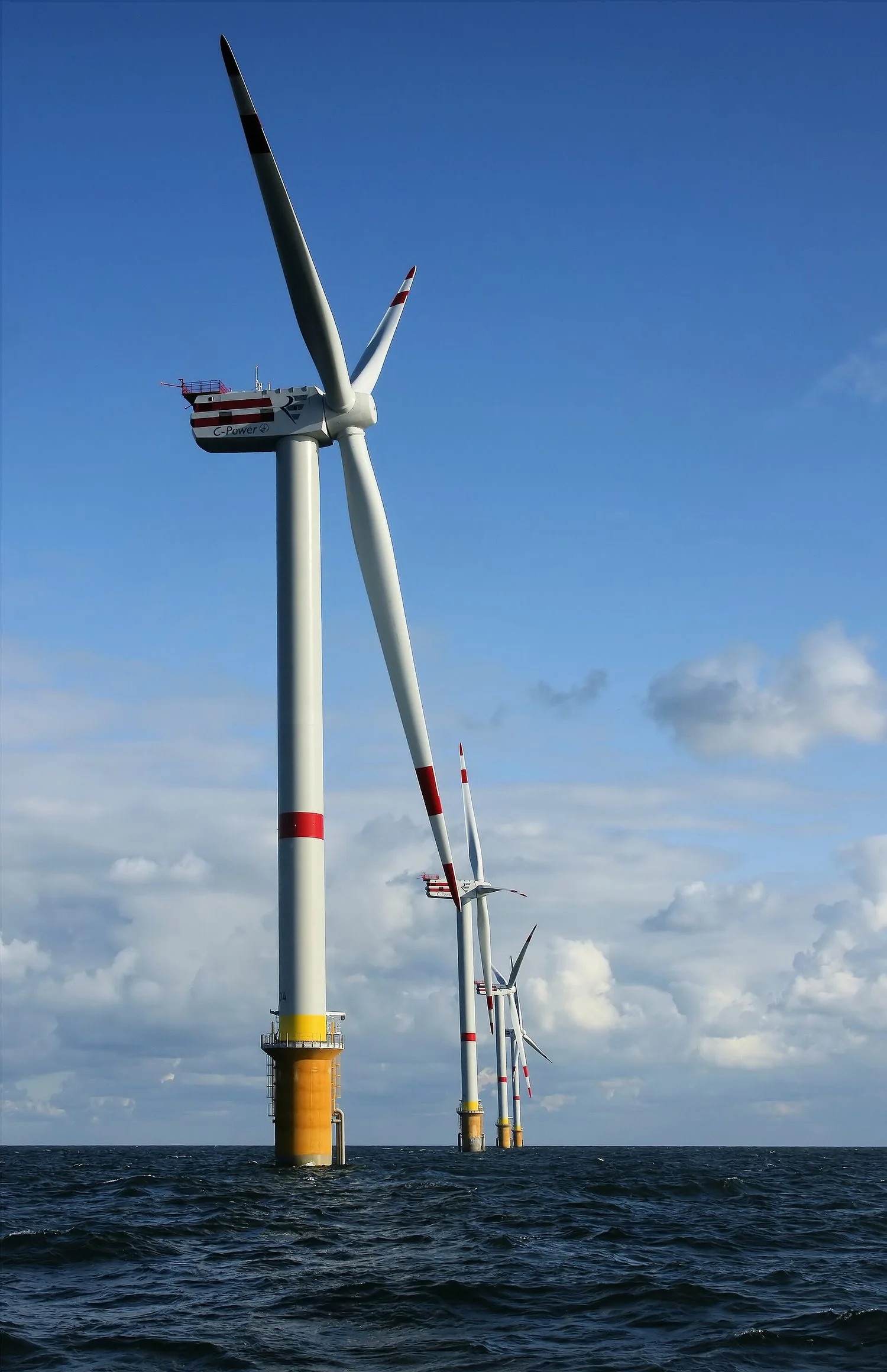
Wind turbines transfer energy from moving air to electricity
Flujo de energía y eficiencia
Input energy splits into useful output and wasted energy; efficiency is the useful fraction, and the total is always conserved.
Energy, work & power
PE + KE = constant
As an object falls, potencial energy becomes cinética — total fixed.
Select todos of these that are energy stores.
Dificultad 2/5 · 140 monedas + un pequeño bono en el primer intento de hoy
Kinetic, chemical and gravitational potential are energy stores. "Loud" and "fast" describe things, but they are not energy stores.
Kinetic and potential energy
- Kinetic energy 动能 is the energy of a moving object:
- Lifting a mass by a height $\Delta h$ changes its gravitational potential energy 重力势能:
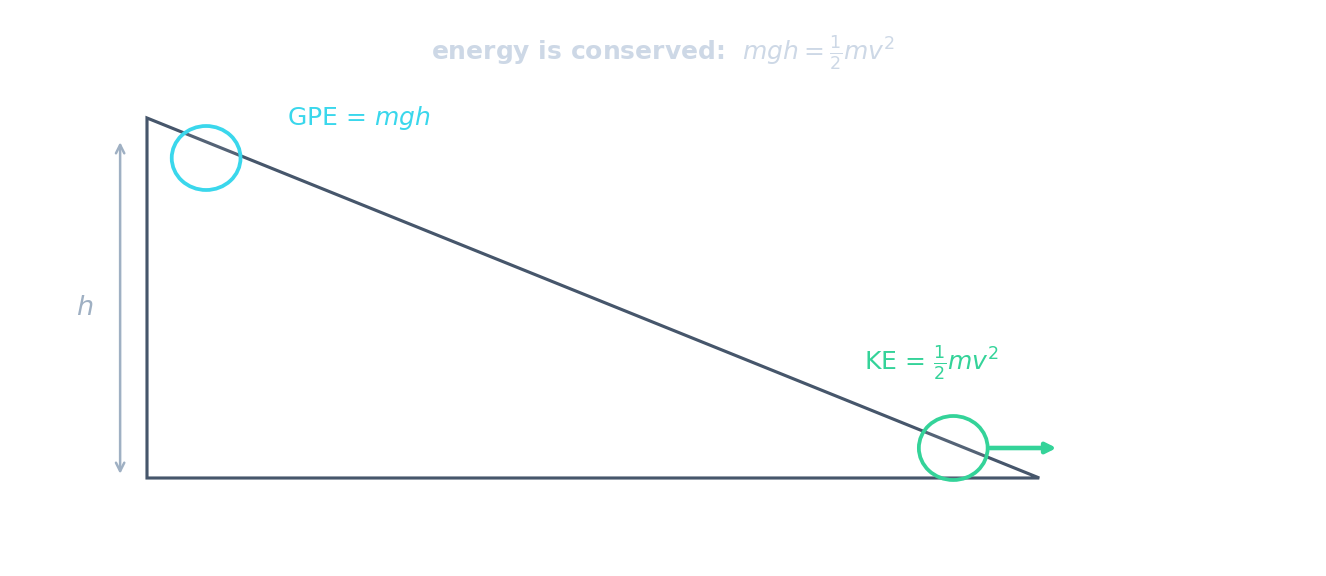
- A falling object turns gravitational PE into kinetic energy.
A $2.0\ \text{kg}$ ball moves at $3.0\ \text{m/s}$. What is its kinetic energy, in J?
Dificultad 2/5 · 140 monedas + un pequeño bono en el primer intento de hoy
$E_k = \tfrac{1}{2}mv^2 = \tfrac{1}{2} \times 2.0 \times 3.0^2 = 9.0\ \text{J}$.
Conservation of energy 能量守恒
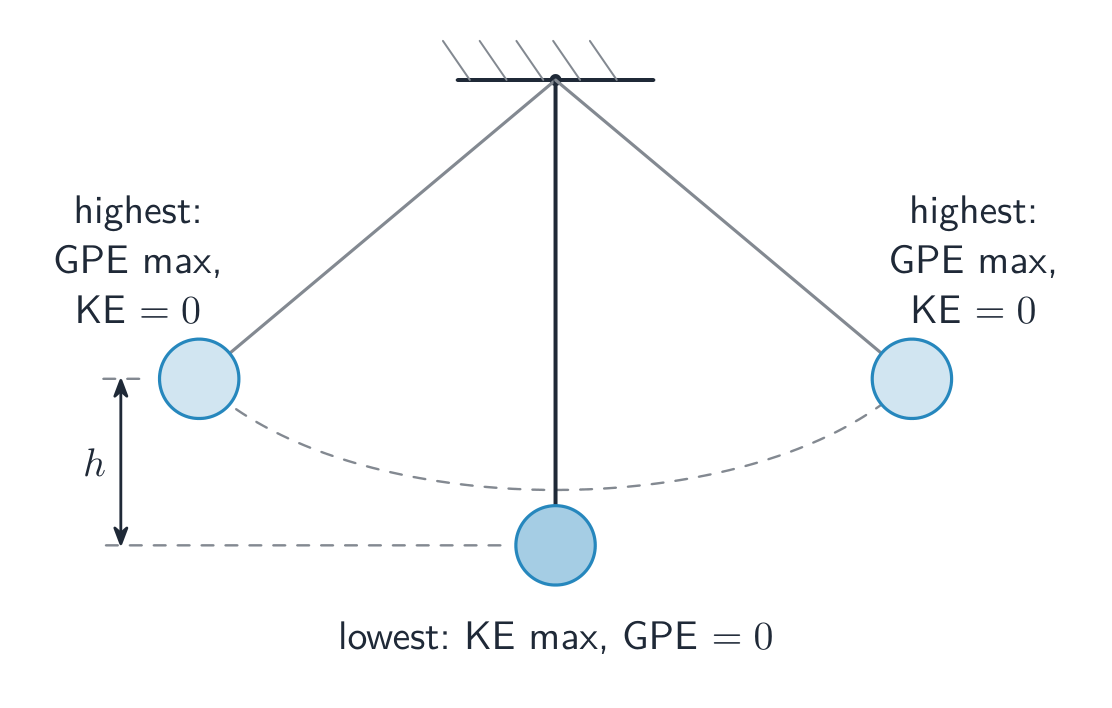
- The principle of conservation of energy: energy is never made or destroyed — it only moves between stores.
- Some energy is always wasted — usually spread out as heat to the surroundings.
- A Sankey diagram 桑基图 shows the input energy splitting into useful energy and wasted energy.
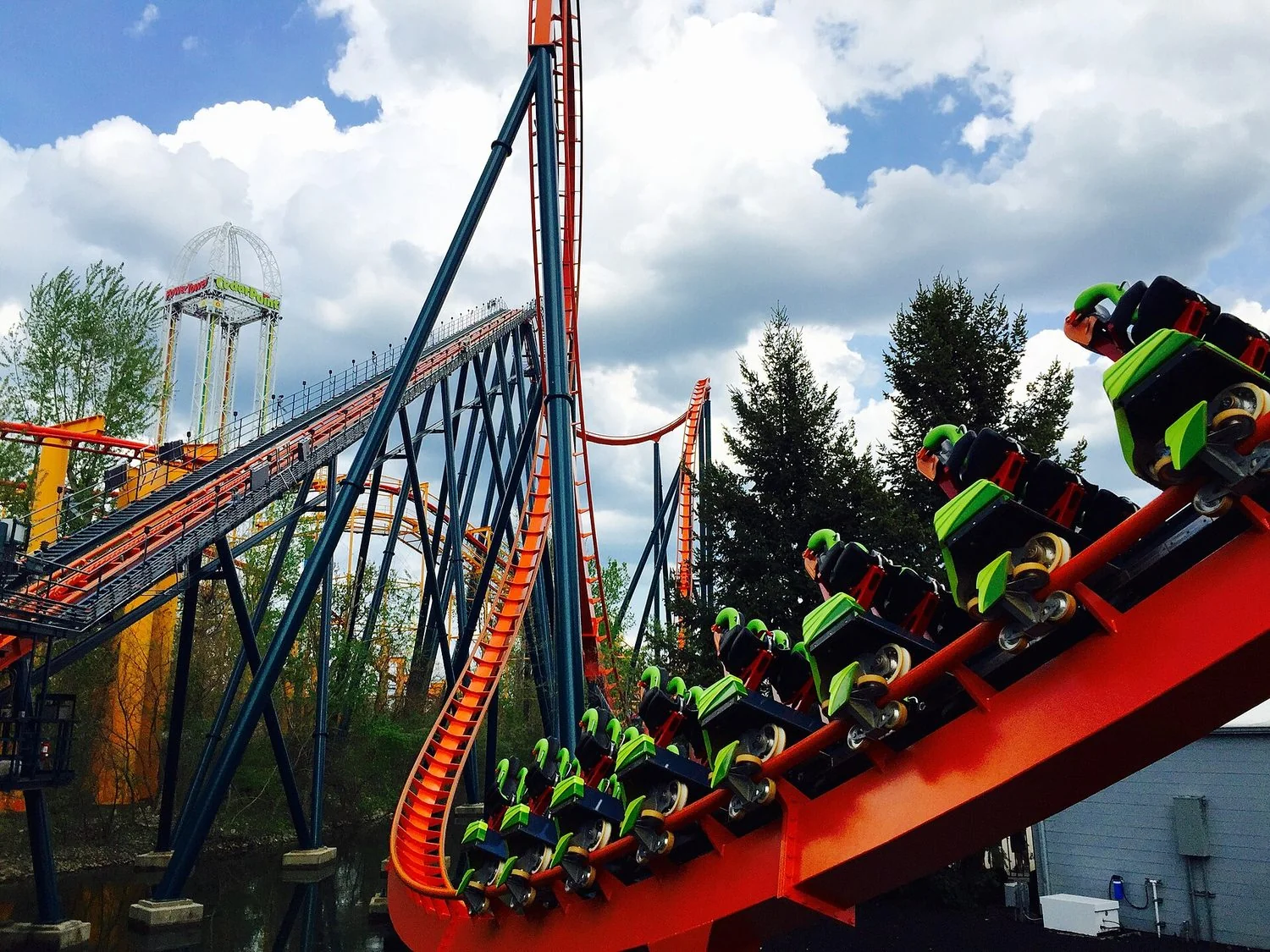
On a roller-coaster, stored energy at the top becomes kinetic energy lower down
Exam question. A 0.50 kg ball is dropped from a height of 5.0 m. Ignore air resistance. (a) Calculate the gravitational potential energy it loses. (b) Calculate its speed just before it hits the ground. [4]
- (a) GPE lost = mgΔh = 0.50 × 9.8 × 5.0 = 24.5 J (1)
- (b) All of this becomes kinetic energy: ½ × 0.50 × v² = 24.5 (1), so v² = 98 (1) and v = 9.9 m/s (1).
- Mark-scheme reasoning: most lost marks come from forgetting the square root at the end. Note that the mass cancels: any object dropped from 5.0 m reaches 9.9 m/s without air resistance.
- With air resistance, some energy is transferred to the surroundings as heat, so the ball's kinetic energy and speed at the bottom are less than this.
When a machine wastes energy, where does the wasted energy usually go?
Dificultad 1/5 · 100 monedas + un pequeño bono en el primer intento de hoy
Energy is conserved — it is never destroyed. Wasted energy is usually spread out as heat, which is hard to use again.
A stone falls 20 m from rest. Ignoring air resistance and using g = 9.8 N/kg, what is its speed just before it lands, in m/s?
Dificultad 2/5 · 140 monedas + un pequeño bono en el primer intento de hoy
mgh = ½mv², so v² = 2gh = 2 × 9.8 × 20 = 392 and v = √392 = 19.8 m/s. The mass cancels.
A real ball is dropped through air. Why is its kinetic energy at the bottom less than the gravitational potential energy it lost?
Dificultad 1/5 · 100 monedas + un pequeño bono en el primer intento de hoy
Energy is conserved. The 'missing' energy has been transferred to the internal (thermal) store of the air and the ball.
Work
- Work done 做功 equals the energy transferred. When a force moves an object along its direction:
- The unit of work and energy is the joule 焦耳 (J).
- Lifting a heavier load, or moving it further, does more work.
A force of $50\ \text{N}$ pushes a box $4.0\ \text{m}$ along the floor. How much work is done, in J?
Dificultad 2/5 · 140 monedas + un pequeño bono en el primer intento de hoy
$W = Fd = 50 \times 4.0 = 200\ \text{J}$.
Power 功率 and efficiency 效率
- Power is the work done (energy transferred) each second:
- The unit is the watt 瓦特 (W); $1\ \text{W} = 1\ \text{J/s}$.
- Efficiency is how much of the input energy becomes useful:
- It is always less than $100\%$ because some energy is always wasted.
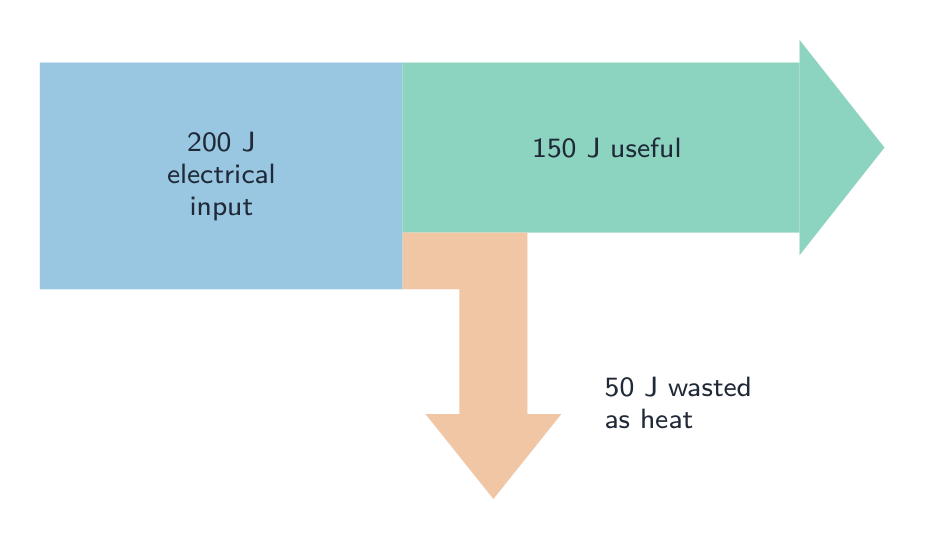
A Sankey diagram: the band widths are proportional to the energy, so the input splits into useful output and wasted heat
A motor does $200\ \text{J}$ of work in $10\ \text{s}$. What is its power, in W?
Dificultad 2/5 · 140 monedas + un pequeño bono en el primer intento de hoy
$P = \dfrac{W}{t} = \dfrac{200}{10} = 20\ \text{W}$.
A lamp takes in $50\ \text{J}$ of electrical energy and gives out $30\ \text{J}$ of useful light. What is its efficiency, in %?
Dificultad 2/5 · 140 monedas + un pequeño bono en el primer intento de hoy
eficiencia $= \dfrac{\text{useful}}{\text{total}} \times 100\% = \dfrac{30}{50} \times 100\% = 60\%$.
Worked examples
1. A $2.0\ \text{kg}$ box is lifted $1.5\ \text{m}$ onto a shelf in $3.0\ \text{s}$. $\Delta E_p = mg\Delta h = 2.0 \times 9.8 \times 1.5 = 29.4\ \text{J}$, and the power is $P = \dfrac{\Delta E}{t} = \dfrac{29.4}{3.0} = 9.8\ \text{W}$.
2. A lamp takes in $60\ \text{J}$ of electrical energy and gives out $12\ \text{J}$ as light. Efficiency $= \dfrac{12}{60} \times 100\% = 20\%$; the other $48\ \text{J}$ heats the surroundings.
Square the speed first. In $E_k = \tfrac12 mv^2$, only $v$ is squared: for $m = 4\ \text{kg}$ and $v = 4\ \text{m/s}$, $E_k = \tfrac12 \times 4 \times 16 = 32\ \text{J}$. Doubling the speed makes the kinetic energy four times bigger.
You've got it
- $E_k = \tfrac{1}{2}mv^2$ · $\Delta E_p = mg\,\Delta h$
- energy is conserved — wasted energy usually ends up as heat
- work $W = Fd$ (joule); power $P = \dfrac{W}{t}$ (watt)
- efficiency $= \dfrac{\text{useful}}{\text{total}} \times 100\%$, always below $100\%$
Write from the data: find the kinetic energy
- A 4 kg ball moves at 4 metres per second.
- Find the kinetic energy. Say what happens to that energy if the speed doubles.
A 4 kg ball moves at 4 metres per second. What is its kinetic energy, and by what factor does that energy change if the speed doubles?
One half of 4 times 16 is 32 joules. The square of 2 is 4, so the energy becomes four times as large.
What is the kinetic energy?
Dificultad 1/5 · 100 monedas + un pequeño bono en el primer intento de hoy
One half times 4 times 16 is 32 joules.