Mass, weight and density · Masa, peso y densidad
| English | Español |
|---|---|
| mass/mæs/ | masa |
| weight/weɪt/ | peso |
| density/ˈdensɪti/ | densidad |
| matter/ˈmætə/ | materia |
| gravity/ˈɡrævɪti/ | gravedad |
| gravitational field strength/ˌɡrævɪˈteɪʃənl fiːld streŋθ/ | intensidad del campo gravitatorio |
| displacement/dɪˈspleɪsmənt/ | desplazamiento |
Same you, lighter on the Moon
- An astronaut on the Moon can leap high and feels light.
- Yet they are made of exactly the same stuff as on Earth.
- The puzzle is solved by two different ideas: mass 质量 and weight 重力. Then we measure density 密度.
Mismo tú, pero más ligero en la Luna
- Un astronauta en la Luna puede saltar alto y se siente ligero.
- Sin embargo, está hecho de exactamente la misma materia que en la Tierra.
- El acertijo se resuelve con dos conceptos diferentes: masa 质量 and peso 重力. Luego medimos la densidad 密度.
Mass
- Mass is the amount of matter 物质 in an object.
- It is measured in kilograms (kg).
- Mass does not change when you move the object — to the Moon, into space, anywhere.
- A balance compares an unknown mass with known masses.
Masa
- La masa es la cantidad de materia 物质 en un objeto.
- Se mide en kilogramos (kg).
- La masa no cambia al mover el objeto — a la Luna, al espacio, a cualquier lugar.
- Una balanza compara una masa desconocida con masas conocidas.

Weight and mass · Peso y masa
W = mg
Weight is proportional to mass — the gradient is the gravitational field strength g (about 10 N/kg on Earth). · El peso es proporcional a la masa — la pendiente es la intensidad del campo gravitatorio g (aproximadamente 10 N/kg en la Tierra).
Weight
- Weight is the force of gravity 引力 on a mass. It is measured in newtons (N).
- Weight can change: it is smaller on the Moon because the Moon's gravity is weaker.
- Gravitational field strength 重力场强度 is the force per unit mass:
- So weight is $W = mg$. On Earth $g \approx 9.8\ \text{N/kg}$ — the same number as the acceleration of free fall.
A falling object speeds up until air resistance grows to equal its weight
Peso
- El peso es la fuerza de gravedad 引力 sobre una masa. Se mide en newtons (N).
- El peso puede cambiar: es menor en la Luna porque la gravedad lunar es más débil.
- La intensidad del campo gravitatorio 重力场强度 es la fuerza por unidad de masa:
- Por lo tanto, el peso es $W = mg$. En la Tierra $g \approx 9.8\ \text{N/kg}$ — el mismo valor numérico que la aceleración de caída libre.
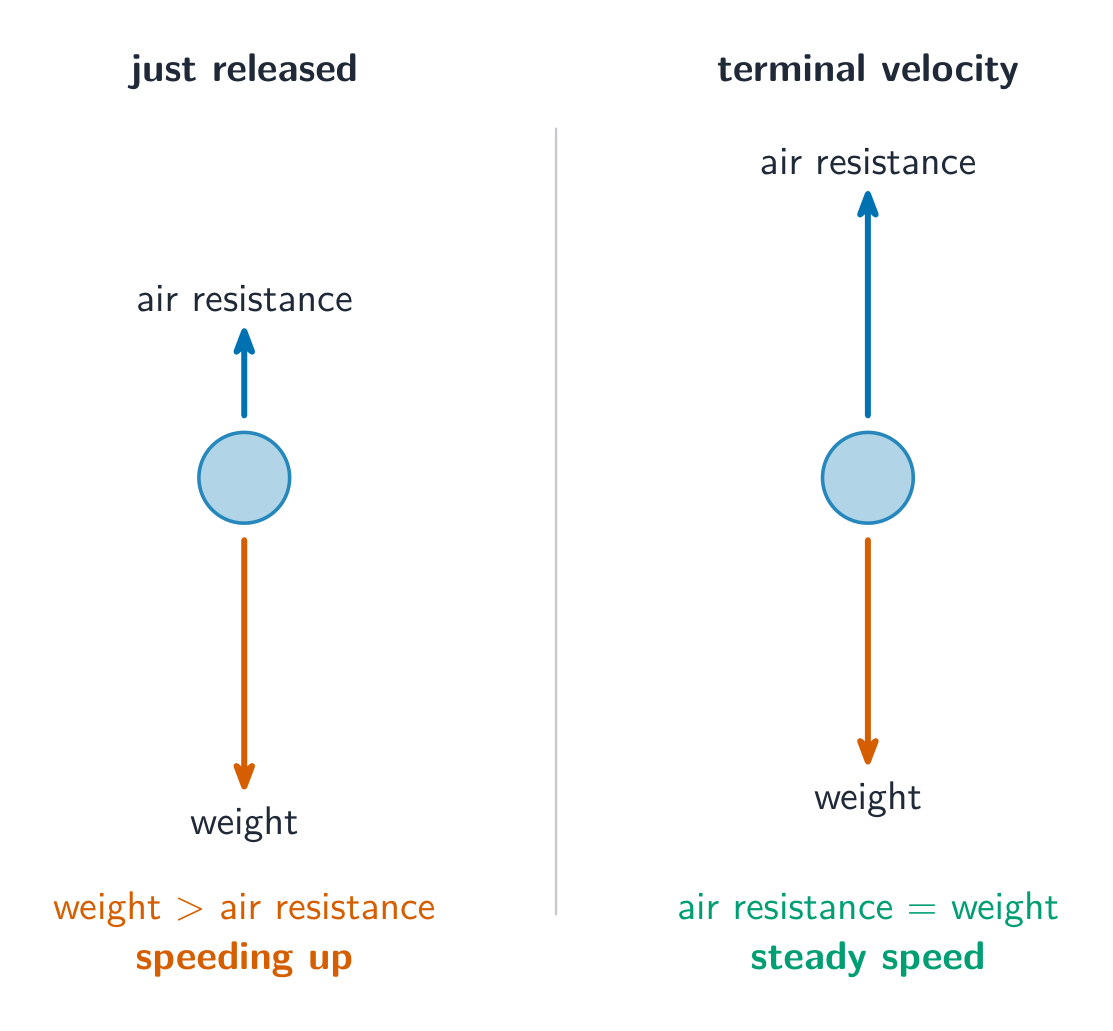
Un objeto en caída acelera hasta que la resistencia del aire aumenta para igualar su peso
Floating and density · Flotación y densidad
Change the object's density and the liquid: it floats if it's less dense, and the denser it is the more sits underwater. Iron sinks in water but floats on mercury. · Cambie la densidad del objeto y el líquido: flota si es menos denso, y cuanto más denso es, más se hunde bajo el agua. El hierro se hunde en agua pero flota sobre mercurio.
An astronaut travels from Earth to the Moon. What happens to their mass · masa and · y weight · peso? · Un astronauta viaja de la Tierra a la Luna. ¿Qué sucede con su masa y su peso?
Mass (amount of matter) never changes. Weight is the force of gravity, and the Moon's gravity is weaker, so the weight is smaller. · La masa (cantidad de materia) nunca cambia. El peso es la fuerza de gravedad, y la gravedad de la Luna es más débil, por lo que el peso es menor.
A bag has a mass of $5.0\ \text{kg}$. What is its weight on Earth, in N? (Use $g = 9.8\ \text{N/kg}$.) · Una bolsa tiene una masa de $5.0\ \text{kg}$. ¿Cuál es su peso en la Tierra, en N? (Use $g = 9.8\ \text{N/kg}$.)
$W = mg = 5.0 \times 9.8 = 49\ \text{N}$.
Density
- Density is the mass packed into each unit of volume:
- The symbol $\rho$ is the Greek letter "rho". The unit is $\text{kg/m}^3$ or $\text{g/cm}^3$.
- To measure it: find the mass with a balance, find the volume, then divide.
- Regular solid (a box): measure the sides and calculate the volume.
- Irregular solid (a stone): lower it into water in a measuring cylinder — the rise in water level is its volume (the displacement 排水法 method).
Densidad
- La densidad es la masa empaquetada en cada unidad de volumen:
- El símbolo $\rho$ es la letra griega "rho". La unidad es $\text{kg/m}^3$ o $\text{g/cm}^3$.
- Para medirla: encuentra la masa con una balanza, encuentra el volumen, luego divide.
- Sólido regular (una caja): mide los lados y calcula el volumen.
- Sólido irregular (una piedra): sumérgelo en agua dentro de un cilindro graduado — el ascenso del nivel del agua es su volumen (el método de desplazamiento 排水法).
A metal block has a mass of $240\ \text{g}$ and a volume of $30\ \text{cm}^3$. What is its density, in g/cm³? · Un bloque de metal tiene una masa de $240\ \text{g}$ y un volumen de $30\ \text{cm}^3$. ¿Cuál es su densidad, en g/cm³?
$\rho = \dfrac{m}{V} = \dfrac{240}{30} = 8.0\ \text{g/cm}^3$.
How do you find the volume of a small, oddly-shaped stone? · ¿Cómo encuentra el volumen de una piedra pequeña e irregular?
The stone pushes the water up. The rise in the water level equals the stone's volume — the displacement method. · La piedra empuja el agua hacia arriba. El ascenso del nivel del agua equivale al volumen de la piedra — el método de desplazamiento.
Water in a measuring cylinder reads $50\ \text{cm}^3$. After a stone is added it reads $74\ \text{cm}^3$. What is the volume of the stone, in cm³? · El agua en un cilindro graduado marca $50\ \text{cm}^3$. Después de añadir una piedra, marca $74\ \text{cm}^3$. ¿Cuál es el volumen de la piedra, en cm³?
The volume is the rise in level: $74 - 50 = 24\ \text{cm}^3$. · El volumen es el ascenso del nivel: $74 - 50 = 24\ \text{cm}^3$.
Floating and sinking
- An object floats if its density is less than the density of the liquid.
- It sinks if its density is greater.
- Ice floats on water because ice is slightly less dense than water.
Flotar y hundirse
- Un objeto flota si su densidad es menor que la densidad del líquido.
- Se hunde si su densidad es mayor.
- El hielo flota sobre el agua porque el hielo es ligeramente menos denso que el agua.
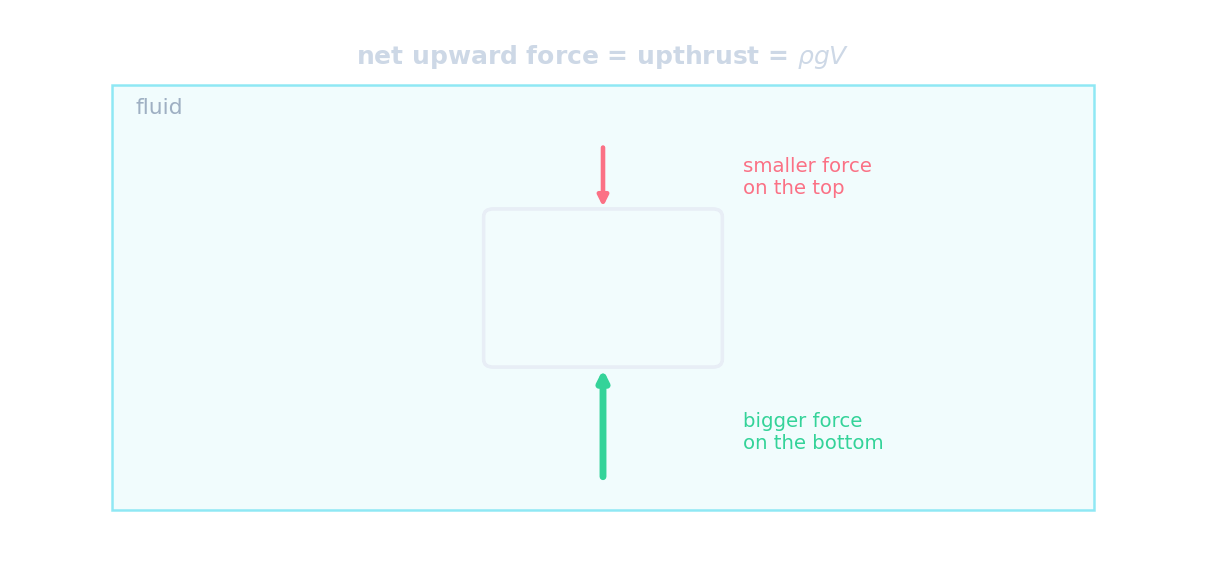
An object floats on a liquid if its density is less than the density of the liquid. · Un objeto flota sobre un líquido si su densidad es menor que la densidad del líquido.
Less dense than the liquid → it floats; denser than the liquid → it sinks. · Menos denso que el líquido → flota; más denso que el líquido → se hunde.
You've got it
- mass = amount of matter (kg), never changes; weight = force of gravity (N), $W = mg$
- $g = \dfrac{W}{m} \approx 9.8\ \text{N/kg}$ on Earth
- density $\rho = \dfrac{m}{V}$; find an odd shape's volume by displacement
- floats if its density is less than the liquid's
Lo has entendido
- masa = cantidad de materia (kg), nunca cambia; peso = fuerza de gravedad (N), $W = mg$
- $g = \dfrac{W}{m} \approx 9.8\ \text{N/kg}$ en la Tierra
- densidad $\rho = \dfrac{m}{V}$; encuentra el volumen de una forma irregular mediante desplazamiento
- flota si su densidad es menor que la del líquido