Constructions, nets and solids · Construcciones, redes y sólidos
| English | Español |
|---|---|
| edge/edʒ/ | arista |
| scale drawing/skeɪl ˈdrɔːɪŋ/ | dibujo a escala |
| net/net/ | neta |
| face/feɪs/ | cara |
| prism/ˈprɪzəm/ | prisma |
| pyramid/ˈpɪrəmɪd/ | pirámide |
Building with ruler and compasses
- Ancient Greek geometers built every shape using just a straight edge 棱 and compasses — no rulers with markings, no protractors.
- Today, construction questions test whether you can use these tools precisely and leave your working visible.
Construcción con regla y compás
- Los antiguos geómetras griegos construyeron cada figura usando solo regla y compás — sin reglas con marcas ni transportadores.
- Hoy en día, los ejercicios de construcción ponen a prueba si sabes usar estas herramientas con precisión y dejar tu proceso visible.
Construction and solid lab · Laboratorio de construcción y sólidos
Classify geometry tasks by the tool or representation needed.
Constructing triangles
- To construct a triangle from three sides:
- 1. Draw the base with a ruler.
- 2. Set compasses to the second side length and swing an arc from one end.
- 3. Set compasses to the third side and swing from the other end.
- 4. The intersection is the third vertex. Leave the arcs showing.
Don't erase the arcs. The examiner needs to see your construction arcs to award marks. They prove you used compasses, not guesswork.
Construcción de triángulos
- Para construir un triángulo a partir de tres lados:
- 1. Dibuja la base con una regla.
- 2. Ajusta el compás a la longitud del segundo lado y traza un arco desde uno de los extremos.
- 3. Ajusta el compás a la longitud del tercer lado y traza un arco desde el otro extremo.
- 4. La intersección es el tercer vértice. Deja los arcos visibles.
No borres los arcos. El examinador necesita ver tus arcos de construcción para otorgar puntos. Demuestran que usaste compases y no que te basaste en suposiciones.
To construct a triangle from three given sides you mainly use a ruler and:
Compasses swing arcs of the correct length for the other two sides.
You should erase your construction arcs to keep the drawing neat.
Leave construction arcs visible — the examiner needs to see them to award marks.
Scale drawings 比例图
- A scale drawing represents a real object at a fixed ratio (e.g. $1\text{ cm}:5\text{ m}$).
- Measure on the drawing, then multiply by the scale factor to get the real measurement.
Scale $1:200$. A room measures $3.5\text{ cm}$ on the plan. Real length $= 3.5 \times 200 = 700\text{ cm} = 7\text{ m}$.
Dibujos a escala
- Un dibujo a escala representa un objeto real en una proporción fija (p. ej., $1\text{ cm}:5\text{ m}$).
- Mide sobre el dibujo y luego multiplica por el factor de escala para obtener la medida real.
Escala $1:200$. Una habitación mide $3.5\text{ cm}$ en el plano. Longitud real $= 3.5 \times 200 = 700\text{ cm} = 7\text{ m}$.
A scale drawing uses 1:200. A room measures 3.5 cm on the plan. What is the real length in metres?
3.5 × 200 = 700 cm = 7 m.
Nets 展开图 and solids
- A net is a flat shape that folds up into a 3D solid — handy for surface area.
- Face 面: a flat side. Edge: where two faces meet. Vertex: a corner.
- A cube has $6$ faces, $12$ edges, and $8$ vertices.
Desplegados y sólidos
- Una plantilla es una figura plana que se pliega para formar un sólido 3D — útil para calcular el área superficial.
- Cara: una cara plana. Arista: donde se encuentran dos caras. Vértice: una esquina.
- Un cubo tiene $6$ caras, $12$ aristas y $8$ vértices.
A flat shape that folds up into a solid is called a ______.
A net is the unfolded, flat version of a solid.
How many faces does a cube have?
A cube has 6 square faces (12 edges, 8 vertices).
How many edges does a cube have?
A cube has 12 edges (where two faces meet).
Naming solids
| Solid | Key property |
|---|---|
| cube / cuboid | box shapes (all flat faces) |
| prism 棱柱 | same cross-section all along |
| cylinder | circular prism |
| pyramid 棱锥 | comes to a point (apex) |
| cone | circular pyramid |
| sphere | perfectly round |
Coordinate grids help with accurate constructions — shapes can be placed, measured, and transformed precisely.
Nomenclatura de sólidos
| Sólido | Propiedad clave |
|---|---|
| cubo / prisma rectangular | formas de caja (todas sus caras son planas) |
| prisma | sección transversal idéntica a lo largo de todo su cuerpo |
| cilindro | prisma circular |
| pirámide | converge hacia un punto (vértice o ápice) |
| cono | pirámide circular |
| esfera | perfectamente redonda |
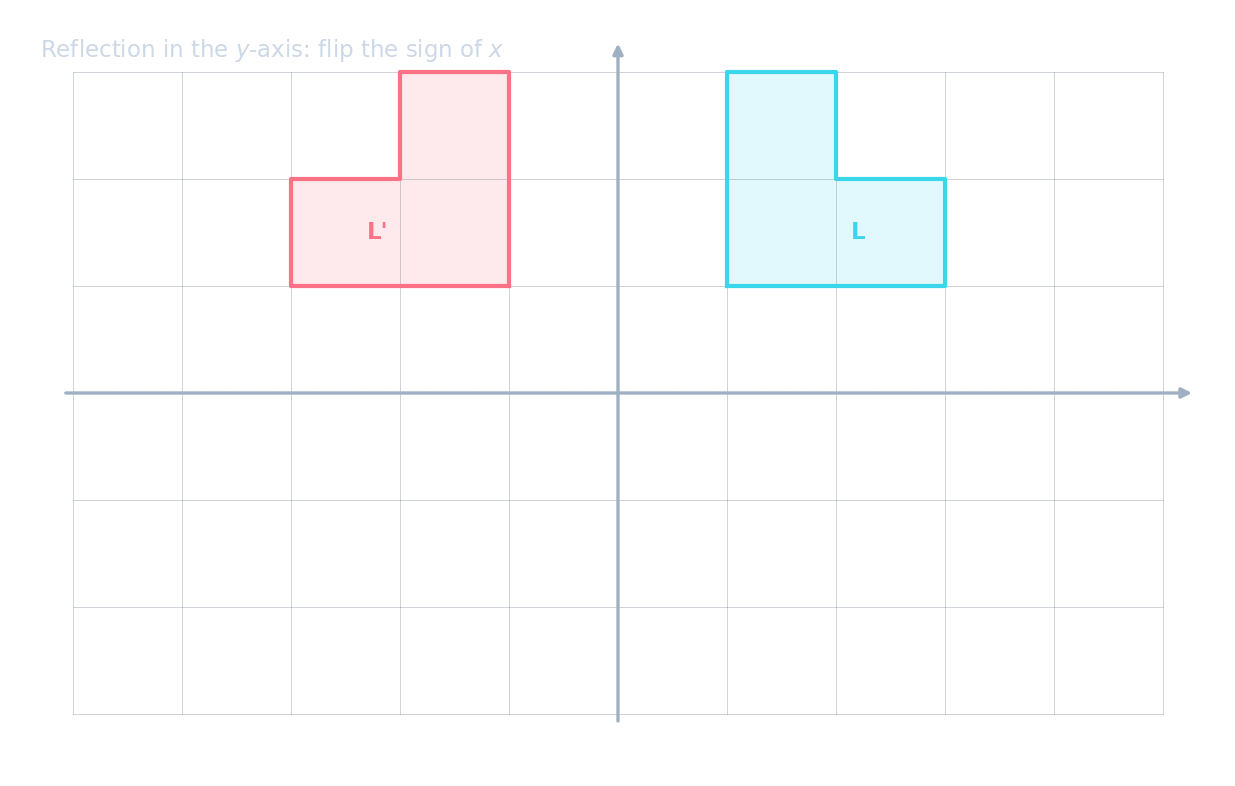
Las cuadrículas de coordenadas facilitan construcciones precisas: las figuras pueden colocarse, medirse y transformarse con exactitud.
Use a net to calculate
- A $3\times2\times1$ cm cuboid needs two faces of each size $3\times2$, $3\times1$, $2\times1$. Surface area $S=2(6+3+2)=22\text{ cm}^2$; volume $V=3(2)(1)=6\text{ cm}^3$.
- A triangular prism net has two identical triangles and three rectangles. Their widths match the three triangle sides, and each rectangle length matches the prism length.
Usar un desplegado para calcular
- Un prisma rectangular de $3\times2\times1$ cm necesita dos caras de cada tamaño $3\times2$, $3\times1$, $2\times1$. Área superficial $S=2(6+3+2)=22\text{ cm}^2$; volumen $V=3(2)(1)=6\text{ cm}^3$.
- Un desplegado de prisma triangular tiene dos triángulos idénticos y tres rectángulos. Sus anchuras coinciden con los tres lados del triángulo, y la longitud de cada rectángulo coincide con la longitud del prisma.
A cuboid is 3 cm by 2 cm by 1 cm. Find its surface area in cm².
There are two faces of each size: 2(6+3+2) = 22 cm².
A rhombus from two triangles
- Draw a 6 cm diagonal AB. Draw 5 cm radius arcs from A and B above and below it, meeting at C and D. Join A-C-B-D-A: all four edges are 5 cm, so the shape is a rhombus. Keep the arcs.
- For a square-based pyramid net, draw a square with one triangle attached to each edge. A base of side 4 cm and face height 3 cm has $S=b^2+4(bh/2)=16+24=40\text{ cm}^2$. Current Core and Extended construction outcomes do not require bisector constructions.
Un rombo formado por dos triángulos
- Dibuja una diagonal AB de 6 cm. Traza arcos con radio de 5 cm desde A y B, tanto arriba como abajo de la línea, que se crucen en C y D. Une los puntos A-C-B-D-A: los cuatro lados miden 5 cm, por lo que la figura es un rombo. Conserva los arcos.
- Para el desarrollo plano de una pirámide de base cuadrada, dibuja un cuadrado con un triángulo adjunto a cada lado. Una base de lado 4 cm y altura lateral de 3 cm tiene $S=b^2+4(bh/2)=16+24=40\text{ cm}^2$. Los resultados actuales de construcción del programa Core y Extended no requieren trazados de bisectrices.
You've got it
- construct with ruler + compasses; leave the construction arcs
- a net folds into a solid (good for surface area)
- a cube: $6$ faces, $12$ edges, $8$ vertices
Lo has entendido
- construir con regla y compás; dejar los arcos de construcción visibles
- una plantilla se pliega formando un sólido (ideal para áreas superficiales)
- un cubo: $6$ caras, $12$ aristas, $8$ vértices