Common text types
Introducido| English | Significado |
|---|---|
| text type/tekst taɪp/ | The kind of writing required, such as a letter, a report, or an article. |
| purpose/ˈpɜːpəs/ | The aim or intended result of an action or communication. |
| audience/ˈɔːdɪəns/ | the people a text is written for |
| formality/fɔːˈmælɪti/ | The degree to which language follows the conventions of a formal rather than casual situation. |
One message, three scripts, 196 BC
- The Rosetta Stone carries a decree from 196 BC about the Egyptian king Ptolemy V. The same message was carved three times: in hieroglyphs for priests, in Demotic for everyday Egyptian use, and in ancient Greek for the government. Each version had a different reader.
- Writing still changes with its reader. Each text type 文本类型 — email, letter, report, article, review — has a purpose 目的, an audience 读者 and a usual level of formality 正式程度.
Which text type is this?
Reader plus tone identifies the text type from a single line.
Why was the Rosetta Stone's message carved in three scripts?
Dificultad 1/5 · 100 monedas + un pequeño bono en el primer intento de hoy
Priests, everyday use and the government.
Purpose and reader
- Ask: who will read this, and why am I writing? To inform, persuade, describe, complain or entertain?
- The answers decide your tone and layout.
Which questions should you ask before writing?
Dificultad 2/5 · 140 monedas + un pequeño bono en el primer intento de hoy
They decide tone and layout.
The formality line
- Informal: email to a friend. Neutral: school magazine article, review. Formal: report, letter to an official.
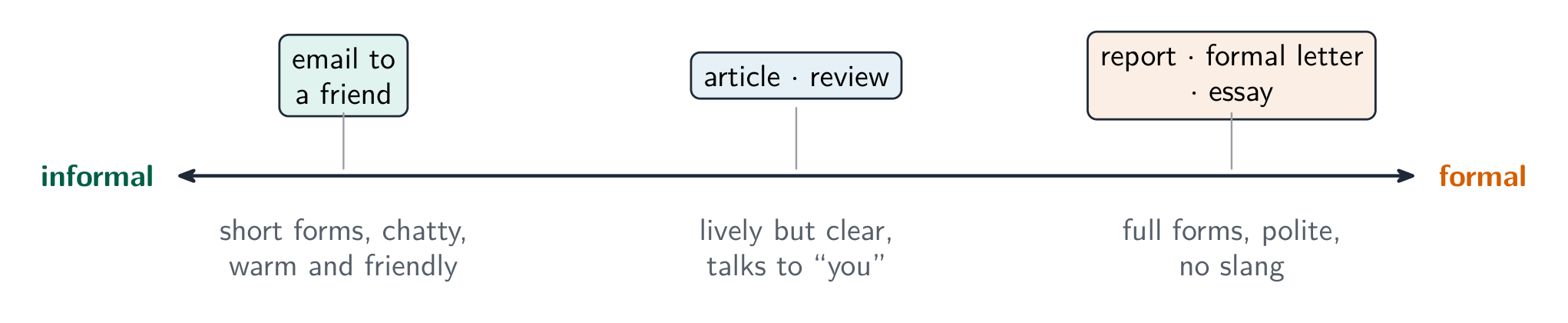
Match each text to its formality.
Dificultad 2/5 · 140 monedas + un pequeño bono en el primer intento de hoy
The formality line.
Match style to type
- Email/letter: greeting and ending. Report: headings, facts, recommendations. Article: headline and hook. Review: description, judgement, recommendation.
- Use the features the examiner expects.
Which features belong to a report?
Dificultad 1/5 · 100 monedas + un pequeño bono en el primer intento de hoy
Use the expected features.
Worked example: one event, three texts
Event: your school's sports day.
- Email to a friend: "Guess what? I won the 400 metres! My legs are still shaking."
- Report for the head teacher: "Introduction: This report evaluates the sports day held on 14 May. Findings: 85 per cent of students took part."
- Magazine article: "Sweat, cheers and one very muddy relay — sports day was back, and better than ever."
Which sports-day line is from the report?
Dificultad 1/5 · 100 monedas + un pequeño bono en el primer intento de hoy
Facts in a neutral tone.
Read the task carefully
- The task names the text type and reader: "Write a report for your principal..." Underline both before you plan.
You should underline the text type and reader in the task.
Dificultad 1/5 · 100 monedas + un pequeño bono en el primer intento de hoy
Before you plan.
Do not use the same style for every task. An article written like a formal letter, or a report like a chatty email, loses marks for register.
The same style suits every writing task.
Dificultad 1/5 · 100 monedas + un pequeño bono en el primer intento de hoy
Register must fit the type.
Each text type has a purpose, audience and formality. Underline the type and reader in the task, place the text on the formality line, and use the features expected for that type.
Write one opening sentence for each: an email to a friend, a report and an article, all about a new school library.
Type, reader, style.