Structure: introduction, body and conclusion
Introducido| English | Significado |
|---|---|
| essay/ˈeseɪ/ | A structured piece of writing that develops a position or argument about a topic. |
| introduction/ˌɪntrəˈdʌkʃn/ | The opening part of a text that establishes its subject, purpose or context. |
| body paragraph | a paragraph in the main part of an essay that develops one idea with reasons and an example |
| conclusion/kənˈkluːʒn/ | A judgement or statement drawn from evidence, results or reasoning. |
The first "essays", 1580
- In 1580 the French writer Michel de Montaigne published a book called Essais. The French word means "attempts" or "tries". In each short piece he tested an idea — about friendship, fear or education — by giving his reasons and examples from life.
- An essay 议论文 still does that. It has an introduction 引言, body paragraphs 主体段落 and a conclusion 结论.
The essay staircase
Introduction, one idea per body paragraph, the other side answered, then a conclusion that adds nothing new.
What does the French word "essais" mean?
Dificultad 1/5 · 100 monedas + un pequeño bono en el primer intento de hoy
Montaigne tested ideas.
Introduction
- Introduce the topic and give your main opinion in one clear sentence.
- Keep it short: two or three sentences.
What should the introduction include?
Dificultad 1/5 · 100 monedas + un pequeño bono en el primer intento de hoy
Keep it short.
Body paragraphs
- Each body paragraph: one idea, then reasons, then an example.
- Use a new paragraph for the other side of the argument if the task asks for both views.
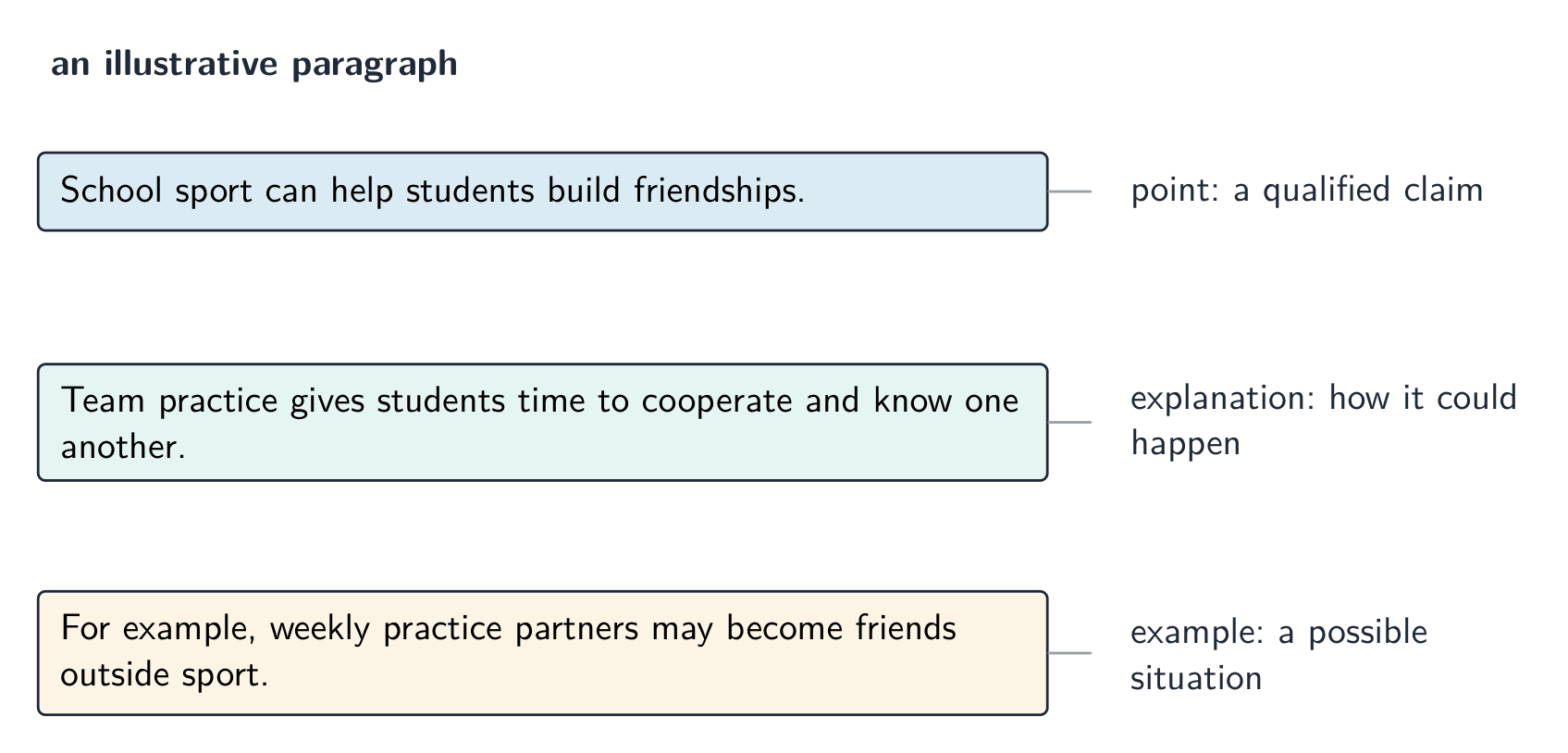
What does each body paragraph contain?
Dificultad 2/5 · 140 monedas + un pequeño bono en el primer intento de hoy
Idea, reasons, example.
Conclusion
- Sum up your main view in fresh words and end with a final thought or suggestion.
- Do not add a new argument at the end.
You should add a new argument in the conclusion.
Dificultad 1/5 · 100 monedas + un pequeño bono en el primer intento de hoy
Sum up in fresh words.
Worked example: is homework useful?
- Introduction: "Most students groan at homework, but I believe a small amount each day helps us learn."
- Body paragraph: "Firstly, homework helps us remember lessons. When we practise a skill at home, it stays in our memory longer. For example, after doing ten maths problems at home, I solved similar questions easily in the test."
- Conclusion: "Overall, short daily homework is useful. Schools should keep it, but limit it to one hour a night."
What example supports "homework helps us remember lessons"?
Dificultad 1/5 · 100 monedas + un pequeño bono en el primer intento de hoy
A specific example.
Both sides
- Many tasks ask Do you agree? Show that you know the other view: "Some people say homework causes stress. However..."
- Then explain why your view is stronger.
Mentioning the other view can make your argument stronger.
Dificultad 1/5 · 100 monedas + un pequeño bono en el primer intento de hoy
Then explain why your view is stronger.
Do not give a list of ideas without reasons. "Homework is good. It helps. Teachers like it." gives no reasons or examples. Develop each idea.
"Homework is good. It helps. Teachers like it." is a well-developed paragraph.
Dificultad 1/5 · 100 monedas + un pequeño bono en el primer intento de hoy
No reasons or examples.
An essay states a clear view in the introduction, develops one idea per body paragraph with reasons and an example, deals with the other side, and ends with a conclusion that sums up and adds no new argument.
Write one body paragraph for: "Mobile phones should be banned in schools. Do you agree?"
Idea, reason, example.