Firms and production
Introducido| English | Significado |
|---|---|
| productivity/ˌprɒdəkˈtɪvɪti/ | productividad |
| production/prəˈdʌkʃn/ | producción |
| training/ˈtreɪnɪŋ/ | capacitación |
| labour-intensive/ˈleɪbə ɪnˈtensɪv/ | intensivo en mano de obra |
| capital-intensive/ˈkæpɪtl ɪnˈtensɪv/ | intensivo en capital |
| technology/tekˈnɒlədʒi/ | tecnología |
| average cost/ˈævrɪdʒ kɒst/ | costo promedio |
| competitiveness/kəmˈpetɪtɪvnəs/ | competitividad |
Forty-eight thousand pins a day, 1776
- In The Wealth of Nations (1776), Adam Smith described a small pin factory. Working alone, one untrained worker could hardly make 20 pins a day. In the factory, ten workers split the work into about 18 separate tasks — drawing the wire, straightening, cutting, sharpening — and together made about 48,000 pins a day.
- Smith was describing a rise in productivity 生产率: output per worker. Production 生产 is the process of turning resources into goods and services.
Factors of production lab
Sort real resources by the factor of production they represent.
Ten workers make 48,000 pins a day. How many pins is that per worker?
Dificultad 2/5 · 140 monedas + un pequeño bono en el primer intento de hoy
48,000 ÷ 10.
Division of labour
- Each worker specialises in one task, becomes faster and needs less training, and less time is lost moving between jobs.
- Drawbacks: boring, repetitive work, and production stops if one stage breaks down.
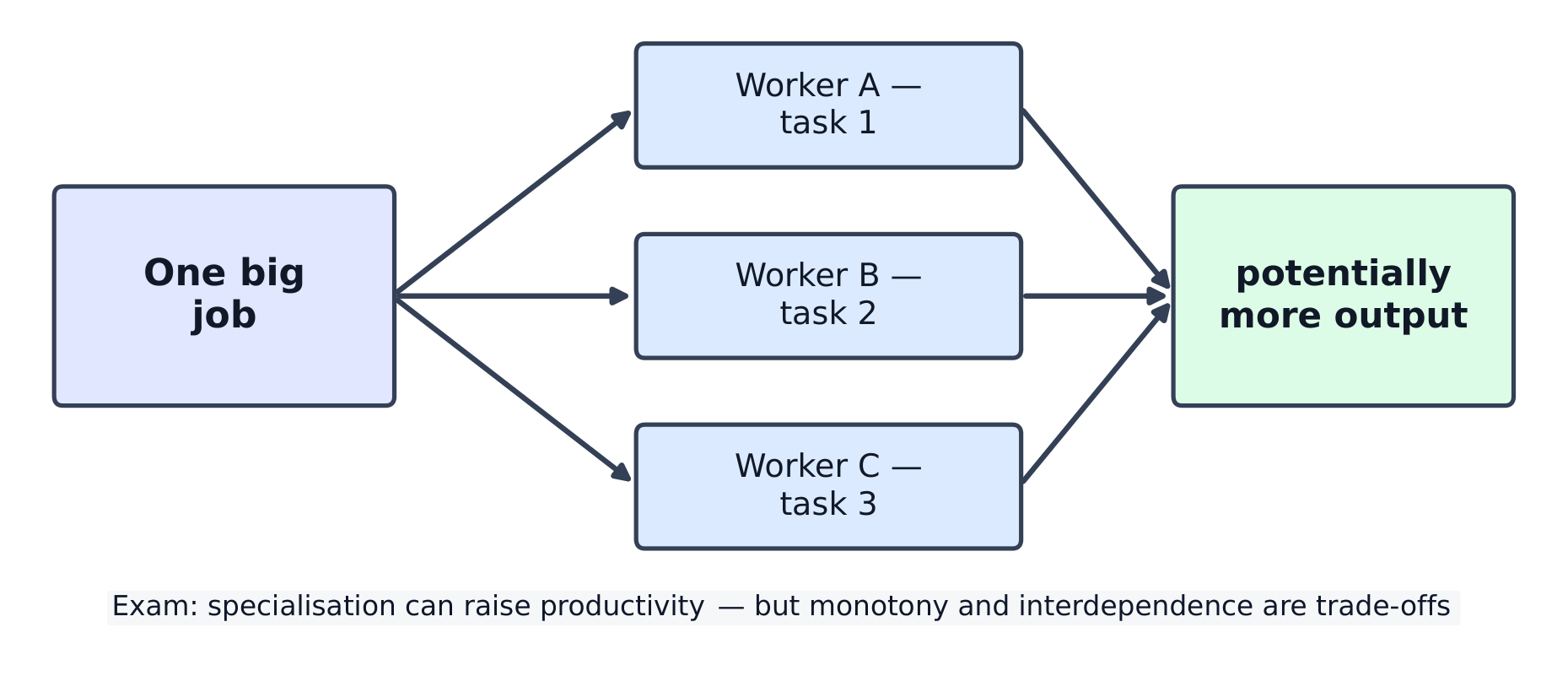
Which are advantages of the division of labour?
Dificultad 2/5 · 140 monedas + un pequeño bono en el primer intento de hoy
Variety falls.
Labour-intensive and capital-intensive
- Labour-intensive 劳动密集型 production uses a lot of labour compared with capital: hand-picking tea, hairdressing.
- Capital-intensive 资本密集型 production uses a lot of machinery: car factories, oil refineries. The choice depends on the relative cost of labour and capital.
Match each example to its type of production.
Dificultad 2/5 · 140 monedas + un pequeño bono en el primer intento de hoy
Labour or machinery.
Raising productivity
- Training 培训 makes workers more skilled; better technology 技术 lets each worker produce more; good management and motivation reduce wasted time.
- Higher productivity can lower average cost 平均成本 (total cost ÷ output).
Which raises labour productivity?
Dificultad 1/5 · 100 monedas + un pequeño bono en el primer intento de hoy
More skilled workers.
Worked example: productivity and average cost
A workshop has 4 workers producing 200 chairs a week. Total weekly cost is $8,000. After training, the same 4 workers make 250 chairs; total cost rises to$8,500.
- Productivity: before $200 \div 4 = 50$ chairs per worker; after $250 \div 4 = 62.5$.
- Average cost: before $8{,}000 \div 200 = \$40$; after $8{,}500 \div 250 = \$34$.
- Result: the firm can cut prices or earn more profit on each chair.
Total cost $6,000 for 300 units. What is the average cost per unit, in dollars?
Dificultad 2/5 · 140 monedas + un pequeño bono en el primer intento de hoy
6,000 ÷ 300.
Why productivity matters
- Lower average costs improve competitiveness 竞争力: the firm can sell at lower prices than rivals, at home and abroad.
- For a country, higher productivity allows higher wages and living standards.
Lower average cost can make a firm more competitive.
Dificultad 1/5 · 100 monedas + un pequeño bono en el primer intento de hoy
It can charge lower prices.
Productivity is not the same as total output. Hiring twice as many workers may double output, but productivity (output per worker) stays the same.
Doubling the workforce and doubling output raises productivity.
Dificultad 1/5 · 100 monedas + un pequeño bono en el primer intento de hoy
Output per worker is unchanged.
Productivity is output per worker. Division of labour, training, technology and better management raise it; firms choose labour- or capital-intensive production by cost. Higher productivity lowers average cost and improves competitiveness.
A clothing firm in a country with low wages is deciding between labour-intensive and capital-intensive production. Advise it.
Choosing a production method.