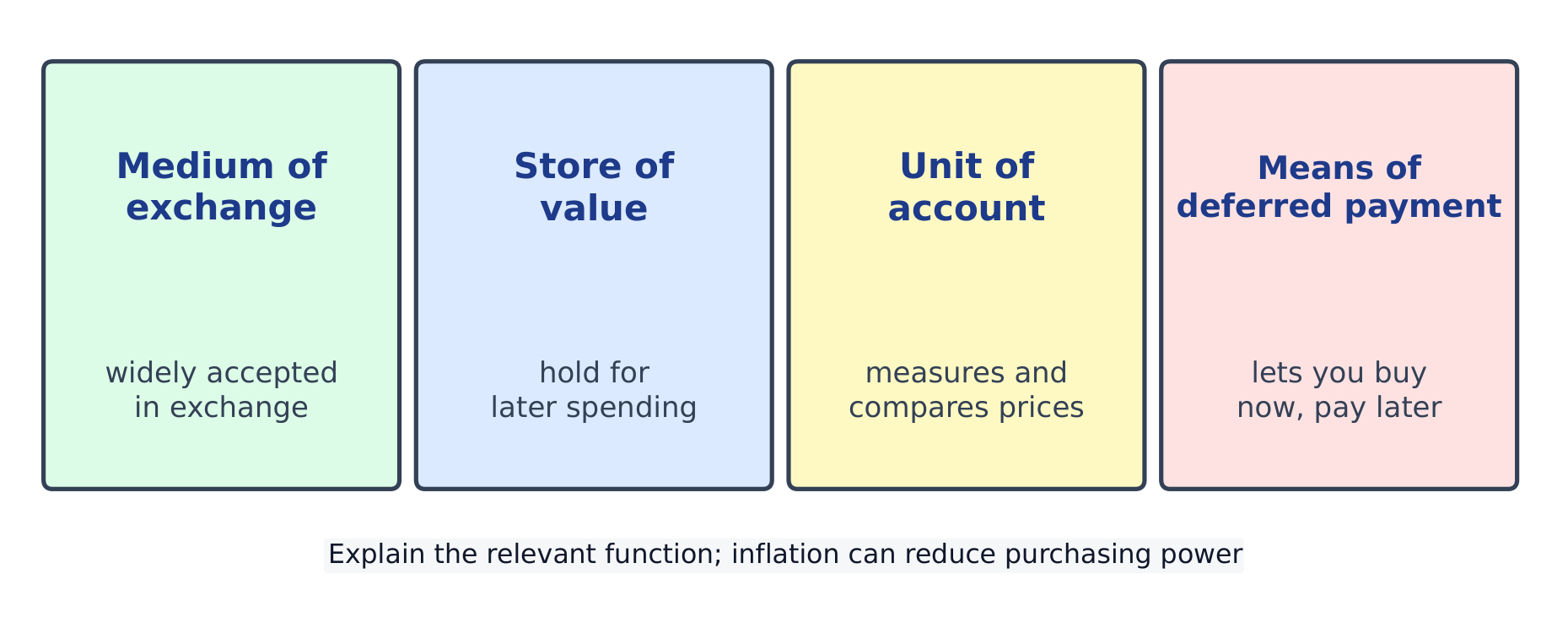
- state the functions of money (medium of exchange, store of value, unit of account, means of deferred payment) and the characteristics of money
- explain the role of central banks and commercial banks
Microeconomic decision-makers
IGCSE Economics · Topic 3
 12:41
12:41
Microeconomic Decision-Makers
You have a fish. You want a pair of shoes. Long ago that meant barter — swapping goods directly. And to do it, you need to find someone who has shoes, and who…
English narration · English + 中文 subtitles burned in
3.1
Money and banking
Syllabus
Source: Cambridge International syllabus
Long ago, people swapped goods directly. This is called barter 物物交换. Barter is hard: you must find someone who has what you want and wants what you have. Money 货币 solves this problem.
The functions of money
Money does four jobs:
- a medium of exchange 交换媒介 — you swap money for goods, so you do not need barter.
- a store of value 价值储藏 — you can hold money now and spend it later, although inflation may reduce what it can buy.
- a unit of account 记账单位 — money measures and compares the value of things (this is the price).
- a means of deferred payment 延期支付手段 — you can buy now and pay later.

The characteristics of money
Good money must be:
- durable 耐用的 — it lasts a long time.
- portable 便于携带的 — easy to carry.
- divisible 可分割的 — can be split into small amounts for small payments.
- limited in supply, hard to copy, and widely accepted for payment.
Banks
- A central bank 中央银行 is the government's bank. Its roles include issuing currency, serving government and banks, and managing monetary policy. Its policy decisions can influence interest rates 利率; it does not set every bank loan rate.
- commercial banks 商业银行 are the ordinary banks that people and firms 企业 use. They take deposits, lend money, and arrange payments. Deposits are not a promise that money keeps its purchasing power.
Explore
Economics case lab
Classify real examples by the economic idea they show.
Vocabulary
Train
| English |
|---|
| barter/ˈbɑːtə/ |
| money/ˈmʌni/ |
| medium of exchange/ˈmiːdɪəm ɒv eksˈtʃeɪndʒ/ |
| store of value/stɔː ɒv ˈvæljuː/ |
| unit of account/ˈjuːnɪt ɒv əˈkaʊnt/ |
| means of deferred payment/miːnz ɒv dɪˈfɜːd ˈpeɪmənt/ |
| durable/ˈdjʊərəbl/ |
| portable/ˈpɔːtəbl/ |
| divisible/dɪˈvɪzɪbl/ |
| central bank/ˈsentrəl bæŋk/ |
| interest rate/ˈɪntrest reɪt/ |
| commercial banks/kəˈmɜːʃl bæŋks/ |
| firms/fɜːmz/ |
3.2
Households

Syllabus
- explain the influences on spending, saving and borrowing by households (income, interest rates, confidence)
Source: Cambridge International syllabus
A household 家庭 is a person or group living together and making money decisions. Each household must choose how much to spend, save, and borrow.
- saving 储蓄 is income that is not spent now.
- borrowing 借贷 is spending money you do not have yet, and paying it back later (usually with an extra charge).
Three main things change these choices:
- income 收入 — more income can allow more spending and saving; debts and household needs also matter.
- interest rates — a higher interest rate makes saving more rewarding and borrowing dearer. This tends to encourage saving and discourage borrowing, other things unchanged. A household with little spare income may still be unable to save.
- confidence 信心 — if people feel sure about their jobs and the future, they may spend and borrow more. Worry may encourage saving, if they can afford it.
Explore
Economics case lab
Classify real examples by the economic idea they show.
Vocabulary
Train
| English |
|---|
| household/ˈhaʊshəʊld/ |
| saving/ˈseɪvɪŋ/ |
| borrowing/ˈbɒrəʊɪŋ/ |
| income/ˈɪŋkʌm/ |
| confidence/ˈkɒnfɪdəns/ |
3.3
Workers
Syllabus
- explain the factors that determine an individual's choice of occupation (wage and non-wage factors)
- explain the reasons for differences in earnings (skills, qualifications, danger, trade unions, discrimination)
- explain division of labour/specialisation and its advantages and disadvantages
Source: Cambridge International syllabus
Choosing a job
When a worker chooses an occupation 职业 (a type of job), two kinds of factor matter:
- wage factors — the pay. The wage 工资 is the money you earn. Higher pay tends to attract workers, but conditions and access to training also matter.
- non-wage factors — everything else: working hours, holidays, how safe or pleasant the job is, whether you enjoy the work, distance from home, and the chance to move up to a higher job.
| Weekly job facts | A | B |
|---|---|---|
| Weekly hours | 40 | 40 |
| Wage | £400 | £440 |
| Travel cost | £20 | £60 |
| Journey each way | 10 minutes | 60 minutes |
| Hours | daytime | night shifts |
| Training | offered | none |
Original decision case. Is B necessarily better? Use the facts above.
Worked decision. Wage after travel = weekly wage − weekly travel cost. A: £400 − £20 = £380. B: £440 − £60 = £380. A offers shorter travel and training. B may suit someone who prefers nights; the decision depends on preferences, not gross pay alone.
Why workers earn different amounts
Workers are not all paid the same. The reasons include:
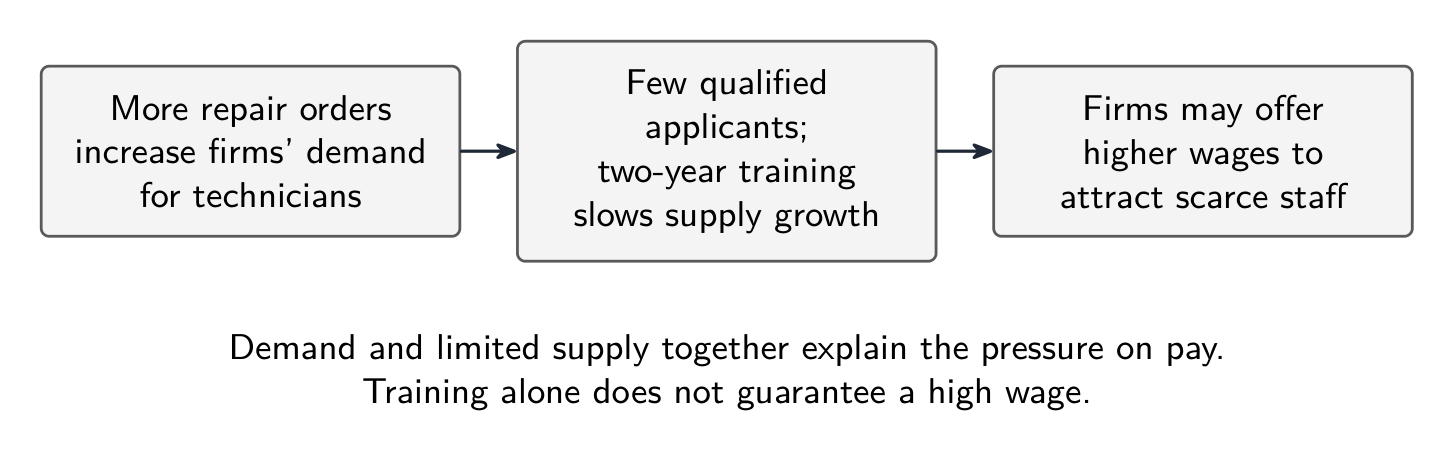
- skill 技能 and qualifications 资格 — scarce skills can restrict labour supply. If firms also demand those skills, pay may be higher. Years of study alone do not guarantee high pay.
- danger — risky or dirty jobs may pay more to attract workers.
- trade unions 工会 — a trade union is a group of workers who join together to bargain for better pay and conditions. Strong unions can raise pay.
- discrimination 歧视 — unfair treatment because of gender, race, or age can cause unfair pay gaps.
Original wage case. A town has few qualified repair technicians and many applicants for assistant jobs. Repair orders rise, but technician training takes two years. More orders increase firms' demand for technicians; slow supply expansion may encourage higher pay. This explains a possible difference without claiming every qualified worker earns more. Average revenue means revenue per unit sold, not per worker or a universal wage ceiling.
Division of labour
Division of labour 劳动分工 (also called specialisation 专业化) means splitting a job into small tasks, with each worker doing one task again and again.
Advantages: workers get faster and better at their one task; less time is wasted moving between tasks; this can raise productivity and output. If costs do not rise proportionately, unit cost falls.
Disadvantages: doing one task is boring, so workers may make mistakes or leave; if one worker is absent, the whole line can stop; each worker learns only one skill.
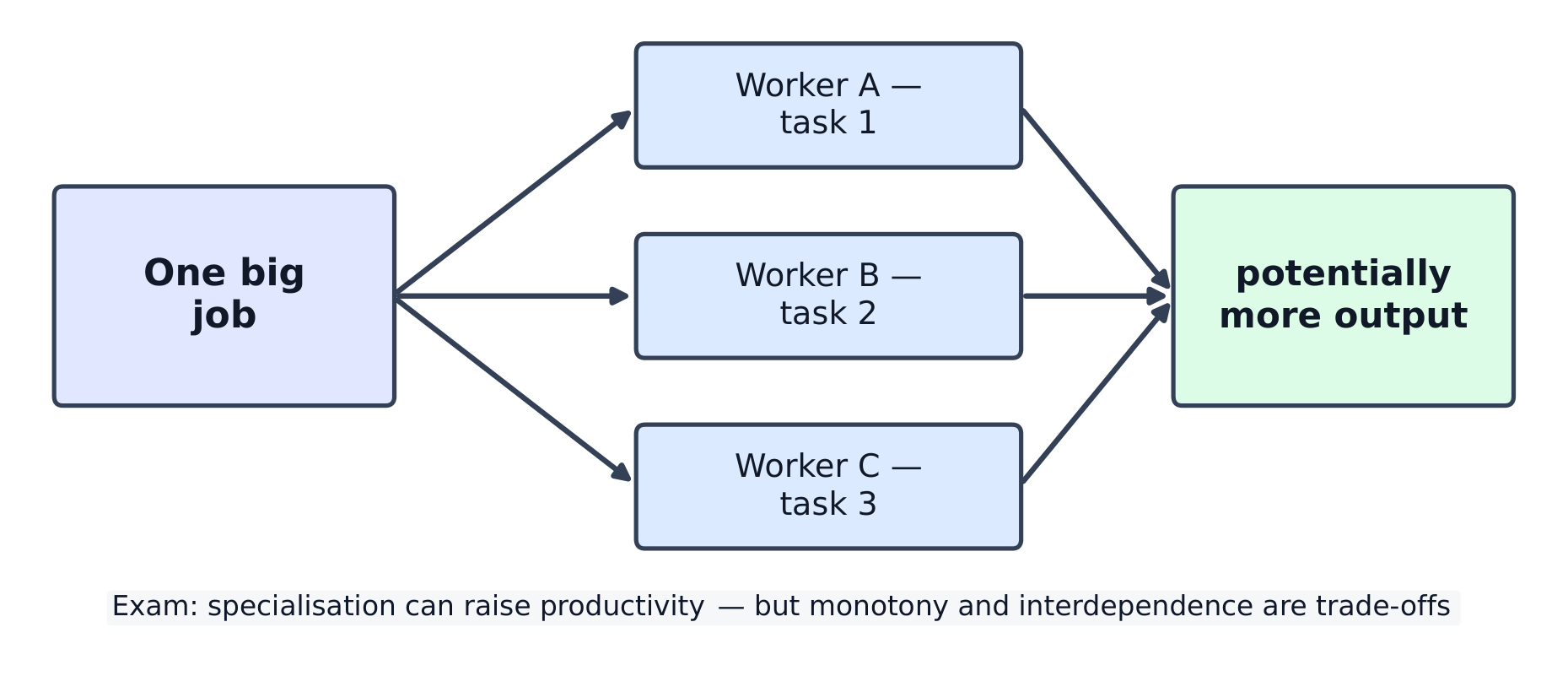
Original productivity case. The same three workers make 30 boxes in one hour before specialisation and 45 after. Other inputs are unchanged. Calculate productivity before and after.
Worked answer. Productivity = output ÷ (workers × hours). Before: 30 ÷ (3 × 1) = 10 boxes per worker per hour. After: 45 ÷ (3 × 1) = 15 boxes per worker per hour. Repetition can save switching time. If total hourly cost is unchanged, cost per box falls. An absent packer could stop completion of boxes.
Explore
Economics case lab
Classify real examples by the economic idea they show.
Vocabulary
Train
| English |
|---|
| occupation/ˌɒkjʊˈpeɪʃn/ |
| wage/weɪdʒ/ |
| skill/skɪl/ |
| qualifications/ˌkwɒlɪfɪˈkeɪʃnz/ |
| trade unions/treɪd ˈjuːnɪənz/ |
| discrimination/dɪˌskrɪmɪˈneɪʃn/ |
| division of labour/dɪˈvɪʒn ɒv ˈleɪbə/ |
| specialisation/ˌspeʃəlaɪˈzeɪʃn/ |
3.4
Firms

Syllabus
- classify firms by size and explain why some firms remain small and why/how firms grow (mergers: horizontal, vertical, conglomerate)
- explain the causes of business failure
Source: Cambridge International syllabus
The size of firms
Firms come in many sizes, from one person to huge companies. We can measure size by the number of workers, the amount of capital 资本 used, or the output.
Some firms stay small because: the market 市场 is small; the product is personal (like a hairdresser); the owner wants to stay in control; or there is little money to grow.
How firms grow
Firms grow by selling more, or by joining with other firms. When two firms join, it is a merger 合并. In a takeover, one firm gains control of another. There are three types:
- horizontal merger 横向合并 — two firms at the same stage of the same industry join (two car makers).
- vertical merger 纵向合并 — two firms at different stages of the same industry join (a car maker and a tyre maker). "Backward" is towards the supplier; "forward" is towards the seller.
- conglomerate merger 混合合并 — two firms in different industries join (a car maker and a food company).
Original classification case. A bakery joins another bakery, its flour mill, bread shops, or a clothing producer. Classify each and explain a possible benefit.
Worked answer. Another bakery is horizontal integration: bulk buying may lower cost, but rivalry falls. The flour mill is backward vertical integration: greater supply control, but milling needs different skills. Bread shops are forward vertical integration: control of outlets, with retail management costs. Clothing is conglomerate integration: spreading risk, with no guarantee either business succeeds.
Business failure
Original survival case. Monthly revenue is £4,000; costs are £4,500. Profit = TR − TC = £4,000 − £4,500 = −£500. Tomorrow a £2,000 bill is due, but cash available is £300 with no agreed loan. Payment shortfall = £2,000 − £300 = £1,700. A loss and a cash shortage are different threats to survival.
Firms can suffer business failure 企业倒闭 (closure) because of high costs, low sales, poor management, strong rivalry, insufficient cash or falling demand 需求.
Explore
Firm objective lab
Classify real firm decisions by the objective they reveal.
Vocabulary
Train
| English |
|---|
| capital/ˈkæpɪtl/ |
| market/ˈmɑːkɪt/ |
| merger/ˈmɜːdʒə/ |
| horizontal merger/ˌhɒrɪˈzɒntl ˈmɜːdʒə/ |
| vertical merger/ˈvɜːtɪkl ˈmɜːdʒə/ |
| conglomerate merger/kənˈɡlɒməreɪt ˈmɜːdʒə/ |
| business failure/ˈbɪznəs ˈfeɪlɪə/ |
| demand/dɪˈmænd/ |
3.5
Firms and production

Syllabus
- distinguish labour-intensive and capital-intensive production and explain productivity
- explain demand for and supply of factors of production and economies and diseconomies of scale
Source: Cambridge International syllabus
Labour-intensive and capital-intensive
- labour-intensive 劳动密集型 production uses relatively more labour 劳动 than capital equipment — for example, hand-made crafts.
- capital-intensive 资本密集型 production uses relatively more capital equipment than labour — for example, a modern car factory.
Original production choice. Method A makes 100 shirts daily with ten workers and simple tools. B makes the same quantity and quality with two operators and automated equipment. A uses relatively more labour; B uses relatively more capital. B may suit stable large orders and scarce labour. A may suit custom orders or limited finance. Compare equipment costs, wages, training, availability and flexibility; counting workers alone does not decide profit.
Productivity
Productivity 生产率 means output per worker (or per machine) in a set time. Higher productivity means more output per worker in the same time. Unit cost falls only if total cost does not rise proportionately. Training, better machines and management can improve productivity.
Demand for and supply of factors
Firms buy factors of production 生产要素 (land 土地, labour, capital, and enterprise 企业家才能). Factor prices and quantities are influenced by demand, supply, bargaining and policy. Product demand, factor prices, availability and productivity affect what firms use. For example, if many firms want skilled workers, their wages may rise if supply cannot expand enough.
Original factor choice. A shirt producer receives more orders. Trained workers are available, but new automated machines take six months to deliver and need costly installation. Hiring workers can expand output sooner; machinery may suit later, stable orders if its productivity justifies its cost. Higher wages alone do not make machinery available or worthwhile.
Economies and diseconomies of scale
As a firm grows and makes more, the cost of each unit can change:
- economies of scale 规模经济 — a larger scale of production lowers long-run average cost. Reasons: buying materials in bulk is cheaper, big machines work more efficiently, and large firms borrow money cheaply.
- diseconomies of scale 规模不经济 — a larger scale of production raises long-run average cost because coordination or other problems outweigh gains. Reasons: a huge firm is hard to manage, messages travel slowly, and workers may feel less important.
Original scale calculation. Compare long-run alternatives with all inputs adjustable. A small plant makes 1,000 units monthly at total cost £8,000; a larger plant makes 2,000 at £14,000. Average cost = TC ÷ output. Small: £8,000 ÷ 1,000 = £8 per unit. Large: £14,000 ÷ 2,000 = £7 per unit. Total cost rises, but average cost falls: economies of scale. Bulk discounts or specialised equipment could explain it. This differs from spreading unchanged rent over more output in an existing plant.

These can be internal (caused by the firm's own size) or external (caused by the whole industry growing).
Explore
Factors of production lab
Sort real resources by the factor of production they represent.
Vocabulary
Train
| English |
|---|
| labour-intensive/ˈleɪbə ɪnˈtensɪv/ |
| labour/ˈleɪbə/ |
| capital-intensive/ˈkæpɪtl ɪnˈtensɪv/ |
| productivity/ˌprɒdəkˈtɪvɪti/ |
| factors of production/ˈfæktəz ɒv prəˈdʌkʃn/ |
| land/lænd/ |
| enterprise/ˈentəpraɪz/ |
| economies of scale/ɪˈkɒnəmiz ɒv skeɪl/ |
| diseconomies of scale/ˌdɪsɪˈkɒnəmiz ɒv skeɪl/ |
3.6
Firms' costs, revenue and objectives

Syllabus
- define and calculate fixed, variable, total and average costs
- define and calculate total and average revenue
- explain the objectives of firms (profit, survival, growth, social objectives)
Source: Cambridge International syllabus
Costs
A cost 成本 is money a firm spends to produce. Costs split into:
- fixed costs 固定成本 — costs that do not change with output within a given period and range, such as rent and insurance. You pay them even if you make nothing.
- variable costs 可变成本 — costs that change with output, such as materials and production-related electricity. More output means more variable cost.
- total cost 总成本 — fixed cost plus variable cost.
- average cost 平均成本 — the cost of each unit: total cost divided by the number of units made.
Revenue
Revenue 收益 is the money a firm gets from selling its goods.
- total revenue 总收益 — the price multiplied by the quantity sold.
- average revenue 平均收益 — total revenue divided by the quantity sold (this is the same as the price).
Profit and other objectives
Profit 利润 is what is left after costs:
profit = total revenue − total cost
Worked example. A firm has fixed costs of £2,000 and variable costs of £3 per unit. It makes 500 units and sells them at £10 each. Find its total cost, total revenue, profit and average cost.
- variable cost = 3 × 500 = £1,500, so total cost = 2,000 + 1,500 = £3,500.
- total revenue = 10 × 500 = £5,000.
- profit = 5,000 - 3,500 = £1,500.
- average cost = total cost ÷ units = 3,500 ÷ 500 = £7 per unit.
The firm makes a profit because the price (£10) is above the average cost (£7).
Most firms want as much profit as possible. But firms can have other objectives 目标:
- survival 生存 — a new firm first just wants to stay open.
- growth 增长 — getting bigger, to gain economies of scale and market power.
- social objectives — some firms aim to help people or protect the environment, not only to earn profit.
Explore
A firm's cost curves
Change output and see how average cost falls then rises — and where marginal cost crosses it.
Vocabulary
Train
| English |
|---|
| cost/kɒst/ |
| fixed costs/fɪkst kɒsts/ |
| variable costs/ˈveərɪəbl kɒsts/ |
| total cost/ˈtəʊtl kɒst/ |
| average cost/ˈævrɪdʒ kɒst/ |
| revenue/ˈrevənjuː/ |
| total revenue/ˈtəʊtl ˈrevənjuː/ |
| average revenue/ˈævrɪdʒ ˈrevənjuː/ |
| profit/ˈprɒfɪt/ |
| objectives/ɒbˈdʒektɪvz/ |
| survival/səˈvaɪvl/ |
| growth/ɡrəʊθ/ |
3.7
Types of markets

Syllabus
- describe the characteristics of competitive markets and monopoly
- explain the advantages and disadvantages of competition for consumers and firms
Source: Cambridge International syllabus
Markets differ by how many firms there are and how hard it is for new firms to join.
Competitive markets
A competitive market has many firms selling similar goods, and it is easy for new firms to enter. This is strong competition 竞争. In such a market:
- buyers may switch suppliers, putting pressure on prices and quality.
- rivalry can encourage cost reduction and new products.
Consumers may gain lower prices, wider choice and better quality. These gains depend on information, switching costs and how strongly firms compete.

Original competition case. Shop A sells a loaf for £2; nearby B sells an equally fresh, equally sized loaf for £1.80. Customers know both prices and can switch easily. A may lose sales, encouraging a price cut, better quality or lower cost. This pressure is weaker if customers value differences or find switching difficult.
Monopoly
A monopoly 垄断 is a market with only one firm, or one firm that controls most of it. New firms find it hard to enter because of barriers to entry 进入壁垒 — for example, very high start-up costs, or the one firm controlling key supplies.
In a monopoly:
- limited alternatives can give the firm power to raise prices; demand and regulation still limit its decisions.
- there is little pressure to improve quality or cut costs.
- but a large monopoly may gain economies of scale, and may use its profit to pay for research.
Competition versus monopoly
| Consumers | Firms | |
|---|---|---|
| competition | may improve price, choice and quality | pressure to compete and control cost |
| monopoly | less choice; price and quality depend on decisions | market power; possible scale gains and inefficiency |
Exam connection: June 2025, 0455/22
Q2(a) asks for two possible merger advantages. Q3(c) asks how division of labour benefits firms. Develop a chain from specialisation to time saved, higher productivity and possible lower unit cost.
Q3(d) asks whether consumers benefit from one shampoo producer. The official scheme supports reasoning on both sides: scale gains may lower prices and profits may finance research; weaker rivalry may raise prices, reduce choice or allow inefficiency. Judge whether savings reach consumers and quality improves. Monopoly does not guarantee high profit or consumer harm.
Explore
Economics case lab
Classify real examples by the economic idea they show.
Vocabulary
Train
| English |
|---|
| competition/ˌkɒmpəˈtɪʃn/ |
| monopoly/məˈnɒpəli/ |
| barriers to entry/ˈbærɪəz tʊ ˈentri/ |
3.7
Exam tips
- For calculations, name the equation, substitute values and give units. Distinguish totals from per-unit figures.
- For explanations, develop a causal chain. For discussions, weigh possible outcomes and judge the conditions that change them.
Interactive lessons on this topic
Work through it step by step, with instant-check exercises.