- state the macroeconomic aims of government (economic growth, full employment/low unemployment, price stability, balance of payments stability, redistribution of income)
- explain why aims may conflict
Government and the macroeconomy
IGCSE Economics · Topic 4
 12:07
12:07
Government and the Macroeconomy
Imagine you are the government. You want the economy to grow faster. So you spend more, firms hire, and unemployment falls. Excellent. Then prices start…
English narration · English + 中文 subtitles burned in
4.1
Government macroeconomic aims

Syllabus
Source: Cambridge International syllabus
Governments try to manage the whole economy — the macroeconomy 宏观经济. They have five main aims:
- economic growth 经济增长 — the economy makes more goods and services each year.
- full employment 充分就业 — almost everyone who wants a job has one, so unemployment 失业 is low.
- price stability 价格稳定 — prices rise only slowly, so inflation 通货膨胀 is low.
- balance of payments 国际收支 stability — avoiding persistent external imbalances, including large current-account deficits. It does not mean exports must always equal imports.
- redistribution of income 收入再分配 — sharing income more fairly, so the gap between rich and poor is not too wide.
These aims can conflict 冲突 (work against each other). For example, fast growth can pull prices up, causing inflation. Cutting unemployment can do the same. So a government must balance its aims.
Explore
Managing aggregate demand
Government policy moves aggregate demand against aggregate supply to steer output and the price level.
Vocabulary
Train
| English |
|---|
| macroeconomy/ˌmækrərɪˈkɒnəmi/ |
| economic growth/ˌiːkəˈnɒmɪk ɡrəʊθ/ |
| full employment/fʊl emˈplɔɪmənt/ |
| unemployment/ʌnemˈplɔɪmənt/ |
| price stability/praɪs stəˈbɪlɪti/ |
| inflation/ɪnˈfleɪʃn/ |
| balance of payments/ˈbæləns ɒv ˈpeɪmənts/ |
| redistribution of income/ˌriːˌdɪstrɪˈbjuːʃn ɒv ˈɪŋkʌm/ |
| conflict/ˈkɒnflɪkt/ |
4.2
Fiscal policy
Syllabus
- define fiscal policy (government spending and taxation) and the government budget (surplus, deficit, balance)
- distinguish direct and indirect taxes and progressive, regressive and proportional taxes
- explain the effects of fiscal policy on government macroeconomic aims
Source: Cambridge International syllabus
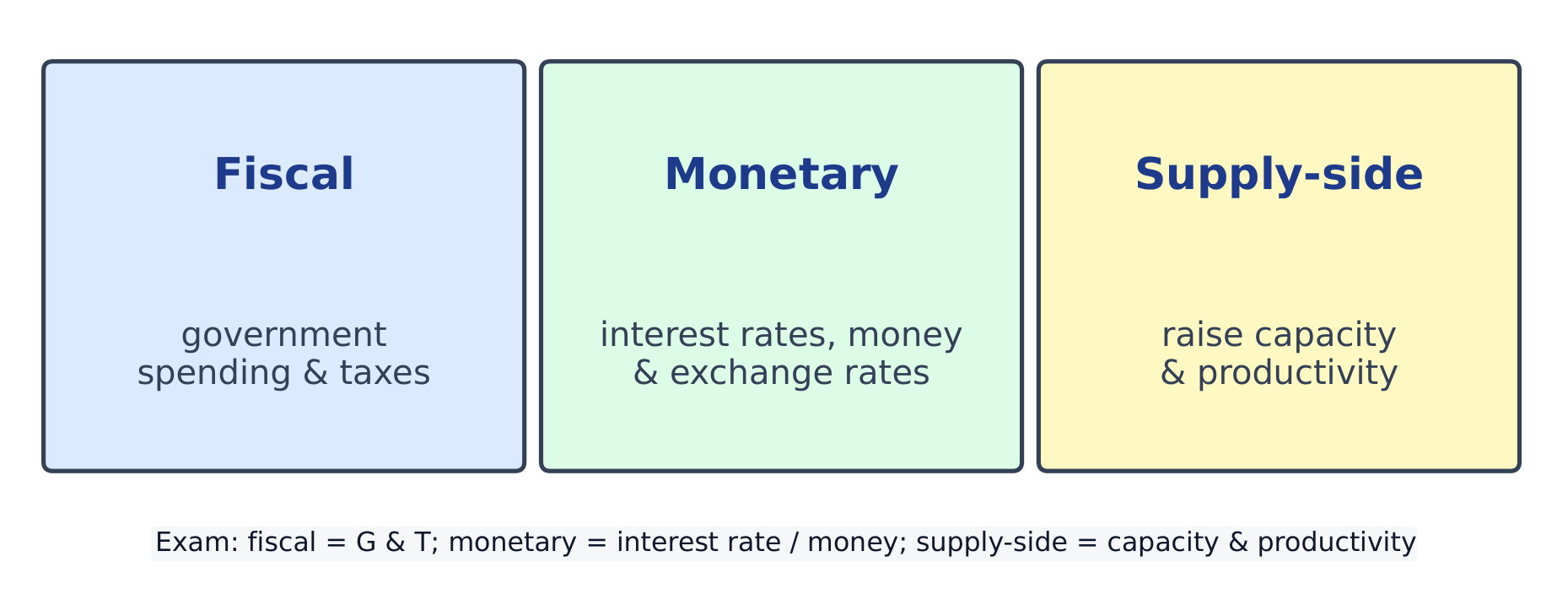
Fiscal policy 财政政策 means the government changing two things to manage the economy:
- government spending 政府支出 — money the government spends, for example on schools, hospitals, and roads.
- taxation 税收 — money the government takes from people and firms.
The government budget 预算 sets spending against tax. There are three outcomes:
- a budget deficit 预算赤字 — spending is more than the tax raised, so the deficit needs financing, often through borrowing.
- a budget surplus 预算盈余 — the tax raised is more than spending.
- a balanced budget — the two are equal.
Official worked budget: June 2025, 0455/22 Q1(a). Government spending was $310 million and tax revenue$292 million. Budget deficit = spending − tax revenue = $310 million −$292 million = $18 million. This is a one-period shortfall, not accumulated government debt.
Types of tax
Taxes are grouped in two ways. By what is taxed:
- a direct tax 直接税 is paid straight to the government from income 收入 or profit 利润 (income tax, corporation tax).
- an indirect tax 间接税 is added to the price of goods and paid when you spend (a sales tax).
By how the rate changes with income:
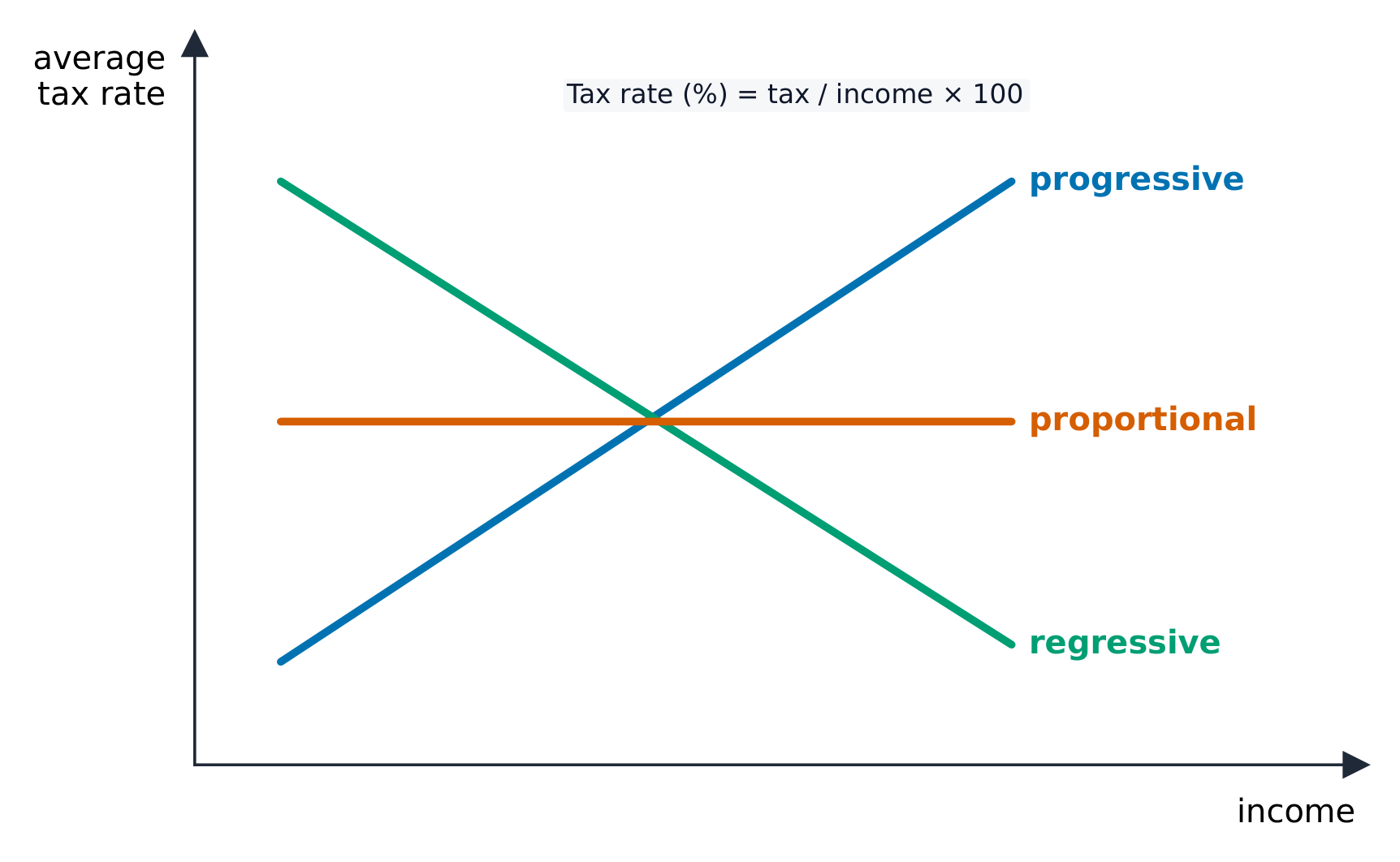
- a progressive tax 累进税 takes a bigger % from higher incomes. This helps redistribute income.
- a regressive tax 累退税 takes a smaller % from higher incomes, so it hits the poor harder.
- a proportional tax 比例税 takes the same % from everyone.
Original tax calculation. A earns £10,000 and pays £1,000; B earns £30,000 and pays £6,000. Average tax rate = tax paid ÷ income × 100. A: £1,000 ÷ £10,000 × 100 = 10%. B: £6,000 ÷ £30,000 × 100 = 20%. The average rate rises with income, so this is progressive. Direct/indirect is a separate classification. A fixed spending-tax payment can take a larger income share from a poorer household; indirect does not mean regressive by definition.
What fiscal policy does
To boost the economy (raise growth and jobs), the government can spend more or cut taxes. This raises total demand 需求 — but if demand grows too fast, it can cause inflation.
To slow the economy (fight inflation), the government can spend less or raise taxes. This lowers demand, but can raise unemployment.
Exam reasoning: June 2025, 0455/22 Q4(c). Higher personal income tax can reduce disposable income, then consumer spending, firms' orders and demand for workers. Cyclical unemployment may rise. This chain assumes spending falls and is not offset elsewhere; government use of extra tax revenue also matters.
Explore
Fiscal policy shifts AD
Spending more or taxing less shifts aggregate demand right — raising output, but also the price level.
Vocabulary
Train
| English |
|---|
| Fiscal policy/ˈfɪskl ˈpɒlɪsi/ |
| government spending/ˈɡʌvənmənt ˈspendɪŋ/ |
| taxation/tækˈseɪʃn/ |
| budget/ˈbʌdʒɪt/ |
| budget deficit/ˈbʌdʒɪt ˈdefɪsɪt/ |
| budget surplus/ˈbʌdʒɪt ˈsɜːpləs/ |
| direct tax/daɪˈrekt tæks/ |
| income/ˈɪŋkʌm/ |
| profit/ˈprɒfɪt/ |
| indirect tax/ɪndaɪˈrekt tæks/ |
| progressive tax/prəˈɡresɪv tæks/ |
| regressive tax/rɪˈɡresɪv tæks/ |
| proportional tax/prəˈpɔːʃənl tæks/ |
| demand/dɪˈmænd/ |
4.3
Monetary policy

Syllabus
- define monetary policy (interest rates, money supply) and the role of the central bank
- explain the effects of changes in interest rates on the economy
Source: Cambridge International syllabus
Monetary policy 货币政策 is the central bank 中央银行 changing interest rates 利率 (and the money supply 货币供给) to manage the economy. The interest rate is the cost of borrowing and the reward for saving.
- Lower interest rates: borrowing is cheaper, which may encourage people and firms to spend and invest 投资 more. Demand rises, potentially increasing output and jobs if there is spare capacity; inflationary pressure may rise.
- Higher interest rates: borrowing is dearer, so spending falls. Demand falls, giving less inflation — but maybe more unemployment.
Explore
Monetary policy shifts AD
Lower interest rates encourage borrowing and spending, shifting aggregate demand right.
Vocabulary
Train
| English |
|---|
| Monetary policy/ˈmʌnɪtəri ˈpɒlɪsi/ |
| central bank/ˈsentrəl bæŋk/ |
| money supply/ˈmʌni səˈplaɪ/ |
| invest/ɪnˈvest/ |
| interest rate/ˈɪntrest reɪt/ |
4.4
Supply-side policy
Syllabus
- define supply-side policy (education and training, privatisation, deregulation, incentives)
- explain the effects of supply-side policy on government macroeconomic aims
Source: Cambridge International syllabus
Supply-side policy 供给侧政策 tries to raise the amount the economy can produce. It improves the quantity and quality of the factors of production 生产要素. Methods include:
- education and training — relevant skills can raise productivity 生产率 when firms can use them.
- privatisation 私有化 — selling state-owned firms to private owners, who may run them better.
- deregulation 放松管制 — removing rules that hold firms back.
- incentives 激励 — lower taxes on income and profit may improve incentives to work and invest; the response varies.
Supply-side policy can raise growth and jobs and lower inflation at the same time. It can take time, costs money and depends on the cause of the constraint; outcomes are not guaranteed.
Original policy comparison. Cutting income tax during weak spending is fiscal policy: more income may be spent, but households may save it. Lowering a policy interest rate is monetary policy: borrowing may be cheaper, but firms with few orders may not invest. Training mechanics for new jobs is supply-side policy: relevant skills may improve employability and capacity, but suitable vacancies must exist. Private ownership alone does not guarantee competition, and education is not the only policy that can improve capacity.
Explore
Economics case lab
Classify real examples by the economic idea they show.
Vocabulary
Train
| English |
|---|
| Supply-side policy/səˈplaɪ saɪd ˈpɒlɪsi/ |
| factors of production/ˈfæktəz ɒv prəˈdʌkʃn/ |
| productivity/ˌprɒdəkˈtɪvɪti/ |
| privatisation/ˌpraɪvətaɪˈzeɪʃn/ |
| deregulation/diːˌreɡjʊˈleɪʃn/ |
| incentives/ɪnˈsentɪvz/ |
4.5
Economic growth

Syllabus
- define economic growth as an increase in real GDP; define GDP and real GDP
- describe the business cycle (boom, recession, slump, recovery)
- explain the causes, consequences (costs and benefits) of economic growth and recession
Source: Cambridge International syllabus
Economic growth is a rise in real GDP.
GDP (gross domestic product 国内生产总值) measures the value of final goods and services produced within a country over a period, usually a year. Counting final output avoids counting inputs again. Real 实际 GDP is GDP after the effect of rising prices is removed, so it shows the true change in output.
Worked example. A country's real GDP was £500 billion last year and £515 billion this year. Find the rate of economic growth.
- economic growth = (515 - 500) ÷ 500 × 100 = 3%.
Because this uses real GDP (with the effect of rising prices taken out), the 3% is a true rise in output, not just higher prices. If prices had risen but output had not, real GDP would be unchanged and its growth rate would be zero; the level of GDP would not be zero.
The business cycle
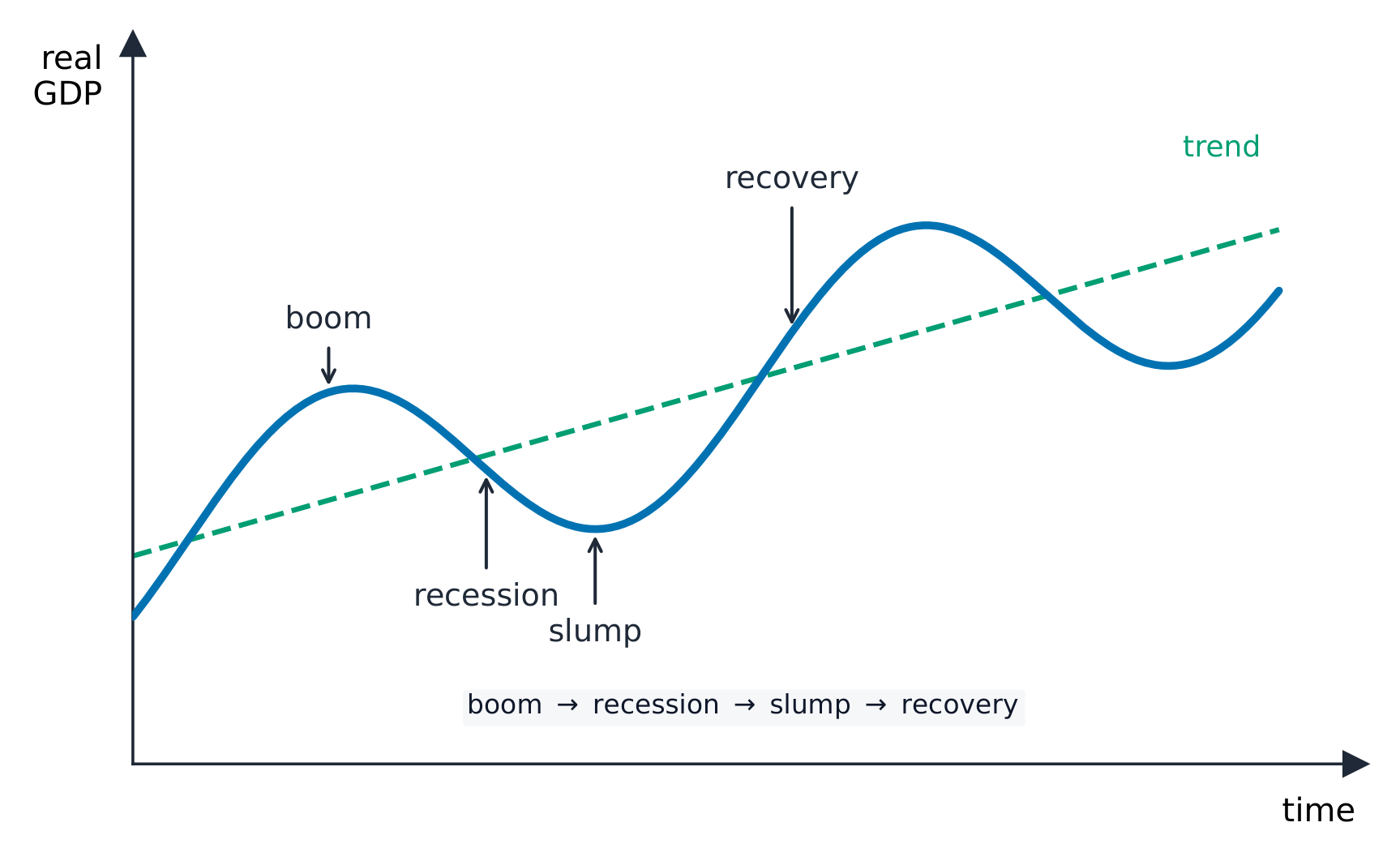
Real GDP does not rise smoothly. It moves through a business cycle 经济周期 with four stages:
- boom 繁荣 — fast growth; output and jobs are high; pressure on prices may increase if capacity is stretched.
- recession 衰退 — output falls and jobs are lost. (A recession is often defined as falling real GDP for six months.)
- slump 萧条 — the bottom of the cycle; very low output and high unemployment.
- recovery 复苏 — output starts to rise again.
Causes and effects
Growth comes from more or better factors of production: investment in new machines, a bigger or more skilled workforce, and new technology.
Good effects: higher incomes, more jobs, better living standards 生活水平, and more tax for the government to spend.
Bad effects: prices may rise (inflation); the gap between rich and poor may grow; and there may be more pollution and use of scarce resources.
A recession can reduce incomes and employment and increase business failures; the effects differ between groups.
Explore
Economic growth
Growth shifts the whole frontier outward — the economy can now produce more of both goods.
Vocabulary
Train
| English |
|---|
| gross domestic product/ɡrəʊs dəˈmestɪk ˈprɒdʌkt/ |
| Real/rɪəl/ |
| business cycle/ˈbɪznəs ˈsaɪkl/ |
| boom/buːm/ |
| recession/rɪˈseʃn/ |
| slump/slʌmp/ |
| recovery/rɪˈkʌvəri/ |
| living standards/ˈlɪvɪŋ ˈstændədz/ |
4.6
Employment and unemployment
Syllabus
- define and measure unemployment (claimant count, labour force survey)
- explain the types of unemployment (frictional, structural, cyclical/demand-deficient) and their causes
- explain the consequences of unemployment and the patterns/changes in employment
Source: Cambridge International syllabus
Measuring unemployment
Unemployment is people who can work and want to work, but cannot find a job. There are two ways to measure it:
- the claimant count 失业救济申领人数 — it counts people who claim unemployment benefit 失业救济金. It misses those who want work but cannot claim.
- the labour force survey 劳动力调查 — a survey that counts people who are not working but are looking for work and are ready to start.
The labour force 劳动力 is everyone who is working plus everyone who is unemployed (and looking for work).
Worked example. A country has 24 million people in work and 2 million people who are unemployed and looking for work. Find the labour force and the unemployment rate.
- labour force = 24 + 2 = 26 million.
- unemployment rate = 2 ÷ 26 × 100 = 7.7%.
People with neither a job nor active job search are usually outside the labour force. A student with a paid job is employed; a student who is jobless, searching and available may be unemployed. A falling rate alone does not show that new jobs were created.
Original survey check. Dana is jobless, actively seeking work and available: unemployed. Eli studies full time and neither works nor seeks work: outside the labour force. Farah studies full time and has a paid part-time job: employed. Classify by activity, not the label “student”.
Original rate comparison. From the initial 24 million employed and 2 million unemployed, 0.5 million unemployed people stop seeking work. Employment stays 24 million. New labour force = 24 + 1.5 = 25.5 million. New unemployment rate = 1.5 ÷ 25.5 × 100 = 5.9% (rounded). No new jobs were created, despite the fall from 7.7%. Claimant counts record benefit claims; surveys can include unemployed non-claimants.
Types of unemployment
- frictional unemployment 摩擦性失业 — short-term unemployment between jobs (a worker who just left one job and is looking for the next).
- structural unemployment 结构性失业 — a whole industry shrinks and workers' skills are no longer wanted (for example, coal miners after the mines close).
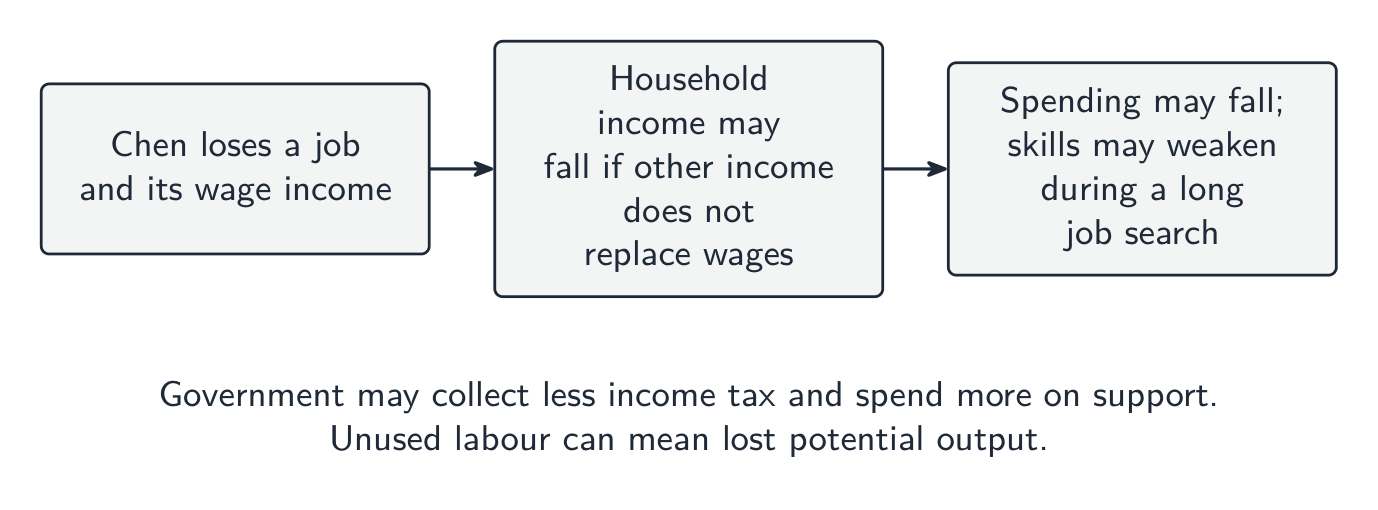
- cyclical unemployment 周期性失业 — caused by a recession, when total demand is low so firms need fewer workers. (It is also called demand-deficient unemployment.)
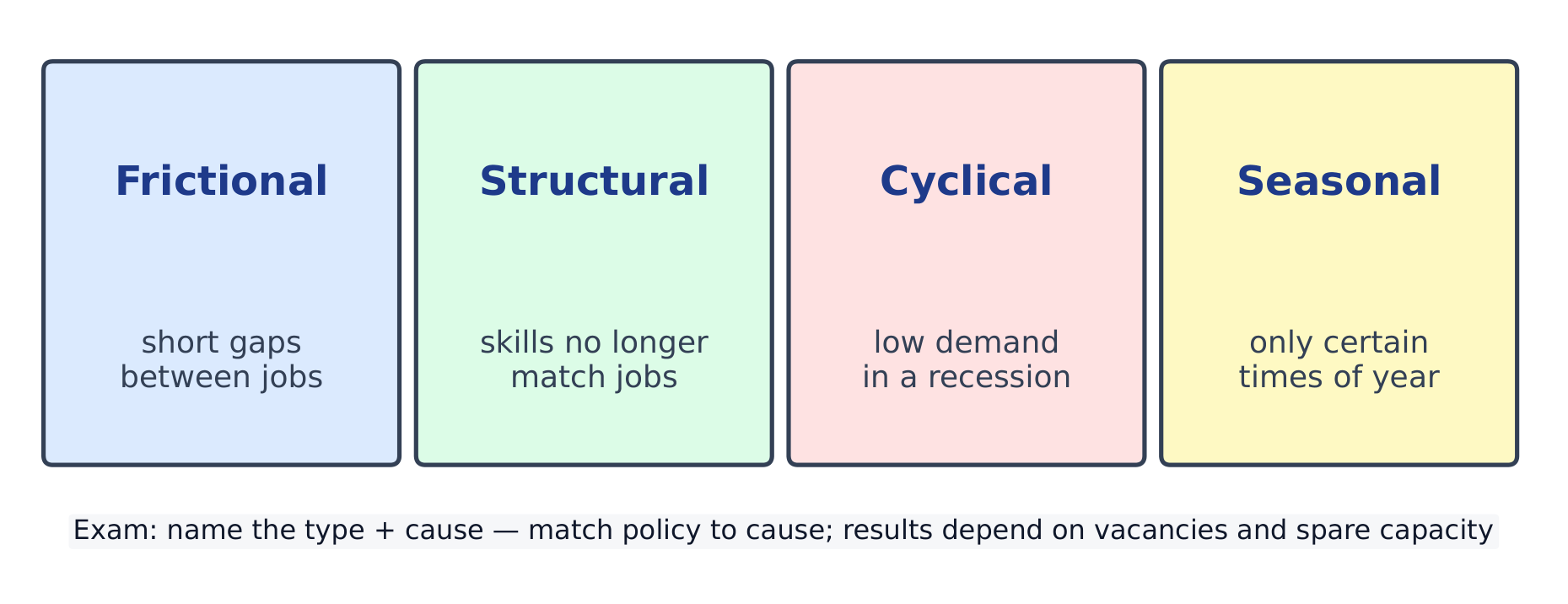
Original worker cases. Asha left a job and is searching for another: frictional unemployment; better vacancy information may shorten the search. Ben's factory closed and vacancies need skills he lacks: structural unemployment; relevant retraining may help. Chen lost work because falling spending reduced orders across the economy: cyclical unemployment; demand support may help if spare capacity exists. Choose a policy from the cause; extra spending alone does not give Ben missing skills.
Effects of unemployment
- workers lose income and may lose their skills.
- the country loses the output those workers could have made.
- the government pays more in benefits and collects less in tax.
- crime and poor health may rise.
Sectors and the changing pattern of employment
The economy has three sectors:
- the primary sector 第一产业 extracts raw materials (farming, fishing, mining);
- the secondary sector 第二产业 makes things (manufacturing, construction);
- the tertiary sector 第三产业 provides services (banking, tourism, retail, transport).
A common development pattern is a shift in employment shares primary → secondary → tertiary; it is not inevitable in every economy. Early on most work is farming; industrialisation moves workers into factories; then deindustrialisation 去工业化 and rising incomes grow the service sector, so most jobs end up tertiary. Modern economies also see more part-time and flexible work.

Original sector check. Growing vegetables is primary activity; canning them is secondary; serving them in a museum café is tertiary. Classify the activity, not simply the business name.
Explore
Development chain lab
Follow how policy and resources can change living standards.
Vocabulary
Train
| English |
|---|
| claimant count/ˈkleɪmənt kaʊnt/ |
| unemployment benefit/ʌnemˈplɔɪmənt ˈbenɪfɪt/ |
| labour force survey/ˈleɪbə fɔːs ˈsɜːveɪ/ |
| labour force/ˈleɪbə fɔːs/ |
| frictional unemployment/ˈfrɪkʃənl ʌnemˈplɔɪmənt/ |
| structural unemployment/ˈstrʌktʃərəl ʌnemˈplɔɪmənt/ |
| cyclical unemployment/ˈsaɪklɪkl ʌnemˈplɔɪmənt/ |
| primary sector/ˈpraɪməri ˈsektə/ |
| secondary sector/ˈsekəndəri ˈsektə/ |
| tertiary sector/ˈtɜːʃjəri ˈsektə/ |
| deindustrialisation/ˌdeɪndəˌstrɪəlaɪˈzeɪʃn/ |
4.7
Inflation
Syllabus
- define inflation and deflation and explain how they are measured (Consumer Prices Index)
- explain the causes (demand-pull and cost-push) and the consequences of inflation and deflation
Source: Cambridge International syllabus
Inflation is a rise in the average level of prices over time. The opposite — falling prices — is deflation 通货紧缩.
Measuring inflation
Inflation is measured by the Consumer Prices Index 消费者价格指数 (CPI). We pick a "basket" of goods a typical family buys, give each good a weight 权重 (a bigger weight for things people spend more on), and track how the price of the whole basket changes each year.
Worked example. A country's Consumer Prices Index (CPI) was 100 last year and 104 this year. Find the rate of inflation.
- inflation rate = (104 - 100) ÷ 100 × 100 = 4%.
Prices rose by 4% on average. If next year the index reaches 107, the inflation rate is (107 - 104) ÷ 104 × 100 = 2.9%. Prices are still rising, but more slowly — a smaller inflation rate is not the same as deflation, because for deflation the index itself would have to fall.
Causes
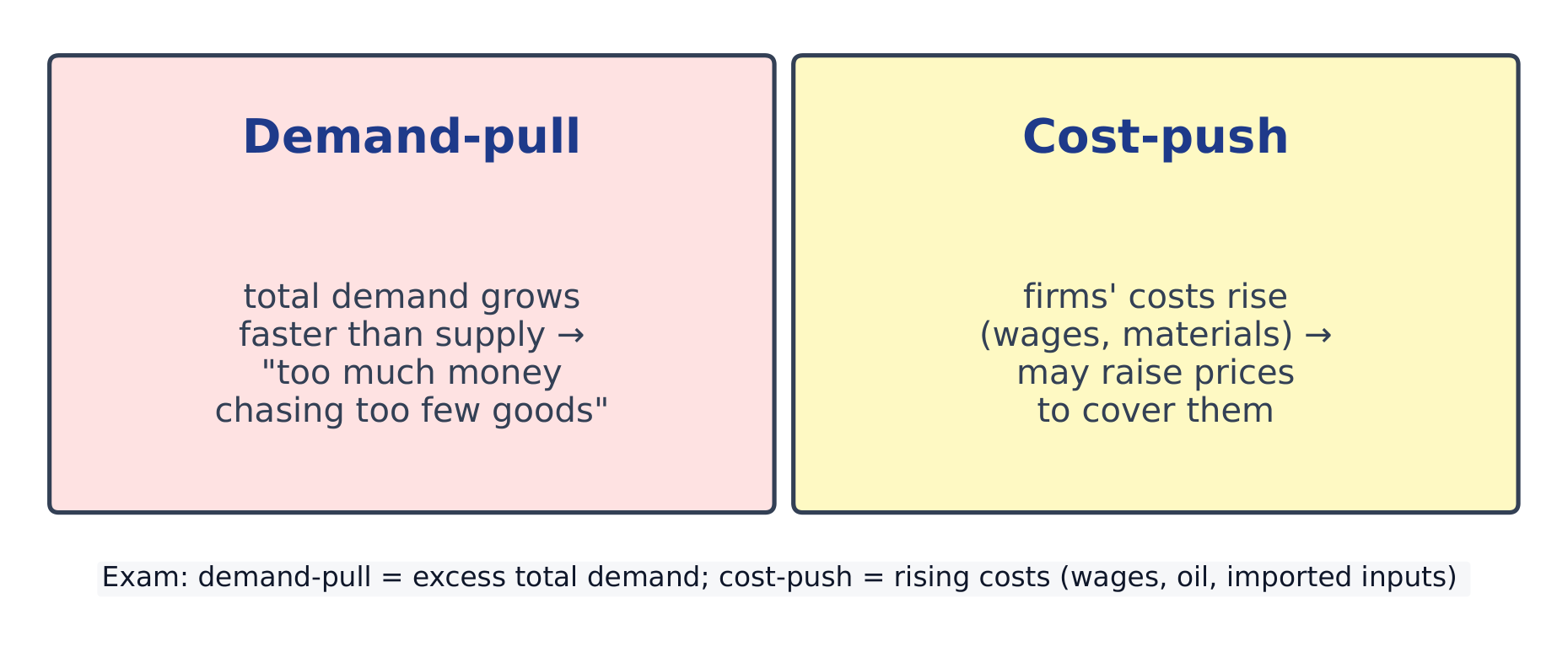
- demand-pull 需求拉动 inflation — total demand grows faster than the economy can supply, so prices are pulled up.
- cost-push 成本推动 inflation — firms' costs rise (wages, materials), so they may raise prices to cover them.
Effects of inflation
- money loses purchasing power 购买力 — each unit of money buys less.
- unchanged money savings lose purchasing power; interest received also matters.
- firms must keep changing prices on labels and lists, which costs time and money.
- if domestic prices rise faster than competitors' and the exchange rate does not offset this, exports may become less competitive.
Deflation
Weaker demand or lower costs can cause deflation; expected falls may delay purchases.
Exam discussion: June 2025, 0455/22 Q1(h). Original A: confidence and spending fall, lowering output and jobs. Fixed debts become harder to repay if income falls. Original B: better technology lowers costs while output rises, potentially improving purchasing power. Judge the cause, affected groups and whether savings reach customers.
Explore
Demand-pull inflation
When aggregate demand rises faster than supply, the price level is pulled up — that is inflation. Push demand and watch prices climb.
Vocabulary
Train
| English |
|---|
| deflation/diːˈfleɪʃn/ |
| Consumer Prices Index/kənˈsuːmə ˈpraɪsɪz ˈɪndeks/ |
| weight/weɪt/ |
| demand-pull/dɪˈmænd pʊl/ |
| cost-push/kɒst pʊʃ/ |
| purchasing power/ˈpɜːtʃɪsɪŋ ˈpaʊə/ |
4.7
Exam tips
Name the equation, use the correct denominator and give units. Explain causal chains; judge causes, constraints and affected groups.
Interactive lessons on this topic
Work through it step by step, with instant-check exercises.