- define microeconomics and macroeconomics
- explain how the market (price mechanism) allocates resources through the signalling, incentive and rationing functions of price
The allocation of resources
IGCSE Economics · Topic 2
 21:51
21:51
The Allocation of Resources
Nobody in the world is in charge of deciding how many coffee beans to grow. No committee meets. No plan is written. And yet, most mornings, there is coffee.…
English narration · English + 中文 subtitles burned in
2.1
Markets and the price mechanism

Syllabus
Source: Cambridge International syllabus
Economics is split into two parts:
- microeconomics 微观经济学 — the study of single parts of the economy, such as one industry or one product.
- macroeconomics 宏观经济学 — the study of the whole economy, like total jobs, prices, and growth.
A market 市场 is any place or system where buyers and sellers meet to trade. It does not need a building — it can be online or over the phone.
When a market is free, no one is in charge of deciding what to make. Instead, the price mechanism 价格机制 (the free movement of prices) allocates 配置 resources 资源 — it decides what is made, how, and for whom. Price does three jobs:
- the signalling 信号 function — a price change tells buyers and sellers what is happening. A rising price signals "make more"; a falling price signals "make less".
- the incentive 激励 function — a higher price gives firms 企业 a reason to produce more, because they can earn more.
- the rationing 配给 function — when a product is scarce, its price rises. The high price shares out the limited amount to those willing to pay.
Explore
How markets allocate resources
Price moves to where demand meets supply. That equilibrium price signals firms what to produce and rations goods to buyers.
Vocabulary
Train
| English |
|---|
| microeconomics/ˌmaɪkrəʊˌiːkəˈnɒmɪks/ |
| macroeconomics/ˌmækrəˌriːkəˈnɒmɪks/ |
| market/ˈmɑːkɪt/ |
| price mechanism/praɪs ˈmekənɪzəm/ |
| allocate/ˈæləkeɪt/ |
| resources/rɪˈzɔːsɪz/ |
| signalling/ˈsɪɡnəlɪŋ/ |
| incentive/ɪnˈsentɪv/ |
| firms/fɜːmz/ |
| rationing/ˈræʃənɪŋ/ |
2.2
Demand

Syllabus
- define demand and explain the law of demand (inverse relationship with price), ceteris paribus
- draw demand curves and distinguish a movement along (change in price) from a shift (change in conditions of demand)
- list the conditions of demand (income, tastes, price of substitutes and complements, population, advertising)
Source: Cambridge International syllabus
Demand 需求 is the amount of a good 物品 that consumers 消费者 (buyers) are willing and able to buy at each price, in a period of time.
The law of demand 需求定律 says: when the price of a good rises, the quantity demanded falls; when the price falls, the quantity demanded rises. Price and quantity move in opposite directions — an inverse relationship 反向关系. This is true ceteris paribus 其他条件不变 (a Latin phrase meaning "all other things stay the same").
Movements and shifts
It helps to separate two ideas:
- quantity demanded 需求量 — the amount bought at one price.
- demand — the whole pattern of buying at every price.
On a demand diagram, price is on the up axis and quantity on the across axis. The demand curve 需求曲线 slopes downward from left to right: high price, low quantity; low price, high quantity.
- A change in the good's own price causes a movement along the demand curve. You slide to a new point on the same line.
- A change in any other condition causes a shift 移动 of the whole curve. A rightward shift means more is demanded at every price; a leftward shift means less.
Conditions of demand
These are the things (other than the good's own price) that shift the demand curve:
- income 收入 — more income usually means more demand.
- tastes 偏好 — if a good becomes popular, demand rises.
- price of substitutes 替代品 — goods used instead of each other (tea and coffee). If coffee gets dearer, demand for tea rises.
- price of complements 互补品 — goods used together (cars and fuel). If cars get dearer, demand for fuel falls.
- population 人口 — more people means more demand.
- advertising 广告 — good adverts raise demand.
Explore
Demand & supply
Demand slopes down — cheaper means more wanted.
Vocabulary
Train
| English |
|---|
| demand/dɪˈmænd/ |
| good/ɡʊd/ |
| consumers/kənˈsuːməz/ |
| law of demand/lɔː ɒv dɪˈmænd/ |
| inverse relationship/ɪnˈvɜːs rɪˈleɪʃənʃɪp/ |
| ceteris paribus/ˈsetərɪs ˈpærɪbəs/ |
| quantity demanded/ˈkwɒntɪti dɪˈmændɪd/ |
| demand curve/dɪˈmænd kɜːv/ |
| shift/ʃɪft/ |
| income/ˈɪŋkʌm/ |
| tastes/teɪsts/ |
| substitutes/ˈsʌbstɪtjuːts/ |
| complements/ˈkɒmplɪmənts/ |
| population/ˌpɒpjʊˈleɪʃn/ |
| advertising/ˈædvətaɪzɪŋ/ |
2.3
Supply
Syllabus
- define supply and explain the law of supply (direct relationship with price)
- draw supply curves and distinguish a movement along from a shift
- list the conditions of supply (costs of production, technology, taxes/subsidies, weather, number of firms)
Source: Cambridge International syllabus
Supply 供给 is the amount of a good that firms are willing and able to sell at each price, in a period of time.
The law of supply 供给定律 says: when the price rises, the quantity supplied rises too. Price and quantity move the same way — a direct relationship 正向关系. Firms supply more at a high price because they can earn more.
Movements and shifts
- quantity supplied 供给量 — the amount offered at one price.
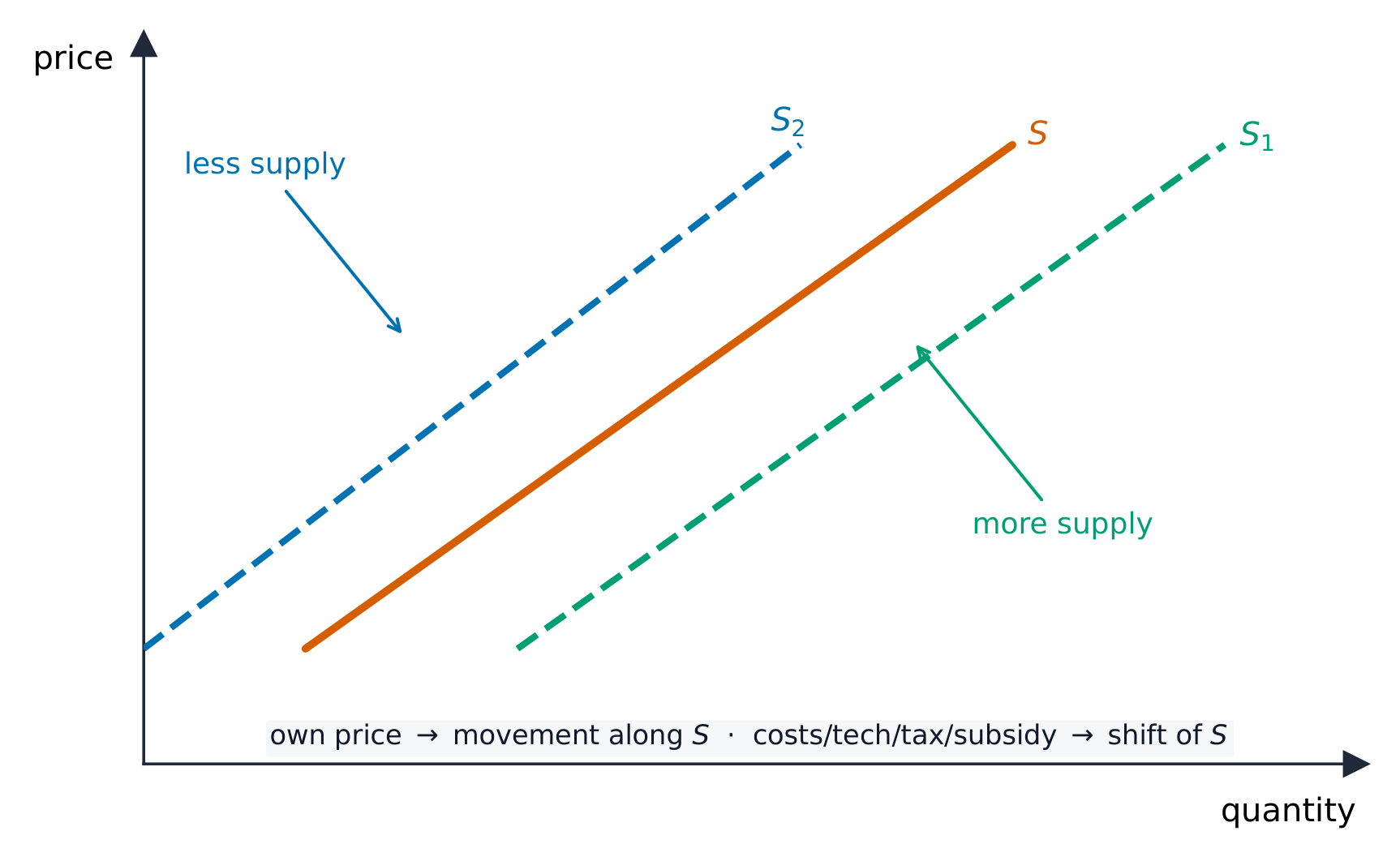
- The supply curve 供给曲线 slopes upward from left to right.
- A change in the good's own price → a movement along the curve.
- A change in any other condition → a shift of the whole curve.
Conditions of supply
- costs of production 生产成本 — if costs rise, firms supply less (curve shifts left).
- technology 技术 — better technology lowers costs, so supply rises.
- taxes and subsidies — a tax 税收 on a good raises firms' costs (supply falls); a subsidy 补贴 (money from the government) lowers costs (supply rises).
- weather — important for farm goods.
- number of firms — more firms means more supply.
Explore
Demand & supply
Supply slopes up — dearer means more made.
Vocabulary
Train
| English |
|---|
| supply/səˈplaɪ/ |
| law of supply/lɔː ɒv səˈplaɪ/ |
| direct relationship/daɪˈrekt rɪˈleɪʃənʃɪp/ |
| quantity supplied/ˈkwɒntɪti səˈplaɪd/ |
| supply curve/səˈplaɪ kɜːv/ |
| costs of production/kɒsts ɒv prəˈdʌkʃn/ |
| technology/tekˈnɒlədʒi/ |
| tax/tæks/ |
| subsidy/ˈsʌbsɪdi/ |
2.4
Price determination

Syllabus
- explain market equilibrium: equilibrium price and quantity where demand equals supply
- draw and interpret demand and supply diagrams to find equilibrium
Source: Cambridge International syllabus
The price of a good is set where demand and supply meet. Draw both curves on one diagram. They cross at a single point. This point gives:
- the equilibrium 均衡 price — the price where the amount buyers want to buy exactly equals the amount firms want to sell.
- the equilibrium quantity — the amount traded at that price.
At equilibrium, quantity demanded equals quantity supplied. There is no good left over and no buyer left waiting.
Explore
Demand & supply
Equilibrium is where demand meets supply.
Vocabulary
Train
| English |
|---|
| equilibrium/ˌiːkwɪˈlɪbrɪəm/ |
2.5
Price changes

Syllabus
- explain how shifts in demand and supply cause changes in equilibrium price and quantity
- explain the consequences of disequilibrium (excess demand/shortage, excess supply/surplus)
Source: Cambridge International syllabus
When a curve shifts, the crossing point moves, so price and quantity change:
- Demand rises (shifts right): price rises and quantity rises.
- Demand falls (shifts left): price falls and quantity falls.
- Supply rises (shifts right): price falls and quantity rises.
- Supply falls (shifts left): price rises and quantity falls.
Disequilibrium
If the price is not at equilibrium, the market is in disequilibrium 非均衡:
- If price is below equilibrium, buyers want more than firms supply. This is excess demand 超额需求, also called a shortage 短缺. Buyers compete, so the price is pushed up until equilibrium returns.
- If price is above equilibrium, firms supply more than buyers want. This is excess supply 超额供给, also called a surplus 过剩. Sellers cut the price until equilibrium returns.
Explore
Demand & supply
A shift in demand or supply moves the equilibrium.
Vocabulary
Train
| English |
|---|
| disequilibrium/ˌdɪˌsiːkwɪˈlɪbrɪəm/ |
| excess demand/ekˈses dɪˈmænd/ |
| shortage/ˈʃɔːtɪdʒ/ |
| excess supply/ekˈses səˈplaɪ/ |
| surplus/ˈsɜːpləs/ |
2.6
Price elasticity of demand (PED)
Syllabus
- define and calculate PED (% change in quantity demanded ÷ % change in price)
- interpret values (elastic, inelastic, unit) and the determinants of PED
- explain the relationship between PED and total revenue and the usefulness of PED to firms and government
Source: Cambridge International syllabus
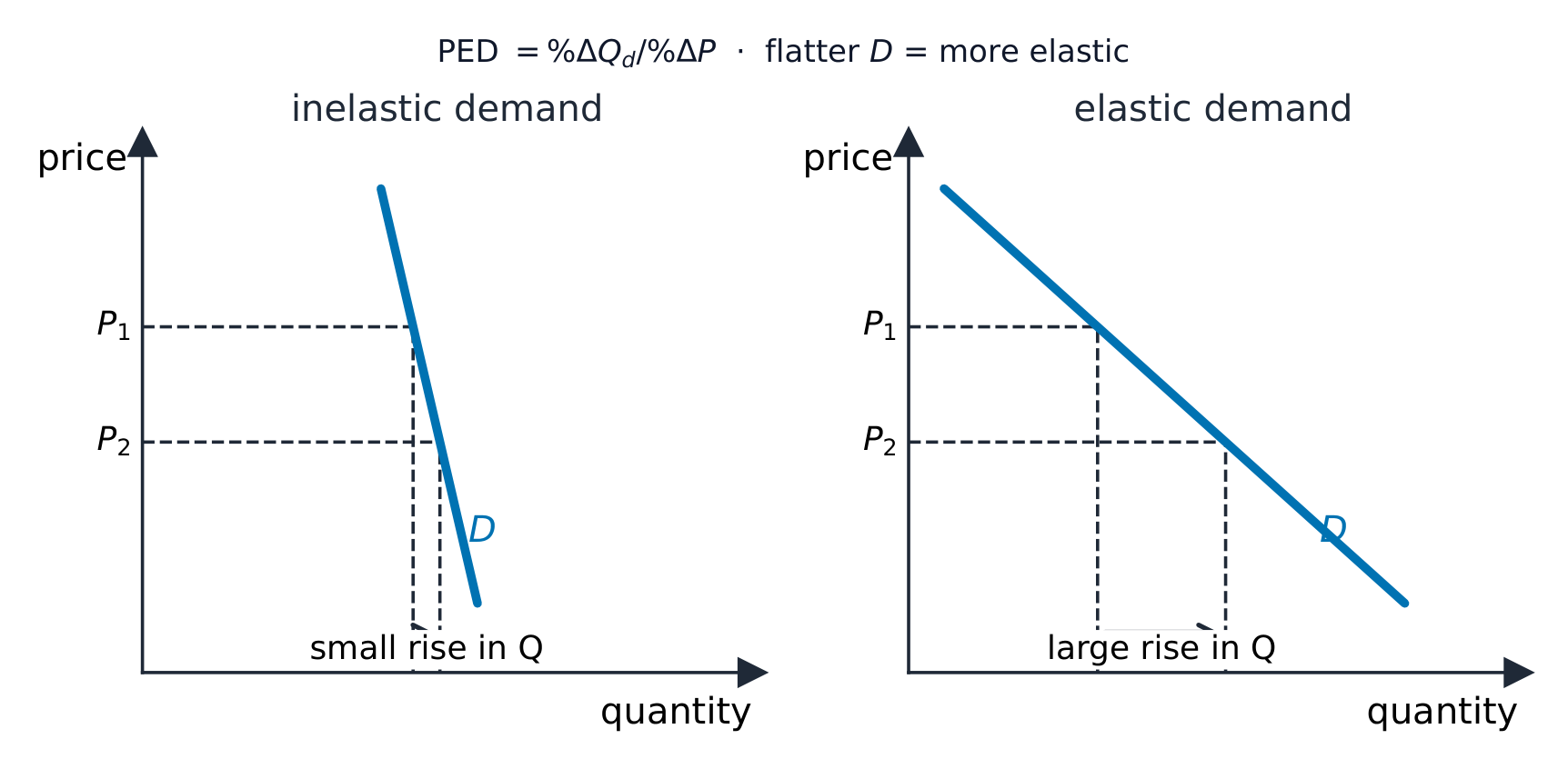
Price elasticity of demand 需求价格弹性 measures how much the quantity demanded changes when the price changes.
PED = (% change in quantity demanded) ÷ (% change in price)
(We usually ignore the minus sign and read the size of the number.) The determinants 决定因素 (the things that decide PED) include whether the good has close substitutes, whether it is a need or a luxury, and what share of income it takes.
Worked example. When the price of a good rises by 20%, the quantity demanded falls by 10%. Find the PED.
PED = (% change in quantity demanded) ÷ (% change in price) = 10 ÷ 20 = 0.5.
Because 0.5 is less than 1, demand is inelastic — the quantity changed by a smaller percentage than the price.
Reading the value
- PED greater than 1: demand is elastic 富有弹性. Quantity changes by a large %. (Goods with many substitutes, like one brand of crisps.)
- PED less than 1: demand is inelastic 缺乏弹性. Quantity changes by a small %. (Needs with few substitutes, like petrol or salt.)
- PED equal to 1: unit elastic 单位弹性. Quantity changes by the same % as price.
PED and total revenue
Total revenue 总收益 is the money a firm gets from sales: price × quantity sold. (To the buyer, the same money is total expenditure 总支出.) PED tells a firm what happens to revenue if it changes its price:
- If demand is inelastic, raising the price raises total revenue (quantity falls only a little).
- If demand is elastic, raising the price lowers total revenue (quantity falls a lot).
This is useful. A firm sets prices knowing how buyers will react. A government taxes inelastic goods (like cigarettes) because people keep buying them, so the tax raises a lot of money.
Worked example. A bus company sells 1,000 tickets a day at £2 each. It raises the price by 10% to £2.20, and daily sales fall by 5% to 950. Find the PED and what happens to total revenue.
- PED = 5 ÷ 10 = 0.5, so demand is inelastic (less than 1).
- old revenue = £2 × 1,000 = £2,000.
- new revenue = £2.20 × 950 = £2,090.
Total revenue rose by £90. Because demand is inelastic, the price rose by a bigger percentage than the quantity fell, so raising the price raised revenue.

Explore
Elasticity & total revenue
PED is the % change in quantity over the % change in price; whether it is above or below 1 decides how total revenue moves.
Explore
Demand & supply
Elasticity of demand is the steepness of the curve.
Vocabulary
Train
| English |
|---|
| price elasticity of demand/praɪs ɪlæˈstɪsɪti ɒv dɪˈmænd/ |
| determinants/dɪˈtɜːmɪnənts/ |
| elastic/ɪˈlæstɪk/ |
| inelastic/ɪnɪˈlæstɪk/ |
| unit elastic/ˈjuːnɪt ɪˈlæstɪk/ |
| total revenue/ˈtəʊtl ˈrevənjuː/ |
| total expenditure/ˈtəʊtl ekˈspendɪtʃə/ |
2.7
Price elasticity of supply (PES)
Syllabus
- define and calculate PES (% change in quantity supplied ÷ % change in price)
- interpret values and explain the determinants of PES (time, spare capacity, stocks, ease of factor switching)
Source: Cambridge International syllabus
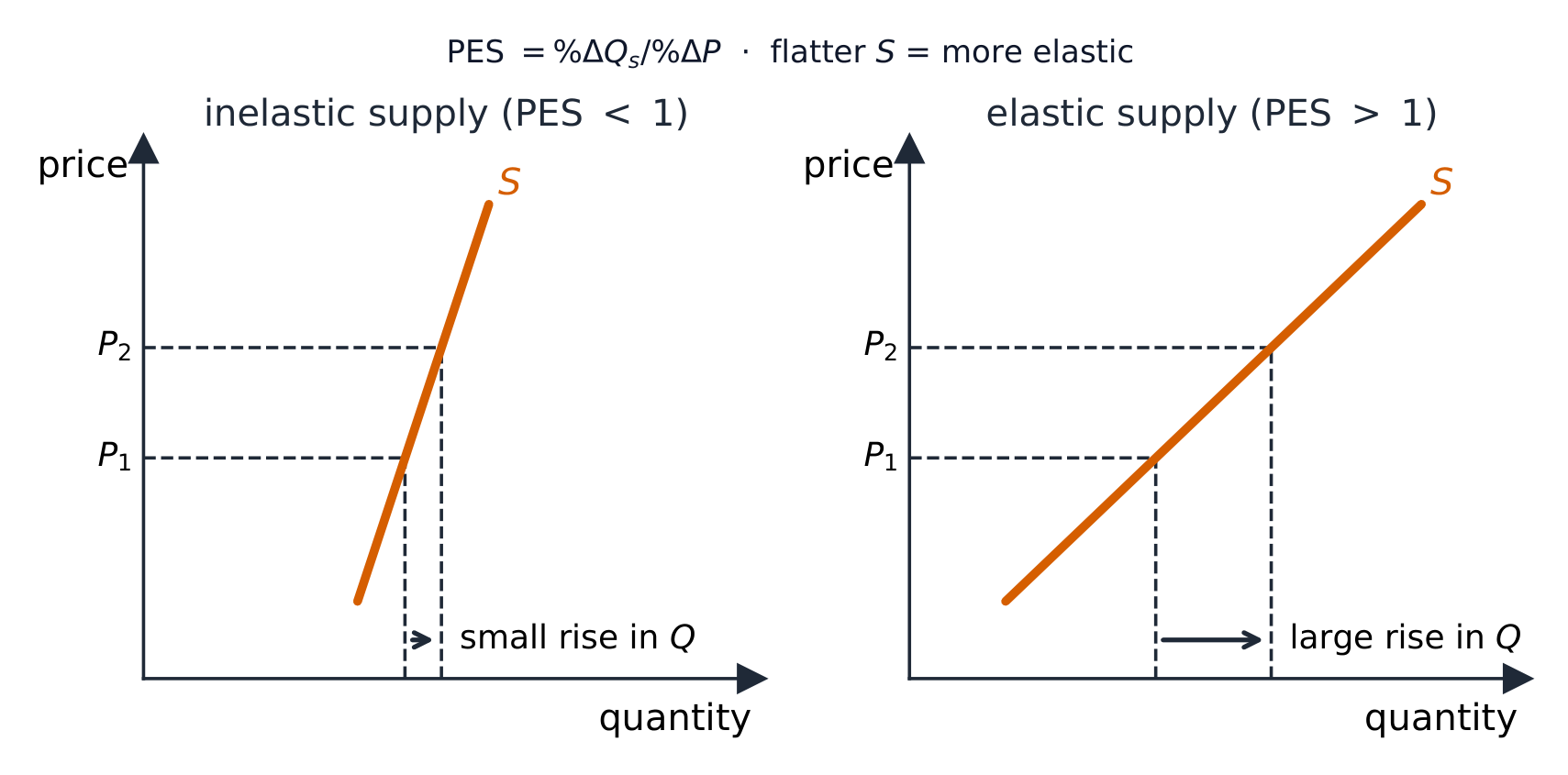
Price elasticity of supply 供给价格弹性 measures how much the quantity supplied changes when the price changes.
PES = (% change in quantity supplied) ÷ (% change in price)
Supply is elastic if PES is greater than 1, and inelastic if PES is less than 1.
Worked example. When the price of a good rises by 10%, the quantity supplied rises by 30%. Find the PES.
PES = (% change in quantity supplied) ÷ (% change in price) = 30 ÷ 10 = 3.
Because 3 is greater than 1, supply is elastic.
The determinants of PES are:
- time — supply is more elastic over a long time, because firms can change how much they make.
- spare capacity 闲置产能 — if a firm has unused machines and workers, it can raise output quickly, so supply is elastic.
- stocks 库存 — goods kept in store can be sold quickly, making supply elastic.
- ease of switching factors — if a firm can move factors of production to make this good easily, supply is more elastic.
Farm goods often have inelastic supply in the short run, because crops take a season to grow.
Explore
Demand & supply
Supply elasticity is how quantity responds to price.
Vocabulary
Train
| English |
|---|
| price elasticity of supply/praɪs ɪlæˈstɪsɪti ɒv səˈplaɪ/ |
| spare capacity/speə kəˈpæsɪti/ |
| stocks/stɒks/ |
2.8
The market economic system
Syllabus
- explain how a market economy allocates resources through the price mechanism
- explain the advantages and disadvantages of the market economic system
Source: Cambridge International syllabus
In a market economy 市场经济, the price mechanism makes all the choices. There is no government planning. (The opposite is a planned economy 计划经济, where the government makes the choices.)
Advantages of the market system:
- Prices guide resources to where they are wanted, without anyone planning.
- Firms compete, so they cut costs and create new and better goods.
- Consumers have wide choice.
Disadvantages:
- Some useful goods are not made because they earn no profit.
- The strong (rich firms and people) do well; the weak may be left with nothing.
- Markets can fail (see below).
Explore
How a market allocates
In a market system, price moves to where demand meets supply — that price signal decides what gets made. Shift the curves and watch it settle.
Vocabulary
Train
| English |
|---|
| market economy/ˈmɑːkɪt ɪˈkɒnəmi/ |
| planned economy/plænd ɪˈkɒnəmi/ |
2.9
Market failure

Syllabus
- define market failure as the inefficient allocation of resources
- explain the causes: external costs and external benefits (social vs private costs/benefits), merit and demerit goods, public goods and the abuse of monopoly power
Source: Cambridge International syllabus
Market failure 市场失灵 happens when the price mechanism leads to an inefficient 低效率 use of resources — resources are not shared out in the best way for society. The main causes:
External costs and benefits
When you produce or consume something, the cost or benefit to you is not always the cost or benefit to everyone.
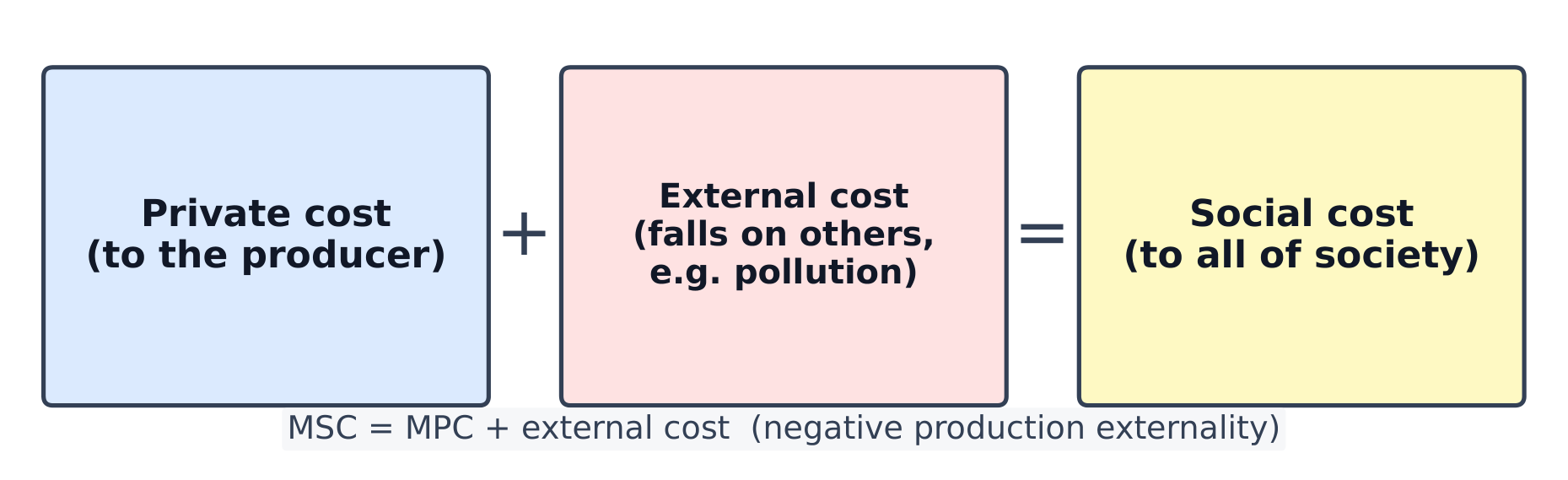
- a private cost 私人成本 is the cost to the person doing the activity.
- an external cost 外部成本 is a cost paid by other people — for example, smoke from a factory harms nearby families.
- the social cost 社会成本 is the private cost plus the external cost (the cost to the whole of society).
In the same way:
- a private benefit 私人效益 is the benefit to the person doing the activity.
- an external benefit 外部效益 is a benefit that others get for free — for example, your neighbour's tidy garden is nice for you too.
- the social benefit 社会效益 is the private benefit plus the external benefit.
Markets fail because firms and consumers only think about their private costs and benefits, not the external ones.
Merit, demerit and public goods
- merit goods 有益物品 are better for you than you realise, so the market makes too few (education, healthcare).
- demerit goods 有害物品 are worse for you than you realise, so the market makes too many (cigarettes, alcohol).
- public goods 公共物品 are things everyone can use and no one can be stopped from using, like street lights or national defence. The market makes none, because firms cannot charge for them.


Abuse of monopoly power
A monopoly 垄断 is a single firm that controls a market. With no competition, it can charge high prices and make poor-quality goods. This is another market failure.
Explore
Demand & supply
Market failure: the free-market crossing isn't always best for society.
Vocabulary
Train
| English |
|---|
| market failure/ˈmɑːkɪt ˈfeɪlɪə/ |
| inefficient/ɪnɪˈfɪʃənt/ |
| private cost/ˈpraɪvət kɒst/ |
| external cost/ekˈstɜːnl kɒst/ |
| social cost/ˈsəʊʃl kɒst/ |
| private benefit/ˈpraɪvət ˈbenɪfɪt/ |
| external benefit/ekˈstɜːnl ˈbenɪfɪt/ |
| social benefit/ˈsəʊʃl ˈbenɪfɪt/ |
| merit goods/ˈmerɪt ɡʊdz/ |
| demerit goods/ˈdemərɪt ɡʊdz/ |
| public goods/ˈpʌblɪk ɡʊdz/ |
| monopoly/məˈnɒpəli/ |
2.10
The mixed economic system
Syllabus
- explain the features of a mixed economy (private sector and public sector)
- explain methods of government intervention to address market failure: maximum and minimum prices, indirect taxes, subsidies, regulation and direct provision
- evaluate the effects of intervention
Source: Cambridge International syllabus
A mixed economy 混合经济 has both:
- a private sector 私营部门 — firms owned by people, guided by the price mechanism.
- a public sector 公共部门 — activity run by the government.
Most real economies are mixed; China's, for example, is a socialist market economy. The government steps in to correct market failure. This is government intervention 干预. The main methods:
| Method | What it does |
|---|---|
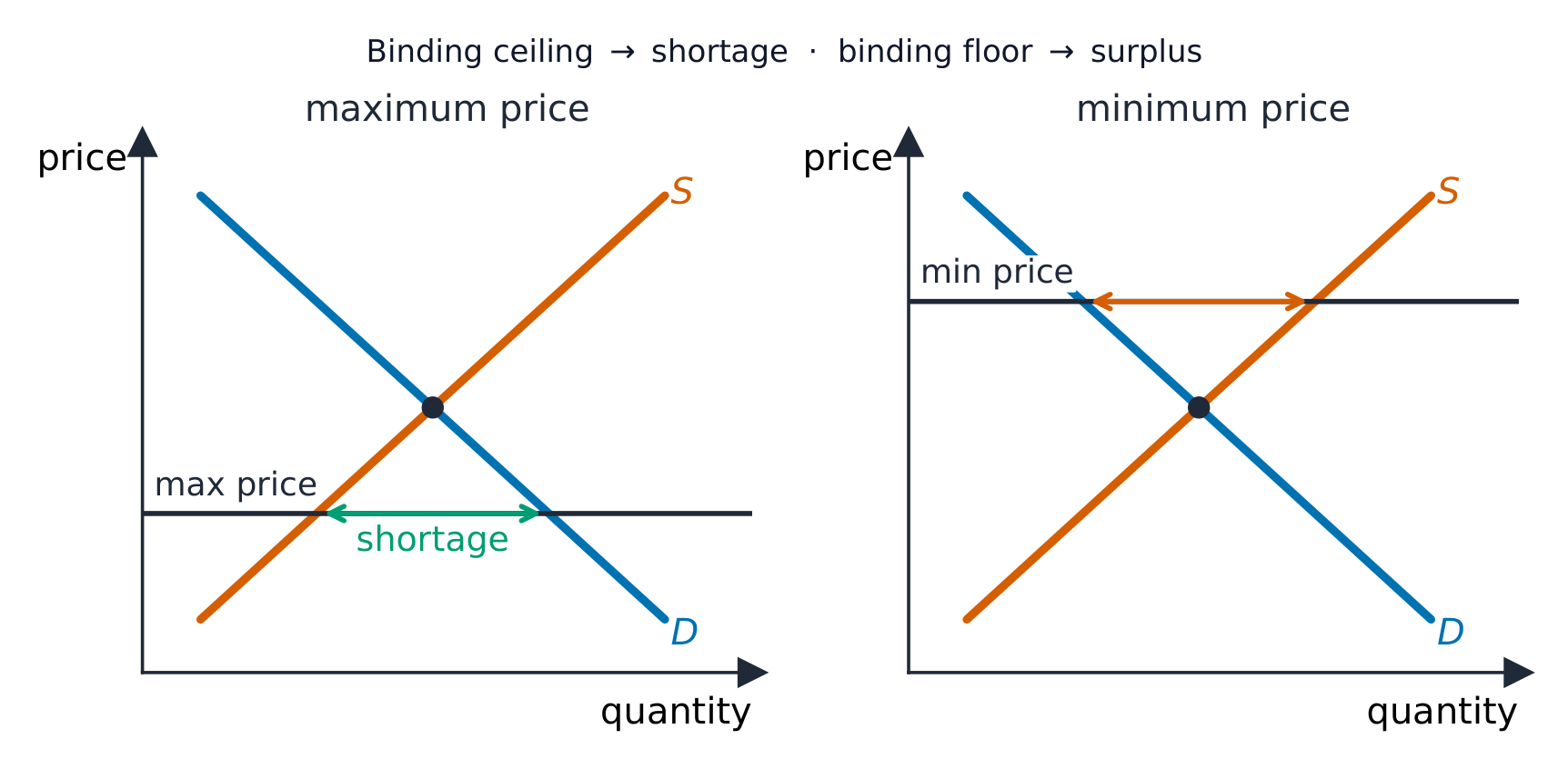
| maximum price 最高价格 | a price ceiling, set below equilibrium, to keep a good (like rent) cheap — but it causes a shortage |
| minimum price 最低价格 | a price floor, set above equilibrium, to keep a price up (like a fair wage) — but it causes a surplus |
| indirect tax 间接税 | a tax on a good (added to its price) to cut demand for demerit goods |
| subsidy | money paid to firms to cut the price and raise output of merit goods |
| regulation 监管 | rules and laws, like banning smoking in public |
| direct provision 直接提供 | the government makes and gives out goods itself, like state schools |
Judging intervention
Intervention can fix market failure, but it has costs. Taxes and rules cost money to collect and check. Governments can get things wrong too (this is called government failure). So you should always weigh the good effects against the bad ones before deciding.
Explore
Economics case lab
Classify real examples by the economic idea they show.
Vocabulary
Train
| English |
|---|
| mixed economy/mɪkst ɪˈkɒnəmi/ |
| private sector/ˈpraɪvət ˈsektə/ |
| public sector/ˈpʌblɪk ˈsektə/ |
| intervention/ˌɪntəˈvenʃn/ |
| maximum price/ˈmæksɪməm praɪs/ |
| minimum price/ˈmɪnɪməm praɪs/ |
| indirect tax/ɪndaɪˈrekt tæks/ |
| regulation/ˌreɡjʊˈleɪʃn/ |
| direct provision/daɪˈrekt prəˈvɪʒn/ |
2.10
Exam tips
- A change in a good's own price is a movement along the curve; a change in anything else (income, tastes, related prices) shifts the whole curve.
- Equilibrium is where demand meets supply. Below it there is excess demand (a shortage, so price rises); above it there is excess supply (a surplus, so price falls).
- PED = %ΔQ ÷ %ΔP. Demand is inelastic if PED < 1 (raising price raises revenue) and elastic if PED > 1 (raising price lowers revenue).
- Market failure (external costs, merit/demerit/public goods, monopoly) means resources are used badly; the government corrects it with taxes, subsidies, rules and direct provision.
Interactive lessons on this topic
Work through it step by step, with instant-check exercises.