Corrosion of metals
Introducido| English | Significado |
|---|---|
| rust/rʌst/ | óxido de hierro |
| corrosion/kəˈrəʊʒn/ | corrosión |
| rusting/ˈrʌstɪŋ/ | oxidación |
| galvanising/ˈɡælvənaɪzɪŋ/ | galvanizado |
| sacrificial protection/ˌsækrɪˈfɪʃl prəˈtekʃn/ | protección sacrificial |
When metals are eaten away
- Leave iron out in the rain and it slowly turns to flaky brown rust 铁锈.
- This slow destruction of a metal is corrosion 腐蚀.
Rusting of iron requires which two things? (Select all that apply.)
Dificultad 2/5 · 140 monedas + un pequeño bono en el primer intento de hoy
Both water and oxygen are needed.
The corrosion of iron specifically is called ______.
Dificultad 1/5 · 100 monedas + un pequeño bono en el primer intento de hoy
Rust is hydrated iron(III) oxide.
Rusting 生锈 of iron
- Rusting is the corrosion of iron, forming hydrated iron(III) oxide (rust).
- It needs both water and oxygen — remove either and iron won't rust.
Corrosion slowly eats away unprotected metal
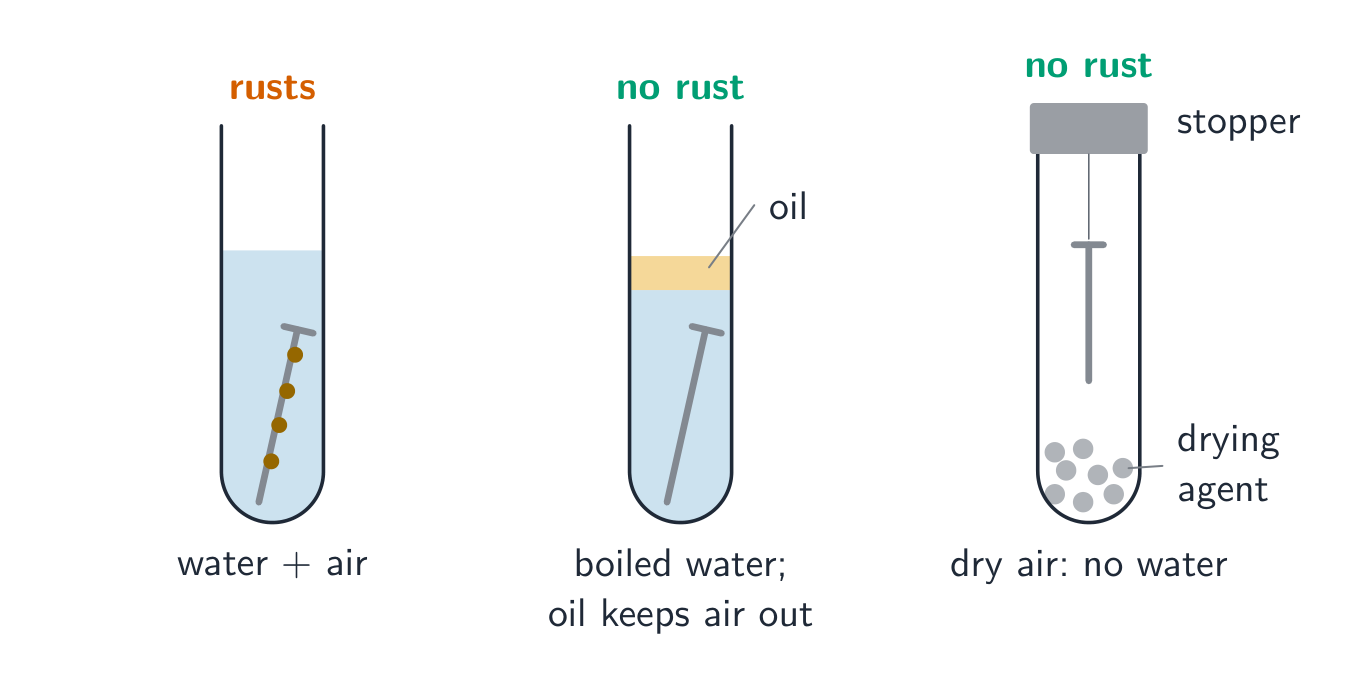
Rusting needs both water and oxygen — the nail rusts only in the tube that has both
Why iron rusts — and how to stop it
Step through rusting. Iron needs BOTH water and oxygen, and once it starts the rust flakes off to expose fresh metal — which is why we protect iron.
Painting iron prevents rust by:
Dificultad 1/5 · 100 monedas + un pequeño bono en el primer intento de hoy
A barrier keeps out the water and oxygen.
Galvanising means coating iron with tin.
Dificultad 1/5 · 100 monedas + un pequeño bono en el primer intento de hoy
False. Galvanising coats iron with zinc, which forms a barrier and also protects sacrificially because zinc is more reactive. Tin plating protects only as a barrier.
Preventing corrosion
- Barrier methods: painting, oiling or coating to keep out water and oxygen.
- Galvanising 镀锌: coating iron with zinc.
In sacrificial protection, the iron is protected by a metal that is:
Dificultad 1/5 · 100 monedas + un pequeño bono en el primer intento de hoy
The more reactive metal corrodes instead.
Sacrificial protection 牺牲保护
- A more reactive metal (like zinc) corrodes instead of the iron, protecting it.
- The zinc is the "sacrifice" — it reacts in preference to the iron.
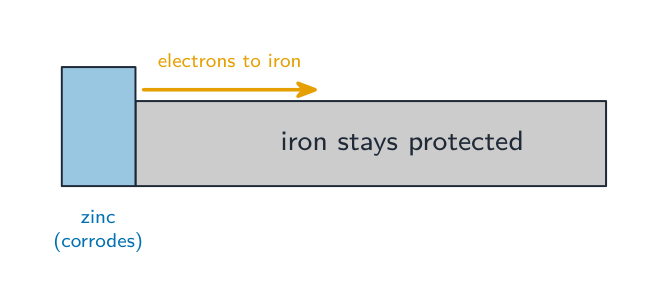
The more reactive zinc corrodes and gives its electrons to the iron, so the iron is protected even where the surface is scratched
Rusting needs both water and oxygen. A famous experiment shows iron does not rust in boiled water (no oxygen) or in dry air (no water). Both must be present.
Worked example: the three-tube test
Three iron nails are left for a week: A in tap water open to air, B in boiled water under a layer of oil, C in dry air with calcium chloride (a drying agent). Only A rusts. Explain.
- A has water and oxygen, so it rusts. B has water but no oxygen (boiling removes dissolved air and the oil stops more dissolving). C has oxygen but no water. So rusting needs both.
- A ship's steel hull has zinc blocks bolted on. Zinc is more reactive than iron, so it corrodes instead: sacrificial protection. The blocks are replaced when they are used up.
A nail in salty water open to the air rusts, because salt water contains both water and dissolved oxygen.
Dificultad 1/5 · 100 monedas + un pequeño bono en el primer intento de hoy
Both are present, so it rusts; dissolved salt actually makes rusting faster.
Why could copper blocks not protect a steel hull by sacrificial protection?
Dificultad 1/5 · 100 monedas + un pequeño bono en el primer intento de hoy
The sacrificial metal must be more reactive than iron, like zinc or magnesium.
You've got it
- rusting is the corrosion of iron; it needs both water and oxygen
- prevent it with a barrier (paint, oil) or by galvanising (zinc coat)
- sacrificial protection: a more reactive metal corrodes instead of the iron
Write from this case
- An iron pipe is connected to a block of zinc.
- Both metals are exposed to water and oxygen.
Which metal corrodes, and why does the iron stay protected?
The more reactive metal corrodes first.
What happens to the zinc block?
Dificultad 1/5 · 100 monedas + un pequeño bono en el primer intento de hoy
Sacrificial protection uses a more reactive metal.