Group VII properties
Introducido| English | Significado |
|---|---|
| halogens/ˈhælədʒnz/ | halógenos |
| Group VII/ɡruːp ˈsevn/ | Grupo VII |
| diatomic molecules/ˌdaɪəˈtɒmɪk ˈmɒlɪkjuːlz/ | moléculas diatómicas |
| displace/dɪˈspleɪs/ | desplazar |
A green gas that bleached flowers, 1774
- In 1774 the Swedish chemist Carl Wilhelm Scheele added hydrochloric acid to a manganese mineral and made a choking yellow-green gas. It bleached flowers and leaves. In 1810 Humphry Davy showed it was an element and named it chlorine, from the Greek for pale green.
- Chlorine is one of the halogens 卤素 in Group VII 第七族: fluorine, chlorine, bromine, iodine.
Group VII trend lab
Follow halogens down the group and watch reactivity decrease.
What colour is chlorine gas?
Dificultad 1/5 · 100 monedas + un pequeño bono en el primer intento de hoy
Its name means pale green.
Diatomic molecules
- All halogens exist as diatomic molecules 双原子分子: F₂, Cl₂, Br₂, I₂. Each atom has seven outer electrons and shares one pair.
- They react by gaining one electron to form 1− ions: Cl₂ + 2e⁻ → 2Cl⁻.
What is the formula of a bromine molecule?
Dificultad 1/5 · 100 monedas + un pequeño bono en el primer intento de hoy
Halogens are diatomic.
Trends down the group
- Chlorine is a pale yellow-green gas, bromine a red-brown liquid, iodine a grey-black solid (purple vapour). Melting and boiling points increase down the group.
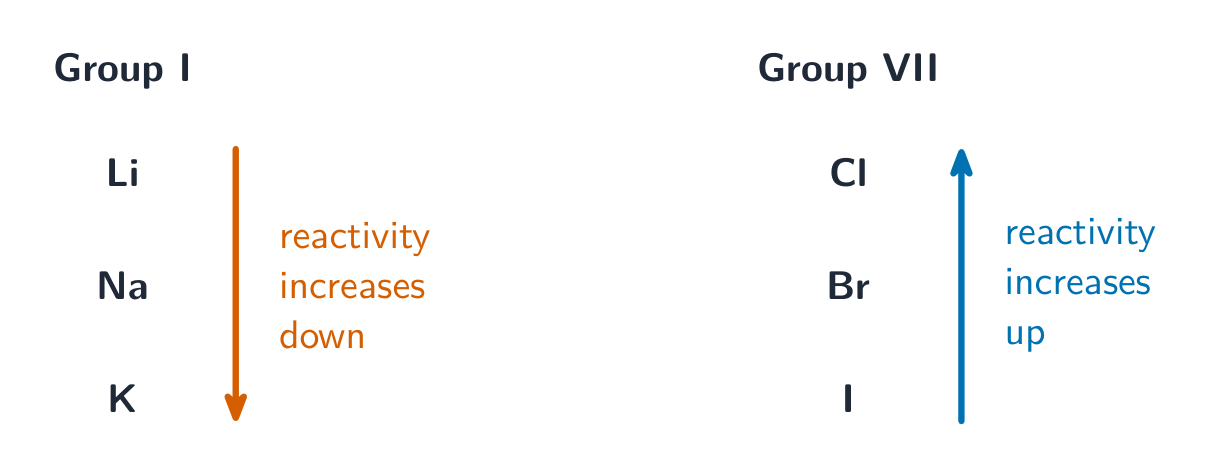
- Reactivity decreases down the group: larger atoms attract an extra electron less strongly.
Match each halogen to its state at room temperature.
Dificultad 2/5 · 140 monedas + un pequeño bono en el primer intento de hoy
Melting points rise down the group.
Halogens become more reactive down the group.
Dificultad 1/5 · 100 monedas + un pequeño bono en el primer intento de hoy
Reactivity decreases.
Displacement reactions
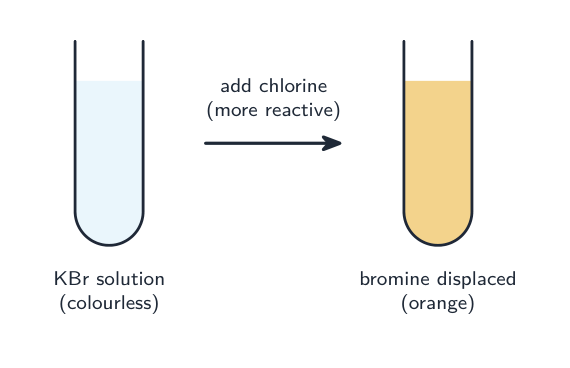
- A more reactive halogen will displace 置换 a less reactive one from its salt solution: Cl₂ + 2KBr → 2KCl + Br₂. The colourless solution turns orange.
- A less reactive halogen cannot displace a more reactive one: iodine does not react with potassium chloride.
Which mixture reacts?
Dificultad 1/5 · 100 monedas + un pequeño bono en el primer intento de hoy
Chlorine is more reactive than iodine.
What colour appears when chlorine is added to potassium bromide solution?
Dificultad 1/5 · 100 monedas + un pequeño bono en el primer intento de hoy
Bromine forms.
Worked example: complete a results table
Chlorine water, bromine water and iodine solution are each added to KCl, KBr and KI solutions.
- Chlorine: displaces Br₂ (orange) and I₂ (brown); no change with KCl.
- Bromine: displaces I₂ only (brown); no change with KCl.
- Iodine: no reaction with either. Order of reactivity: Cl > Br > I.
Order the halogens from most to least reactive.
Dificultad 3/5 · 200 monedas + un pequeño bono en el primer intento de hoy
From the displacement results.
Uses and safety
- Chlorine kills bacteria in drinking water and swimming pools; iodine solution is an antiseptic.
- Chlorine is toxic: use small amounts in a fume cupboard.
Halogen reactivity decreases down the group — the opposite of Group I. Group I atoms lose an electron more easily as they get bigger; Group VII atoms gain one less easily.
Halogens are diatomic, gain one electron to form 1− ions, darken and rise in melting point down the group, and become less reactive down the group. A more reactive halogen displaces a less reactive one from its salt.
Predict whether bromine reacts with sodium iodide solution. Give the word or symbol equation and the colour change.
Reactivity order.