Giant covalent structures
Introducido| English | Significado |
|---|---|
| giant covalent/ˈdʒaɪənt ˈkəʊvələnt/ | Covalente gigante |
| diamond/ˈdaɪəmənd/ | Diamante |
| graphite/ˈɡræfaɪt/ | Grafito |
| silicon dioxide/ˈsɪlɪkən daɪˈɒksaɪd/ | Dióxido de silicio |
| lubricant/ˈluːbrɪkənt/ | lubrificante |
Covalent giants
- Not all covalent substances are small molecules. Some are vast networks of atoms — giant covalent 巨型共价 structures.
- Their endless web of strong bonds gives remarkable properties.
Giant covalent lab
Compare giant covalent structures by bonding and properties.
A giant covalent structure has:
Dificultad 1/5 · 100 monedas + un pequeño bono en el primer intento de hoy
It is a continuous network of covalent bonds.
Giant covalent structures
- A giant covalent structure has millions of atoms joined by covalent bonds in a continuous network.
- Examples: diamond 金刚石, graphite 石墨 and silicon dioxide 二氧化硅 (sand).
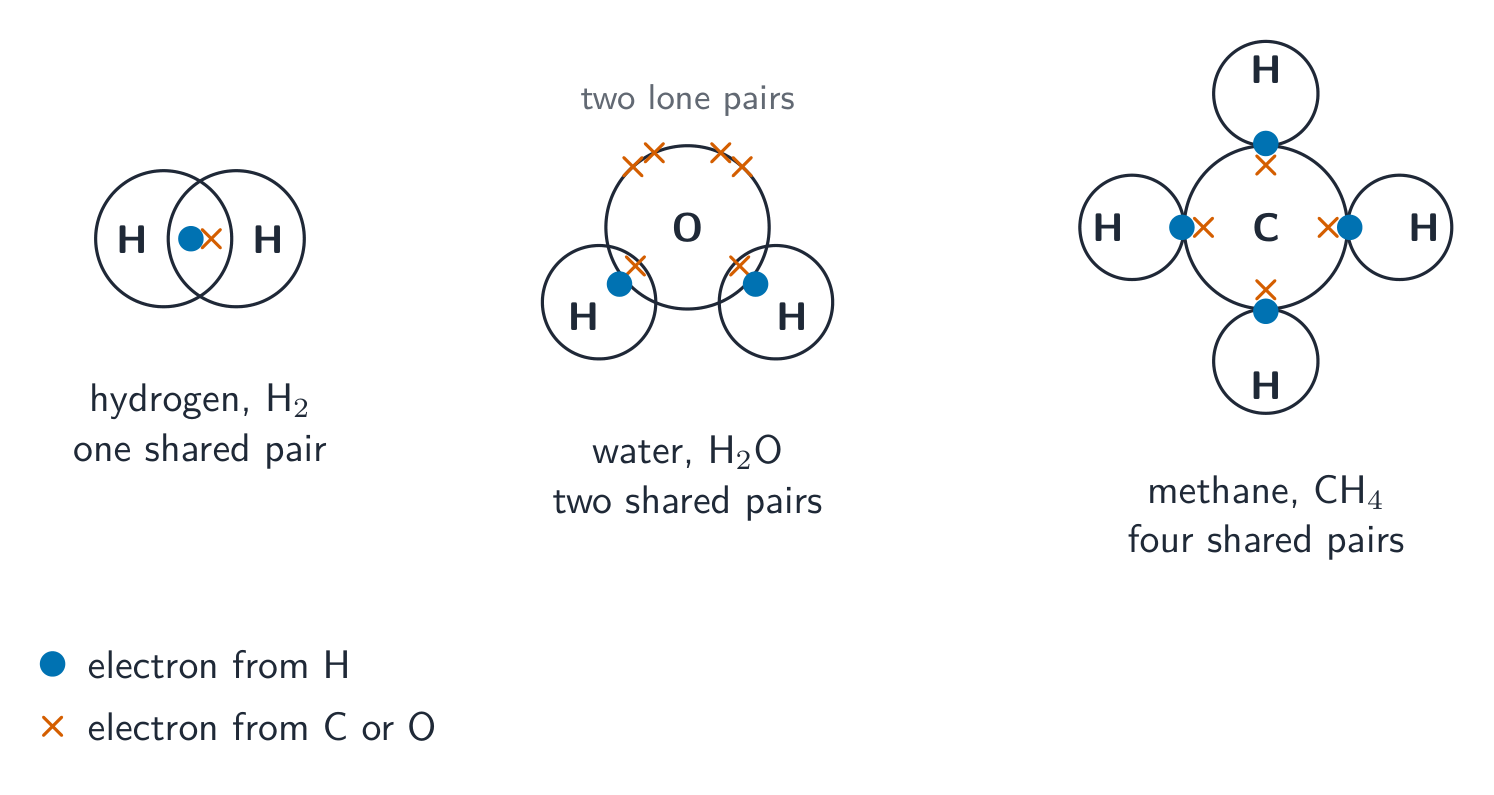
In a covalent bond atoms share pairs of electrons so each reaches a full outer shell
In diamond, each carbon atom is bonded to how many others?
Dificultad 1/5 · 100 monedas + un pequeño bono en el primer intento de hoy
Four bonds make diamond a rigid, hard lattice.
Because each carbon forms four bonds in a rigid lattice, diamond is extremely ______.
Dificultad 1/5 · 100 monedas + un pequeño bono en el primer intento de hoy
The rigid 3D network makes diamond hard.
Diamond
- In diamond, each carbon atom bonds to four others in a rigid 3D lattice.
- This makes diamond extremely hard with a very high melting point.
Graphite can conduct electricity and is soft because it has:
Dificultad 1/5 · 100 monedas + un pequeño bono en el primer intento de hoy
Three bonds leave free electrons; layers slide.
Diamond and graphite are both made of pure carbon.
Dificultad 1/5 · 100 monedas + un pequeño bono en el primer intento de hoy
Different bonding arrangements give different properties.
Graphite
- In graphite, each carbon bonds to three others, forming layers that can slide.
- This makes graphite soft (a lubricant 润滑剂) and able to conduct electricity (free electrons between layers).
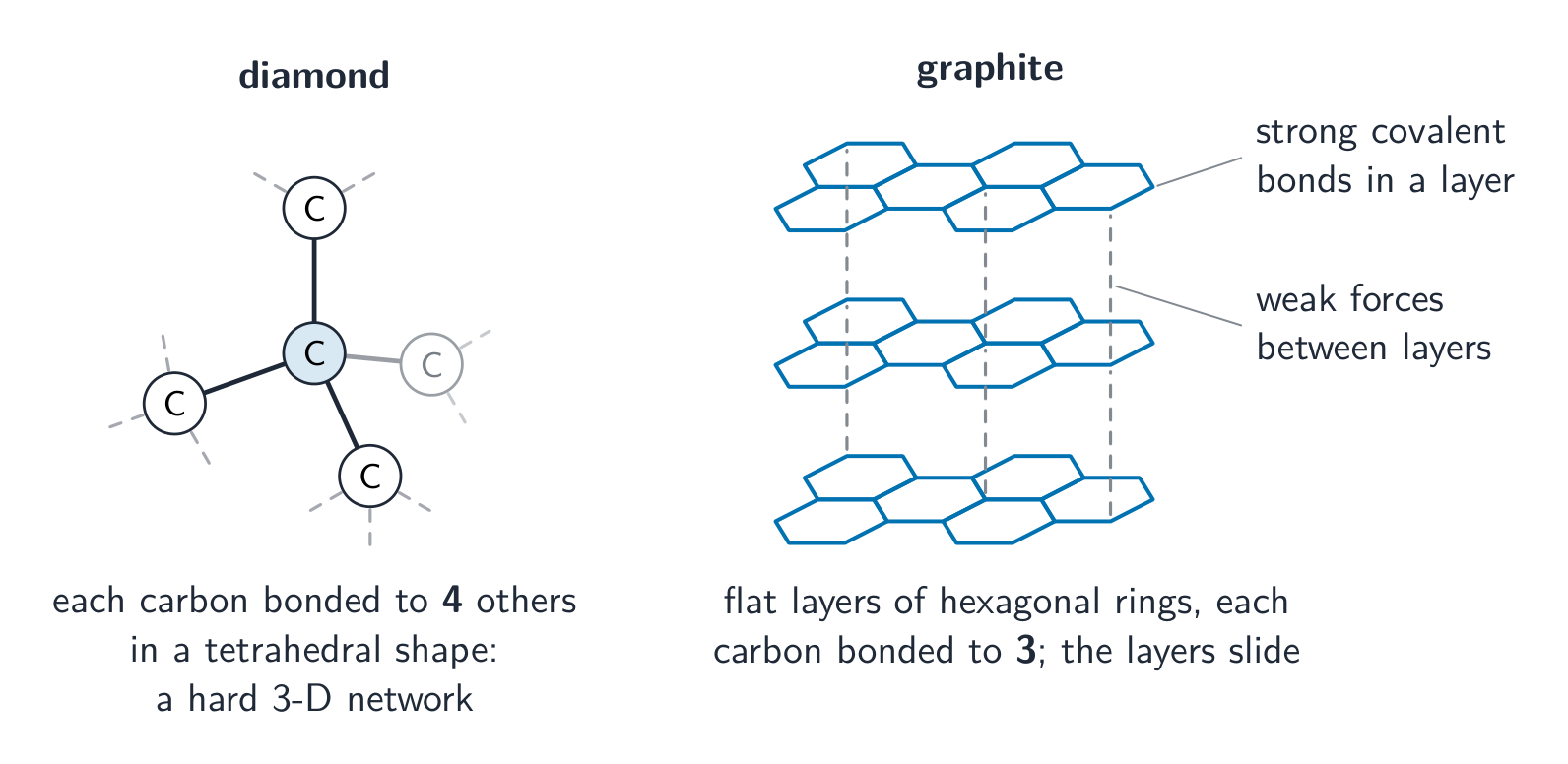
Diamond and graphite are both pure carbon: diamond's 3D lattice is hard, graphite's layers slide and conduct
Diamond and graphite are both pure carbon. Same element, but a different arrangement of bonds gives completely different properties — hard and non-conducting (diamond) vs soft and conducting (graphite).
Worked example: why sand is hard to melt
Silicon dioxide (sand) melts at about 1700 °C, but carbon dioxide is a gas at room temperature. Explain the difference.
- In silicon dioxide, every Si atom is bonded to 4 O atoms and every O to 2 Si atoms, in one giant network. Melting means breaking many strong covalent bonds, which needs a lot of energy.
- Carbon dioxide is made of small separate molecules. Its covalent bonds are strong too, but they are not broken when it turns to gas: only the weak forces between molecules are overcome.
How many other carbon atoms is each carbon atom bonded to in graphite?
Dificultad 2/5 · 140 monedas + un pequeño bono en el primer intento de hoy
Three bonds per carbon make flat layers; the fourth electron is free to move, so graphite conducts.
Silicon dioxide conducts electricity because it is a giant structure.
Dificultad 1/5 · 100 monedas + un pequeño bono en el primer intento de hoy
All its outer electrons are used in bonds and it has no ions, so nothing can carry charge. Only graphite, among these giant covalent structures, conducts.
You've got it
- giant covalent structures are huge networks of covalently bonded atoms (high melting points)
- diamond: 4 bonds per carbon → very hard, doesn't conduct
- graphite: 3 bonds, sliding layers → soft and conducts electricity
Write from graphite conducting
- Diamond and graphite are both giant covalent forms of carbon.
- Only one of them has delocalised electrons between the layers.
Which one conducts electricity?
Mobile electrons let graphite conduct.
Which giant covalent carbon conducts?
Dificultad 1/5 · 100 monedas + un pequeño bono en el primer intento de hoy
Graphite has electrons that are free to move.