Fermenters
Introducido| English | Significado |
|---|---|
| fermenter/fɜːˈmentə/ | fermentador |
| sterile/ˈsteraɪl/ | estéril |
| stirrer/ˈstɜːrə/ | agitador |
Growing microbes on a large scale
- To make products like medicines or food on a big scale, microbes are grown in huge tanks.
- These tanks are called fermenters 发酵罐.
Fermenter control loop
Watch how a fermenter keeps microbes growing at the best rate.
A fermenter is used to:
Dificultad 1/5 · 100 monedas + un pequeño bono en el primer intento de hoy
Fermenters culture microbes to make products.
What a fermenter is
- A fermenter is a large vessel that grows microbes under carefully controlled conditions.
- Everything is kept ideal so the microbes grow fast and make lots of product.
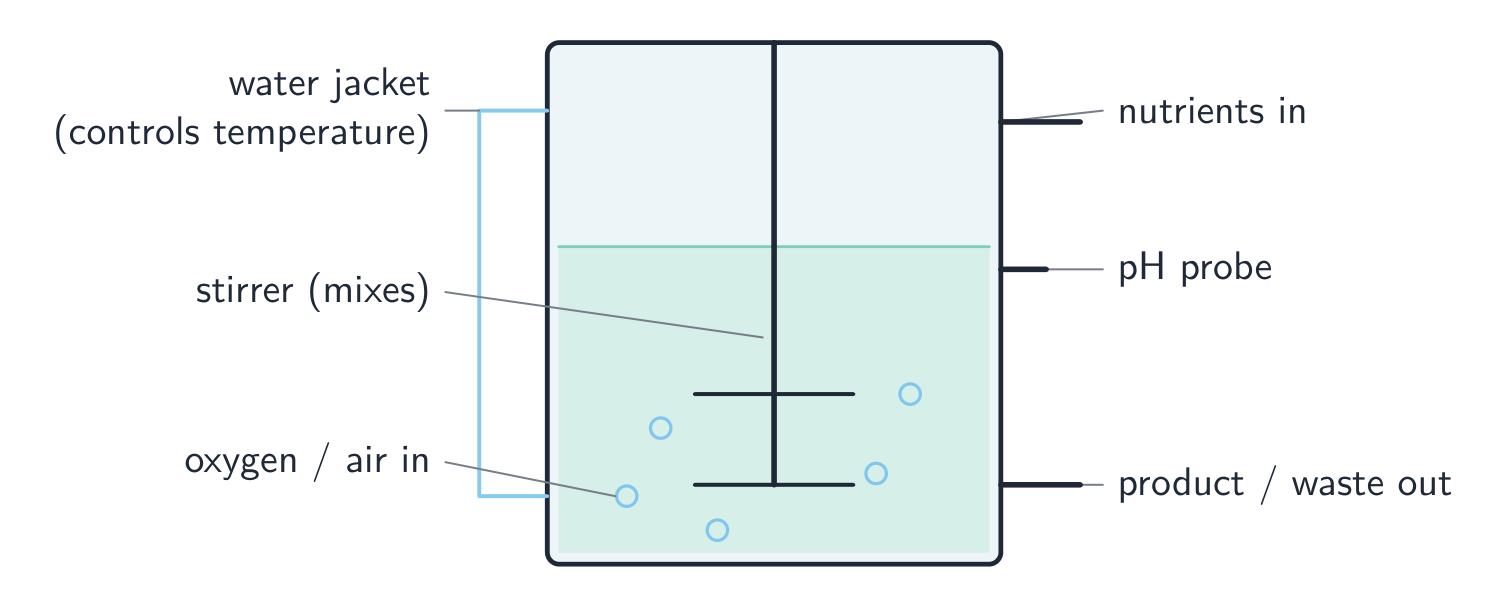
A fermenter grows microbes with the temperature, pH, oxygen and nutrients all controlled
A water jacket around a fermenter is used to:
Dificultad 1/5 · 100 monedas + un pequeño bono en el primer intento de hoy
It cools the tank to keep the optimum temperature.
Which conditions are controlled in a fermenter? (Select all that apply.)
Dificultad 2/5 · 140 monedas + un pequeño bono en el primer intento de hoy
Temperature, pH and oxygen matter; tank colour does not.
Controlling the conditions
- Temperature is controlled (a water jacket removes the heat from respiration).
- pH, oxygen (air is bubbled in), and nutrients are all kept at their best.
A fermenter is kept open to the air so that more microbes can help the process.
Dificultad 1/5 · 100 monedas + un pequeño bono en el primer intento de hoy
False. A fermenter is kept sterile so that other microbes cannot contaminate the product or compete with the useful microorganism.
A ______ keeps the contents of a fermenter mixed and evenly supplied.
Dificultad 1/5 · 100 monedas + un pequeño bono en el primer intento de hoy
Stirring distributes heat, oxygen and nutrients.
Keeping it sterile 无菌的
- The fermenter is kept sterile (free of other microbes) so nothing competes or contaminates the product.
- A stirrer 搅拌器 keeps everything mixed and evenly supplied.
Fermenters must remove heat, not add it. Microbes respire and release heat; if the tank overheats, enzymes denature and the microbes die. A cooling water jacket keeps the temperature at the optimum.
Worked example: running a fermenter
A company grows the fungus Penicillium in a fermenter to make penicillin. For each control, say why it is needed: a water jacket, an air supply, a pH probe, and steam-cleaning between batches.
- Water jacket: respiration releases heat, which could denature the fungus's enzymes; cold water keeps it near the best temperature (about 25 °C). Air supply: oxygen for aerobic respiration, so the fungus grows fast.
- pH probe: acid or alkali is added to keep the pH at the enzymes' best value. Steam-cleaning (aseptic conditions): kills other microbes, which would compete for nutrients or contaminate the product.
Why does a fermenter have a stirring paddle?
Dificultad 1/5 · 100 monedas + un pequeño bono en el primer intento de hoy
Mixing keeps conditions the same everywhere, so all the microbes grow well.
A fermenter usually needs cooling, because the respiring microbes release heat.
Dificultad 1/5 · 100 monedas + un pequeño bono en el primer intento de hoy
Respiration releases energy, much of it as heat.
You've got it
- a fermenter grows microbes in large amounts under controlled conditions
- temperature, pH, oxygen and nutrients are all kept ideal (a water jacket cools it)
- it is kept sterile and stirred to maximise product and avoid contamination
Write from this case
- Microbes in a tank are making a product.
- The tank would overheat if nothing removed the heat.
What cools the tank, and why must it stay sterile?
Respiration heats the culture, so the jacket removes that heat.
What stops a fermenter overheating?
Dificultad 1/5 · 100 monedas + un pequeño bono en el primer intento de hoy
Cooling water in the jacket takes heat away.