How DNA makes proteins
Introducido| English | Significado |
|---|---|
| amino acid/əˈmiːnəʊ ˈæsɪd/ | aminoácido |
| base sequence/beɪs ˈsiːkwəns/ | secuencia de bases |
| double helix/ˈdʌbl ˈhiːlɪks/ | doble hélice |
| bases/ˈbeɪsɪz/ | bases nitrogenadas |
Three letters for one amino acid, 1961
- In May 1961 Marshall Nirenberg and Heinrich Matthaei, at the US National Institutes of Health, added an artificial genetic message made only of the base U — UUUUUU… — to a mixture of cell parts. The mixture made a protein chain made only of one amino acid, phenylalanine. It was the first word of the genetic code to be read.
- A gene's base sequence 碱基序列 decides the order of amino acids 氨基酸 in a protein.
Which amino acid did Nirenberg's all-U message make?
Dificultad 1/5 · 100 monedas + un pequeño bono en el primer intento de hoy
The first code word read.
The structure of DNA
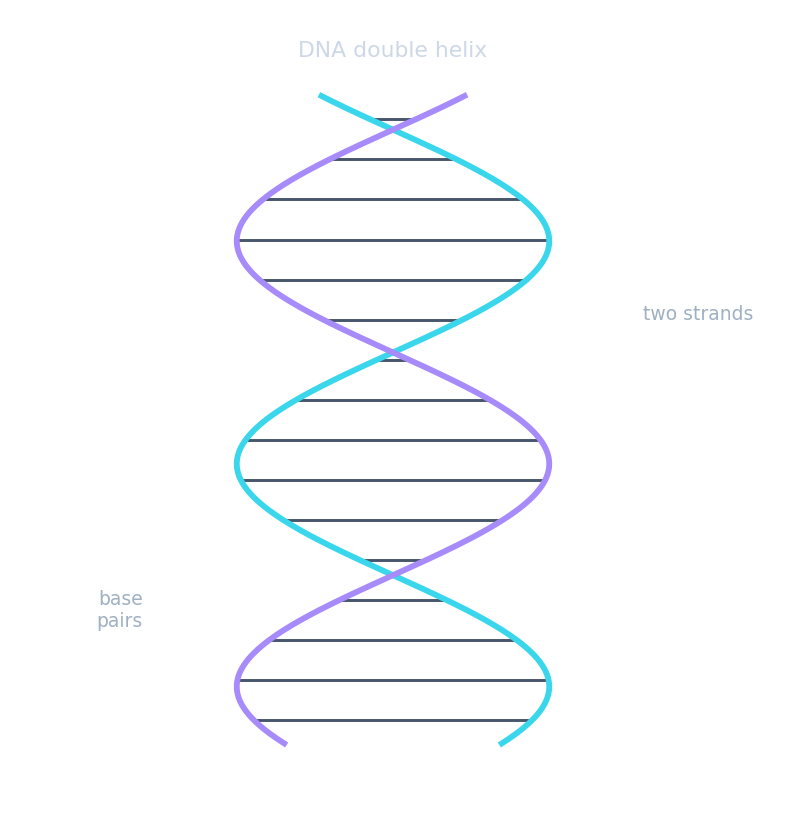
- DNA is two strands twisted into a double helix 双螺旋. The strands are joined by pairs of bases 碱基: A with T, C with G.
- A gene is a length of DNA that codes for one protein.
From gene to protein
Step through the central dogma: the DNA template is transcribed into mRNA by base pairing (A→U, T→A, G→C, C→G), then read in codons and translated into a chain of amino acids.
Match each base to its partner in DNA.
Dificultad 2/5 · 140 monedas + un pequeño bono en el primer intento de hoy
Complementary pairing.
A gene is a length of DNA that codes for one protein.
Dificultad 1/5 · 100 monedas + un pequeño bono en el primer intento de hoy
The definition.
From gene to messenger
- DNA stays in the nucleus. A copy of one gene is made as messenger RNA (mRNA), which leaves the nucleus.
- mRNA travels to a ribosome in the cytoplasm.
What carries the gene's copy to the ribosome?
Dificultad 1/5 · 100 monedas + un pequeño bono en el primer intento de hoy
DNA stays in the nucleus.
Building the protein
- At the ribosome, each group of three bases codes for one amino acid. Amino acids are joined in the order the bases give.
- The chain folds into a particular shape — for example an enzyme's active site or an antibody.
Worked example: count amino acids
A section of a gene has 27 bases.
- Rule: three bases code for one amino acid.
- Count: 27 ÷ 3 = 9 amino acids.
- Base pairs: if one strand reads ATGCCT, the other strand reads TACGGA.
How many amino acids does a 45-base section code for?
Dificultad 2/5 · 140 monedas + un pequeño bono en el primer intento de hoy
45 ÷ 3.
One DNA strand reads GATC. What does the other strand read?
Dificultad 1/5 · 100 monedas + un pequeño bono en el primer intento de hoy
G–C, A–T.
Why the sequence matters
- A change in the base sequence (a mutation) can change one amino acid, which may change the protein's shape so it no longer works.
- Different cells use different genes, so cells can make different proteins even though they all contain the same DNA.
A change in one base can change a protein's shape.
Dificultad 1/5 · 100 monedas + un pequeño bono en el primer intento de hoy
A different amino acid may be used.
DNA does not leave the nucleus to make proteins. It is the mRNA copy that travels to the ribosome.
DNA is a double helix with paired bases (A–T, C–G). A gene's base sequence is copied into mRNA, which goes to a ribosome; each three bases code for one amino acid, so the sequence decides the protein.
Describe how the base sequence of a gene controls the shape of an enzyme.
Gene to protein.