Fertilisation and germination
Introducido| English | Significado |
|---|---|
| seed/siːd/ | semilla |
| pollen tube/ˈpɒlən tjuːb/ | tubo polínico |
| ovule/ˈɒvjuːl/ | óvulo |
| fruit/fruːt/ | fruto |
| germination/ˌdʒɜːmɪˈneɪʃn/ | germinación |
From pollen to a new plant
- After pollination, the plant must complete fertilisation and grow a seed 种子 — which later sprouts.
- These steps turn a flower into the next generation.
After landing on the stigma, a pollen grain grows a:
Dificultad 1/5 · 100 monedas + un pequeño bono en el primer intento de hoy
The pollen tube carries the male nucleus to the ovule.
After fertilisation, the ovule becomes a:
Dificultad 1/5 · 100 monedas + un pequeño bono en el primer intento de hoy
The ovule becomes a seed; the ovary becomes a fruit.
Fertilisation in plants
- A pollen grain grows a pollen tube 花粉管 down the style to an ovule 胚珠 in the ovary.
- The male nucleus fuses with the ovule — fertilisation. The ovule becomes a seed; the ovary becomes a fruit 果实.
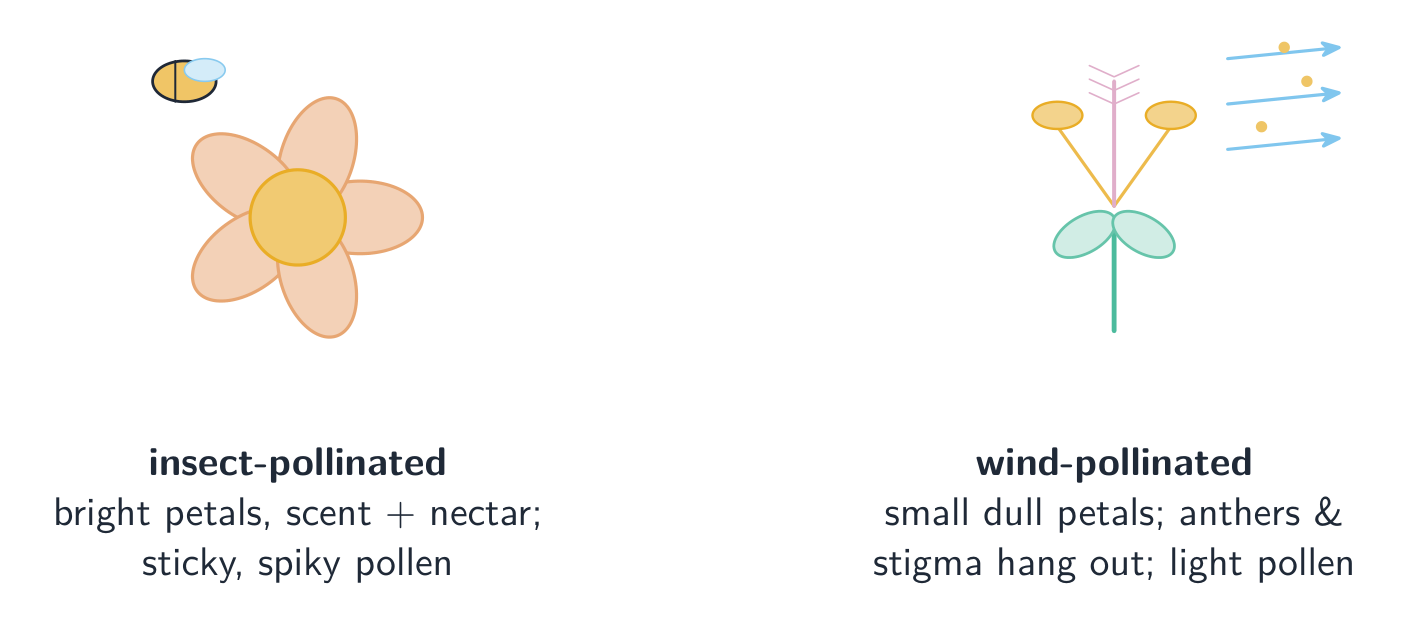
Pollination transfers pollen from anther to stigma — the first step toward a new plant
Germination of a seed
A seed stays dormant until it has the right conditions, then the young plant grows out.
Which conditions does a seed need to germinate? (Select all that apply.)
Dificultad 2/5 · 140 monedas + un pequeño bono en el primer intento de hoy
Seeds need water, oxygen and warmth — not light at first.
Germination needs ______ to activate the seed's enzymes.
Dificultad 1/5 · 100 monedas + un pequeño bono en el primer intento de hoy
Water, oxygen and warmth start germination.
What a seed needs to germinate
- Germination 萌发 is a seed starting to grow. It needs water, oxygen and a suitable temperature.
- (It does not need light at first — the energy comes from the seed's food store.)
A seed needs light to begin germinating.
Dificultad 1/5 · 100 monedas + un pequeño bono en el primer intento de hoy
The seed uses its own food store; light is needed only later.
Why those conditions
- Water activates enzymes; oxygen is for respiration; warmth speeds the enzymes up.
- The young plant uses stored food until its leaves can photosynthesise.
Seeds don't need light to germinate. Many people assume they do, but the seed has its own food store. Light is only needed later, once the seedling must photosynthesise.
Worked example: four tubes of seeds
Cress seeds are set up in four tubes for a week: A moist cotton wool at 20 °C; B dry cotton wool at 20 °C; C moist cotton wool at 4 °C (fridge); D moist cotton wool at 20 °C with all oxygen removed. Only A germinates. Explain.
- B lacks water, needed to activate enzymes and swell the seed. C is too cold: enzymes work very slowly. D lacks oxygen for aerobic respiration, which releases the energy for growth.
- A has all three, so it is the control: comparing each tube with A changes only one variable at a time. Light is not needed: seeds germinate in the dark using stored food.
Why is tube A needed in this experiment?
Dificultad 1/5 · 100 monedas + un pequeño bono en el primer intento de hoy
Without A, failure in B, C or D could be due to dead seeds rather than the missing condition.
Seeds must have light to germinate.
Dificultad 1/5 · 100 monedas + un pequeño bono en el primer intento de hoy
Germination uses the seed's food store; light is needed later, once leaves start photosynthesising.
You've got it
- a pollen tube carries the male nucleus to the ovule → fertilisation
- the ovule becomes a seed, the ovary becomes a fruit
- germination needs water, oxygen and warmth (not light at first)
Write from a seed in the dark
- A seed has water, oxygen and warmth.
- It is kept in the dark.
Can it germinate, and what does the ovary become?
The three germination conditions do not include light.
Which set lets a seed germinate?
Dificultad 1/5 · 100 monedas + un pequeño bono en el primer intento de hoy
Water, oxygen and warmth are the required conditions.