Breathing and gas exchange · Respiración e intercambio de gases
| English | Español |
|---|---|
| ventilation/ˌventɪˈleɪʃn/ | ventilación |
| diaphragm/ˈdaɪəfræm/ | diafragma |
| inhaled/ɪnˈheɪld/ | inhalar |
| exhaled/eksˈheɪld/ | exhalar |
Breathing in and out
- To keep the gradient steep at the alveoli, fresh air must be pumped in and stale air out.
- This is ventilation 通气 (breathing), powered by muscles.
Inspirar y espirar
- Para mantener un gradiente pronunciado en los alvéolos, debe bombearse aire fresco hacia adentro y aire viciado hacia afuera.
- Esto es la ventilación 通气 (respiración), impulsada por músculos.
When you breathe in, the diaphragm: · Cuando inhalas, el diafragma:
The diaphragm flattens to increase chest volume. · El diafragma se aplanan para aumentar el volumen torácico.
Air rushes into the lungs when the pressure inside the chest: · El aire entra rápidamente en los pulmones cuando la presión interna del tórax:
Lower internal pressure draws air in. · La menor presión interna atrae el aire hacia adentro.
During inhaling, the rib muscles lift the ribs up and out. · Durante la inhalación, los músculos intercostales levantan las costillas hacia arriba y hacia afuera.
This expands the chest, lowering pressure. · Esto expande el tórax, reduciendo la presión.
The movement of air in and out of the lungs is called ______ (breathing). · El movimiento del aire hacia adentro y hacia afuera de los pulmones se llama ______ (respiración).
Ventilation keeps the gas-exchange gradient steep. · La ventilación mantiene el gradiente de intercambio de gases pronunciado.
Breathing in (inhaling)
- The diaphragm 膈肌 flattens and the rib muscles lift the ribs up and out.
- This increases the chest volume, lowering the pressure, so air rushes in.
The lungs are the gas-exchange organs of the body
Inspiración (inspirar)
- El diafragma 膈肌 se aplanan y los músculos intercostales elevan las costillas hacia arriba y hacia afuera.
- Esto aumenta el volumen torácico, disminuyendo la presión, lo que provoca que el aire fluya hacia adentro.
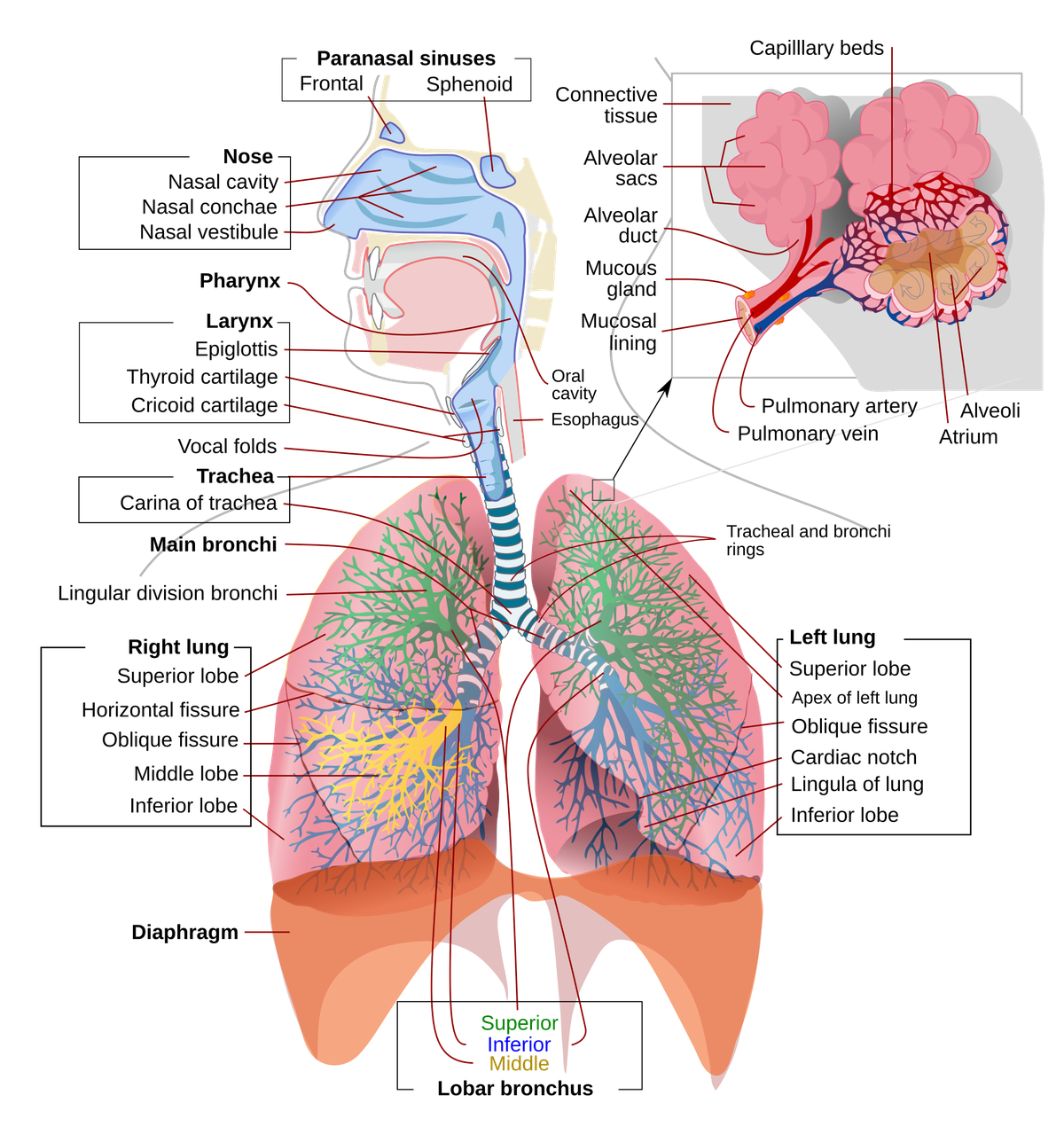
Los pulmones son los órganos de intercambio gaseoso del cuerpo
Breathing in and out · Inhalación y exhalación
Breathing changes the volume of the chest, which changes the pressure and makes air flow in or out. · La respiración cambia el volumen del tórax, lo que altera la presión y provoca el flujo de aire hacia adentro o hacia afuera.
Compared with inhaled air, exhaled air has: · En comparación con el aire inhalado, el aire exhalado tiene:
Oxygen is used and carbon dioxide added. · Se consume oxígeno y se añade dióxido de carbono.
Breathing out (exhaling)
- The diaphragm relaxes (domes up) and the ribs drop.
- Chest volume decreases, pressure rises, and air is pushed out.
Air travels from the trachea through the bronchi and bronchioles to the alveoli
Espiración (espirar)
- El diafragma se relaja ( forming an arc) y las costillas descienden.
- El volumen torácico disminuye, la presión aumenta y el aire es expulsado.

El aire viaja desde la tráquea a través de los bronquios y bronquiolos hasta los alvéolos
Breathing mechanism · Mecanismo de respiración
Watch a breath — the diaphragm flattens and ribs lift, the chest grows, the pressure drops, and air flows in. Relax and it pushes back out. · Observa una respiración: el diafragma se aplanan y las costillas se elevan, el tórax crece, la presión disminuye y entra aire. Al relajarse, el aire es expulsado nuevamente.
Inhaled 吸入的 vs exhaled 呼出的 air
- Inhaled air has more oxygen and less carbon dioxide.
- Exhaled air has less oxygen, more carbon dioxide, and more water vapour.
Worked example. When you breathe in, the diaphragm contracts and flattens, the chest expands, pressure inside falls below the outside, and air flows in — exactly like pulling out a syringe plunger draws air in.
Breathing in makes the thorax bigger; breathing out makes it smaller
Aire inspirado 吸入的 vs espirado 呼出的
- El aire inspirado tiene más oxígeno y menos dióxido de carbono.
- El aire espirado tiene menos oxígeno, más dióxido de carbono y más vapor de agua.
Ejemplo resuelto. Cuando inhalas, el diafragma se contrae y se aplanan, el tórax se expande, la presión interna cae por debajo de la externa y el aire entra — exactamente igual que al tirar del émbolo de una jeringuilla se atrae el aire hacia adentro.

Inspirar hace que el tórax sea más grande; espirar lo hace más pequeño
You've got it
- inhaling: diaphragm flattens, ribs rise → chest volume up, pressure down → air in
- exhaling: diaphragm relaxes, ribs drop → chest volume down, pressure up → air out
- exhaled air has less oxygen and more carbon dioxide than inhaled air
Lo has logrado
- Inspirando: el diafragma se aplanan, las costillas suben → volumen torácico aumenta, presión disminuye → aire entra
- Espirando: el diafragma se relaja, las costillas bajan → volumen torácico disminuye, presión aumenta → aire sale
- El aire espirado tiene menos oxígeno y más dióxido de carbono que el aire inspirado