Rigid bodies and rotational dynamics
Introducido| English | Significado |
|---|---|
| torque/tɔːk/ | par de fuerzas |
| moment of inertia/ˈməʊmənt ɒv ɪˈnɜːʃə/ | momento de inercia |
What would explain this observation?
- A door is easier to open when pushed near its outer edge. Force size alone does not determine the turning effect.
Build the model
- Torque 力矩 depends on force and perpendicular distance from the axis.
- Moment of inertia 转动惯量 describes resistance to angular acceleration and depends on mass distribution about a stated axis.
- torque: Turning effect about an axis.
- moment of inertia: Resistance to angular acceleration about a specified axis.

What increases torque for the same perpendicular force?
Dificultad 1/5 · 100 monedas + un pequeño bono en el primer intento de hoy
Torque = force x perpendicular distance from the axis, so for the same force a larger perpendicular lever arm gives a larger torque. This is why a longer spanner loosens a tight nut more easily.
Match each technical term to its precise meaning.
Dificultad 2/5 · 140 monedas + un pequeño bono en el primer intento de hoy
Use the definitions to distinguish related quantities and processes.
Choose evidence that can test it
- For a rigid body about a fixed axis, net torque equals moment of inertia multiplied by angular acceleration.
- Rotational kinetic energy depends on angular speed squared.
- Angular momentum is conserved when net external torque is zero.
In the lab: Draw the pivot, force direction and perpendicular lever arm. Do not use the sloping distance from pivot to force point unless it is perpendicular to the force. For experiments, keep rotating parts guarded and loads secure.
Which two habits make the investigation or model in this case more defensible?
Dificultad 2/5 · 140 monedas + un pequeño bono en el primer intento de hoy
Stating the conditions and assumptions lets others repeat the work exactly, and recording the supporting evidence lets them check the conclusion. Hiding disagreeing results removes the evidence that could challenge a wrong conclusion, and one measurement can never establish a wider claim.
Work from known quantities
- Known: a 10 N perpendicular force acts 0.30 m from an axis.
- Torque = force × perpendicular distance = 10×0.30 = 3.0 N m.
- If moment of inertia is 0.60 kg square metres, angular acceleration = torque/inertia = 3.0/0.60 = 5.0 radians per second squared.
Your turn: A 12 N force acts perpendicularly 0.25 m from the pivot. Find torque.
The force angle changes the lever arm
Start with 10 N perpendicular to a 0.30 m radius and I = 0.60 kg·m². Compare the radius with the perpendicular lever arm, and connect net torque to angular acceleration.
A 12 N force acts perpendicularly 0.25 m from the pivot. Find torque.
Dificultad 2/5 · 140 monedas + un pequeño bono en el primer intento de hoy
The result is 3 N m. Known: force 12 N perpendicular to a lever arm of 0.25 m. Use torque = force x perpendicular distance. Torque = 12 x 0.25 = 3.0 N m. A force through the pivot would give zero torque however large it was.
Check the conclusion and its limits
- Torque has unit N m but is a turning effect, not an energy store.
- Moment of inertia changes if the same mass moves farther from the axis.
Not true: Moment of inertia depends only on total mass, never its distribution. Moment of inertia depends on how mass is distributed relative to the axis: the same total mass farther from the axis gives a larger moment of inertia. With negligible external torque, a skater spins faster when the arms are pulled inward because the smaller moment of inertia must accompany a larger angular speed.
- Torque depends on force and perpendicular distance from the axis.
- For a rigid body about a fixed axis, net torque equals moment of inertia multiplied by angular acceleration.
- Watch for: torque has unit N m but is a turning effect, not an energy store.
Moment of inertia depends on how mass is distributed relative to the axis: the same total mass farther from the axis gives a larger moment of inertia.
Dificultad 1/5 · 100 monedas + un pequeño bono en el primer intento de hoy
True. Moment of inertia depends on how mass is distributed relative to the axis: the same total mass farther from the axis gives a larger moment of inertia. With negligible external torque, a skater spins faster when the arms are pulled inward because the smaller moment of inertia must accompany a larger angular speed.
Turning effect about an axis: write the technical term.
Dificultad 1/5 · 100 monedas + un pequeño bono en el primer intento de hoy
torque means Turning effect about an axis.
Write from the data given
- A 20 N force acts perpendicularly 0.40 m from the pivot.
- Find the torque. Moment of inertia depends on how mass is distributed.
A 20 N force acts perpendicularly 0.40 m from the pivot. What is the torque, and why does moment of inertia not depend only on total mass?
Torque is force times the perpendicular distance from the pivot. Mass closer to the axis contributes less to the moment of inertia.
For the written 20 N force perpendicular to a 0.40 m lever arm, what is the torque?
Dificultad 1/5 · 100 monedas + un pequeño bono en el primer intento de hoy
20 times 0.40 is 8 newton metres. Other options — 3 newton metres (the lesson force of 12 N at 0.25 m); 20 N (the force).
AHL: Measure the perpendicular lever arm
- This whole rigid-body unit is additional higher level; it has no SL counterpart. A rigid-body model keeps distances between its particles fixed while allowing translation and rotation. For a force acting a distance r from an axis, torque magnitude is $\tau=Fr\sin\theta$. The lever arm is the shortest perpendicular distance to the force's line of action, not necessarily the distance to its application point.
- In invented teaching cases here, use g = 9.8 metres per second squared. A 40 N force at 60° to a 0.25 m spanner gives 8.66 N m, or 8.7 N m. At 30° the torque is 5.0 N m; perpendicular gives 10 N m. Choose a clockwise/anticlockwise sign and retain it. Torque has units N m but is a turning effect; do not label it joules just because work has the same dimensions.

An invented 40 N force acts at 30 degrees to a spanner 0.25 m long. Find torque magnitude about the bolt.
Dificultad 2/5 · 140 monedas + un pequeño bono en el primer intento de hoy
Torque = Fr sin30° = 40 × .25 × .50 = 5.0 N m. The lever arm is .125 m, not the full .25 m.
AHL: Separate a couple from a single force
- A force whose line of action passes through the chosen axis has zero torque about that axis. Two equal and opposite parallel forces with distinct lines of action form a couple: resultant force is zero but torque is not. For forces of magnitude F separated perpendicularly by d, couple torque magnitude is Fd. The separation is between the lines of action, not each line's distance to an arbitrary midpoint.
- For 8.0 N forces separated by 0.30 m, couple torque is 2.4 N m. Taking moments about either application point or about the midpoint gives the same result: at the midpoint each contributes $8.0(0.15)=1.2$ N m in the same turning sense. Equal and opposite forces acting along the same line do not make a couple. A couple can change rotation without accelerating the centre of mass.
An invented couple consists of opposite parallel 8.0 N forces with perpendicular separation 0.30 m between their lines of action. Find torque magnitude.
Dificultad 2/5 · 140 monedas + un pequeño bono en el primer intento de hoy
A couple gives Fd = 8.0 × .30 = 2.4 N m. Resultant force is zero, but the two turning effects have the same sense.
AHL: Impose both force balance and torque balance
- For complete equilibrium require zero resultant external force and zero resultant external torque. Take torques about a point that eliminates an unknown reaction; then use the force equations to find the other reactions. Once the resultant force is zero, changing the reference point does not change the resultant torque. Torque balance about a single point alone does not establish complete equilibrium.
- A uniform 4.0 m plank of mass 20 kg has a 60 kg person 1.0 m from its left support. Weight of the plank acts at its centre. About the left end, the right reaction times 4.0 balances $196(2.0)+588(1.0)=980$ N m. Thus right reaction is 245 N and left reaction is $784-245=539$ N. Independently, moments about the right end give $539(4.0)=196(2.0)+588(3.0)$.
A uniform 4.0 m plank of mass 20 kg has end supports. A 60 kg person is 1.0 m from the left support. Take g = 9.8 metres per second squared and find the left upward reaction.
Dificultad 2/5 · 140 monedas + un pequeño bono en el primer intento de hoy
Weights are 20 × 9.8 = 196 N at the plank centre, 2.0 m from the left, and 60 × 9.8 = 588 N at 1.0 m. Moments about the left give 4Rright = 196 × 2 + 588 × 1 = 980 N m, so Rright = 245 N. Vertical balance gives Rleft = 196 + 588 − 245 = 539 N. About the right end, 539 × 4 = 196 × 2 + 588 × 3 = 2,156 N m, checking the result.
AHL: Convert rotations into radians before using linear links
- One revolution is $2\pi$ radians. For rotation about a fixed axis, angular displacement, angular velocity and angular acceleration describe all points of the rigid body. Their path quantities depend on radius: arc length $s=r\Delta\theta$, tangential speed $v=\omega r$, and tangential acceleration $a_t=\alpha r$. The centripetal component is separately $a_r=\omega^2r$.
- A point 0.20 m from an axis rotating at 120 revolutions per minute has frequency 2 Hz, angular speed $4\pi$ rad/s, tangential speed about 2.51 m/s and inward acceleration about 31.6 metres per second squared. Constant angular speed makes tangential acceleration zero but does not remove radial acceleration. Specify a rotation sense for signed one-axis equations; “speed” alone is a magnitude.
AHL: Use angular motion equations only for constant acceleration
- For constant angular acceleration, use $\omega_f=\omega_i+\alpha t$, $\Delta\theta=\omega_i t+\dfrac12\alpha t^2$, or $\omega_f^2=\omega_i^2+2\alpha\Delta\theta$. A wheel changing uniformly from 5.0 to 25 rad/s over 4.0 s has acceleration 5.0 radians per second squared and angular displacement 60 radians, about 9.55 revolutions.
- A model fan initially at 30 rad/s stops uniformly after 40 revolutions. Convert first: the displacement is $80\pi$ radians. Its acceleration is about −1.79 radians per second squared, and stopping time about 16.8 s. A negative acceleration need not mean negative angular velocity: this fan still turns in the original direction until it reaches zero. If torque varies substantially, do not assume a single constant angular acceleration without justification.
A model wheel changes uniformly from 5.0 to 25 rad/s over 4.0 s. Find angular displacement in radians.
Dificultad 2/5 · 140 monedas + un pequeño bono en el primer intento de hoy
Average angular velocity = (5 + 25)/2 = 15 rad/s. Multiply by 4 s to obtain 60 radians, or 60/(2π) ≈ 9.55 revolutions.
AHL: Distinguish angular graph gradients and areas
- Gradient on an angular-displacement–time graph gives angular velocity. Gradient on an angular-velocity–time graph gives angular acceleration, and signed area under that velocity graph gives angular displacement. The wheel changing from 5 to 25 rad/s over 4 s sweeps a trapezium of area $\dfrac12(5+25)(4)=60$ radians, an independent check on its motion equation.
- Area under a torque–time graph gives angular impulse instead, in N m s. Area under a torque–angle graph gives rotational work in joules when the torque and angular displacement refer to the same axis. Read axis labels before selecting an area rule. A torque–time triangle with a 4 N m peak and 3 s duration gives angular impulse 6 N m s, not 6 J.
An invented positive torque–time pulse is triangular, with peak 4 N m and full duration 3 s. Find its angular impulse.
Dificultad 2/5 · 140 monedas + un pequeño bono en el primer intento de hoy
Signed torque–time area = ½ × 3 × 4 = +6 N m s, equal to +6 kg m²/s change in angular momentum. This is not work in joules.
AHL: Specify the axis when calculating moment of inertia
- For point masses, $I=\sum mr^2$, with r the perpendicular distance from the stated axis. The unit is kg m². Masses 0.20, 0.30 and 0.50 kg at radii 0.10, 0.20 and 0.30 m contribute 0.002, 0.012 and 0.045 kg m², summing to 0.059 kg m². Mass farther from the axis contributes disproportionately because radius is squared.
- Two 0.50 kg masses at radii 0.40 m give 0.16 kg m²; moving each to 0.20 m reduces this to 0.040 kg m². For extended bodies use the supplied formula with its specified axis: a thin ring has $MR^2$ about its symmetry axis, whereas a solid uniform disc has $\dfrac12MR^2$. Equal total mass and radius do not imply equal moment of inertia.
Point masses .20, .30 and .50 kg are at perpendicular radii .10, .20 and .30 m from a fixed axis. Find total moment of inertia.
Dificultad 2/5 · 140 monedas + un pequeño bono en el primer intento de hoy
Sum mr² = .20(.10²) + .30(.20²) + .50(.30²) = .002 + .012 + .045 = .059 kg m².
AHL: Apply resultant torque to the appropriate rotational model
- For a rigid body with constant I about a fixed axis, $\tau_{\rm net}=I\alpha$. Subtract a resisting torque before dividing by I. A model wheel of inertia 0.40 kg m² driven by 2.0 N m against 0.50 N m resistance has net torque 1.5 N m and angular acceleration 3.75 radians per second squared; using the driving torque alone gives the wrong answer.
- More generally external torque changes angular momentum. If the mass distribution changes, $\Delta L/\Delta t$ remains the relevant average relation; treating I as constant in $I\alpha$ would omit that change. For a constant 2.0 N m net torque on a 0.40 kg m² disc initially at rest for 6.0 s, final angular speed is 30 rad/s, angular momentum 12 kg m²/s and rotational kinetic energy 180 J.
An invented wheel has inertia .40 kg m². Driving torque is 2.0 N m and opposing torque .50 N m. Find angular acceleration in the driving sense.
Dificultad 2/5 · 140 monedas + un pequeño bono en el primer intento de hoy
Net torque = 2.0 − .50 = 1.50 N m; α = net torque / I = 1.50/.40 = 3.75 radians per second squared.
AHL: Link a falling mass to a rotating pulley
- For a light string unwinding without slip, $a=\alpha r$. Treat the hanging mass and fixed-axis pulley separately: downward on the mass, $mg-T=ma$; about the axle, $Tr=I\alpha$ if bearing resistance is negligible. Tension is not equal to weight while the mass accelerates, and the pulley receives torque from tension rather than directly from the hanging mass's weight.
- For a 1.0 kg mass, pulley radius 0.10 m and inertia 0.020 kg m², $T=Ia/r^2=2a$. Combining gives $9.8=3a$, so acceleration is about 3.27 metres per second squared and tension 6.53 N. The downward acceleration is less than g because the hanging mass also drives the pulley's rotation. Check that the string remains taut and that the no-slip link is valid.
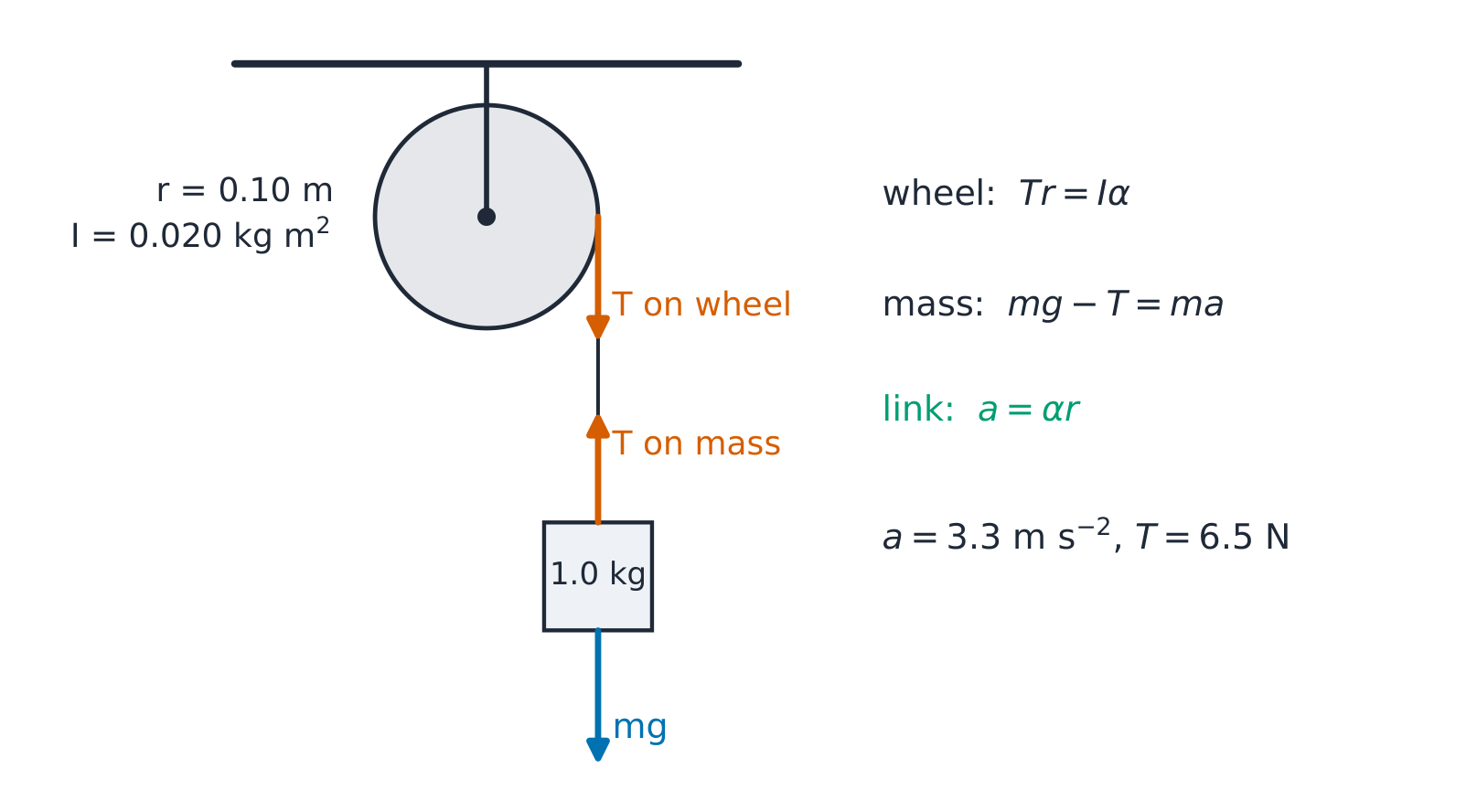
A 1.0 kg mass drives a fixed-axis pulley of radius .10 m and inertia .020 kg m² through a light, non-slipping string. Neglect bearing resistance and use g = 9.8 metres per second squared. Find string tension.
Dificultad 2/5 · 140 monedas + un pequeño bono en el primer intento de hoy
No slip gives α = a/r. Pulley torque Tr = Iα therefore gives T = Ia/r² = .020a/.10² = 2a. For the hanging mass, mg − T = ma gives 9.8 − 2a = a, so a = 9.8/3. Hence T = 2 × 9.8/3 ≈ 6.53 N, below weight because the mass accelerates downward.
AHL: Conserve angular momentum without assuming constant kinetic energy
- For the one-axis model, angular momentum is $L=I\omega$. It is conserved for the chosen system when external torque has negligible impulse over the interval. Internal forces can redistribute angular momentum between parts. A skater changing inertia from 3.0 to 1.0 kg m² while initially at 2.0 rad/s spins at 6.0 rad/s under that condition.
- The skater's kinetic energy rises from 6.0 to 18 J: muscles do work as the body configuration changes. Conservation of angular momentum does not require conservation of kinetic energy. Similarly, a diver with inertia 12 kg m² at 2.0 rad/s tucking to 4.0 kg m² reaches 6.0 rad/s; kinetic energy rises from 24 to 72 J. State the body/system and neglected external torque, not merely “momentum is conserved”.
A skater pulls in their arms with negligible external angular impulse. Which statement correctly accounts for their rotation?
Dificultad 1/5 · 100 monedas + un pequeño bono en el primer intento de hoy
Smaller I requires larger ω for constant Iω. Kinetic energy L²/(2I) then rises; energy is supplied through internal work, without creating external angular impulse.
AHL: Test angular momentum in a sticking interaction
- A disc with inertia 0.20 kg m² at 30 rad/s contacts a stationary coaxial disc of inertia 0.10 kg m². If axle torque has negligible angular impulse while they reach a common speed, initial angular momentum 6.0 kg m²/s equals $0.30\omega_f$, giving 20 rad/s. The frictional torques between the discs are internal to the combined system.
- Initial rotational kinetic energy is 90 J and final is 60 J, so 30 J becomes other energy, principally thermal. Separately, dropping a 0.10 kg lump of clay vertically onto a freely rotating 0.050 kg m² turntable initially turning at 3.0 rad/s, at radius 0.15 m adds inertia 0.00225 kg m². With no initial clay angular momentum about that vertical axis, $L_i=0.050(3.0)=0.150$ kg m²/s and $\omega_f=0.150/(0.050+0.00225)\approx2.87$ rad/s. Do not replace the clay's contribution by mass alone.
AHL: Give braking angular impulse a sign
- Choose the initial rotation as positive. A brake torque of −15 N m lasting 4.0 s gives angular impulse −60 N m s and change in angular momentum −60 kg m²/s. For inertia 2.0 kg m² and initial angular velocity 50 rad/s, initial angular momentum is 100; final is 40, so angular velocity is 20 rad/s. The impulse magnitude is 60, but the directed change is negative.
- With the triangular torque pulse described earlier, angular impulse magnitude 6 N m s changes a fixed-inertia 0.50 kg m² wheel's angular velocity by 12 rad/s in the pulse's direction. To find final velocity add that signed change to the initial value. Average torque is total angular impulse divided by duration; it need not equal the peak torque of a non-rectangular pulse.
Take a flywheel’s initial rotation as positive. A constant opposing brake torque has magnitude 15 N m and lasts 4.0 s. Find the signed angular impulse.
Dificultad 2/5 · 140 monedas + un pequeño bono en el primer intento de hoy
The directed torque is −15 N m. Its impulse is (−15) × 4.0 = −60 N m s. The positive magnitude 60 is not the signed angular-momentum change.
AHL: Split rolling kinetic energy into two contributions
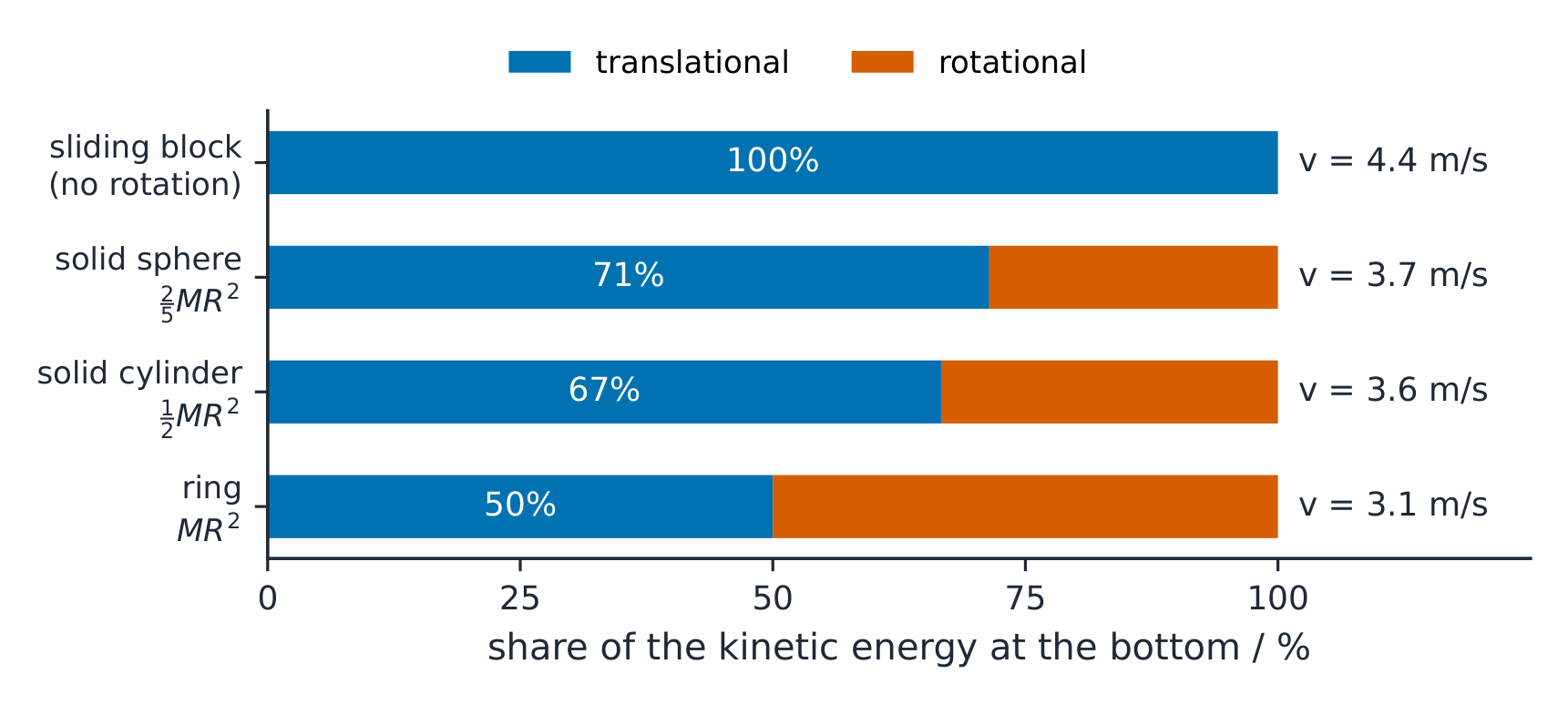
- A rigid body rolling without slipping on a stationary surface has centre speed $v=\omega R$ and total kinetic energy $\dfrac12Mv^2+\dfrac12I\omega^2$, with I about its centre of mass. A solid cylinder has $I=\dfrac12MR^2$; from rest down a 1.0 m vertical drop without dissipative losses, $Mgh=\dfrac34Mv^2$, giving speed about 3.61 m/s.
- For the same ideal drop, a ring reaches 3.13 m/s, a solid sphere 3.74 m/s, and a non-rotating frictionless sliding block 4.43 m/s. The cylinder's energy fractions are two-thirds translational and one-third rotational; a ring splits equally. The comparison assumes rolling without slip and common starting conditions. Static friction can provide the rolling constraint without dissipating energy at an ideal stationary contact; slipping or rolling resistance changes the balance.
AHL: Check coupled dynamics using an independent energy method
- Let the same 1.0 kg hanging mass descend 0.60 m from rest while driving the 0.020 kg m² pulley of radius 0.10 m. Initial gravitational energy is 5.88 J. With no bearing loss or slip, $mgh=\dfrac12mv^2+\dfrac12I(v/r)^2$, giving $5.88=1.5v^2$. Thus $v^2=3.92$ and speed is about 1.98 m/s.
- The mass's translational kinetic energy is 1.96 J and pulley's rotational kinetic energy 3.92 J, summing to 5.88 J. Independently use $v^2=2as$ with the earlier acceleration $9.8/3$: it gives the same 3.92. Keeping only the falling mass's kinetic energy would incorrectly predict free fall. These two methods test whether the force model, no-slip relation and energy bookkeeping agree.
The 1.0 kg mass and .020 kg m² pulley of radius .10 m start from rest. The mass drops .60 m with no slip or dissipation. Take g = 9.8 metres per second squared. Find final speed of the mass.
Dificultad 2/5 · 140 monedas + un pequeño bono en el primer intento de hoy
mgh = 5.88 J = ½[m + I/r²]v² = 1.5v². Thus v = √3.92 ≈ 1.98 m/s. Energy divides into 1.96 J translational and 3.92 J rotational; v² = 2as checks this independently.
AHL: Design a torque and inertia measurement
- Guard the rotating equipment and secure suspended loads. Apply known tangential force at a measured radius, measure angular velocity against time, and use its gradient for acceleration. Vary the applied torque while holding inertia fixed. A plot of net torque against acceleration should have gradient I; uncorrected approximately constant bearing torque gives an intercept in the applied-torque plot.
- Record force direction and lever arm, repeats and uncertainty. Move equal masses symmetrically to change I while controlling total mass and the axis. Each mass contribution mr² falls to a quarter when its radius halves, not to a half. Use controlled small loads and valid force/acceleration ranges; an apparent intercept or curvature is evidence to examine the bearing model, measurement zero, string slip or changing resistance.
AHL: Build a rotational explanation with a stated axis
- Begin with a diagram, an axis and a positive rotation sense. Choose force/torque balance for complete equilibrium, constant-acceleration equations for a justified uniform acceleration, resultant torque for dynamics, or angular-momentum conservation for negligible external angular impulse. Link coupled translational and rotational motions with the actual no-slip constraint, not a guessed equality of linear and angular speeds.
- Check units, signs, mass distribution and energy separately. Torque–time area gives angular impulse; torque–angle area gives work. A sticking interaction can conserve angular momentum while kinetic energy decreases; a tucking skater can conserve angular momentum while kinetic energy increases. For rolling or pulleys, include both motion contributions and verify at least one answer with a second method before rounding.
Explain how to choose a rotational equation and check a coupled-body answer. Include axis, signs, angular impulse and energy.
The equations depend on the axis, system and physical constraints, so those choices must accompany the numerical answer.