Relativity and measuring events
Introducido| English | Significado |
|---|---|
| proper time/ˈprɒpə taɪm/ | tiempo propio |
| inertial frame/ɪˈnɜːʃl freɪm/ | sistema de referencia inercial |
What would explain this observation?
- Two observers can assign different times between the same events. A clock reading has meaning only when the frame and events are specified.
Build the model
- In special relativity, inertial observers measure the same vacuum light speed.
- Time dilation compares proper time 固有时间 measured where two events occur at one place with the interval in another inertial frame 惯性参考系.
- proper time: Time between events measured at one location in a frame.
- inertial frame: A frame in which a free body moves at constant velocity.

Where is proper length measured?
Dificultad 1/5 · 100 monedas + un pequeño bono en el primer intento de hoy
Proper length is defined in the frame where the object is at rest; every frame moving relative to the object measures a contracted length. It exists - it is simply tied to one specific frame.
Match each technical term to its precise meaning.
Dificultad 2/5 · 140 monedas + un pequeño bono en el primer intento de hoy
Use the definitions to distinguish related quantities and processes.
Choose evidence that can test it
- The Lorentz factor is 1 divided by the square root of 1 minus speed squared over light speed squared.
- Galilean velocity addition is an approximation for speeds much smaller than light speed.
In the lab: Label which frame measures proper time or proper length before substituting. Use event coordinates consistently. Do not combine lengths from one frame with time intervals from another without transformation.
Which two habits make the investigation or model in this case more defensible?
Dificultad 2/5 · 140 monedas + un pequeño bono en el primer intento de hoy
Stating the conditions and assumptions lets others repeat the work exactly, and recording the supporting evidence lets them check the conclusion. Hiding disagreeing results removes the evidence that could challenge a wrong conclusion, and one measurement can never establish a wider claim.
Work from known quantities
- Known: v = 0.60c and proper time is 4.0 microseconds. γ = 1/√(1-v²/c²) = 1/√(1-0.60²) = 1.25. Δt = γΔt₀ = 1.25×4.0 = 5.0 microseconds in the stated second frame.
Your turn: A proper interval is 8 microseconds and gamma is 1.25. Find the other-frame interval.
Same events, different frame times
At v = 0.60c, a 4 μs proper interval corresponds to 5 μs in the lab frame. Compare the vertical and diagonal light paths while keeping c fixed and identifying where the two events occur.
A proper interval is 8 microseconds and gamma is 1.25. Find the other-frame interval.
Dificultad 2/5 · 140 monedas + un pequeño bono en el primer intento de hoy
The result is 10 μs. Known: proper interval 8 microseconds; gamma = 1.25. Use time dilation: other-frame interval = gamma x proper interval. Interval = 1.25 x 8 = 10 microseconds. The moving-frame interval is longer, as the worked case at 0.60c also shows.
Check the conclusion and its limits
- Time dilation is not an instrument fault.
- Proper length is measured in the object rest frame; a contracted length is measured in a frame where it moves.
Not true: All inertial observers must measure the same time interval between any two events. Coordinate-time intervals depend on the inertial frame. For timelike-separated events, proper time is measured by a clock at rest where both events occur; it is not the coordinate-time reading in every frame. The space-time interval is invariant.
- In special relativity, inertial observers measure the same vacuum light speed.
- The Lorentz factor is 1 divided by the square root of 1 minus speed squared over light speed squared.
- Watch for: time dilation is not an instrument fault.
All inertial observers must measure the same time interval between any two events.
Dificultad 1/5 · 100 monedas + un pequeño bono en el primer intento de hoy
Coordinate-time intervals depend on the inertial frame. For timelike-separated events, proper time is measured by a clock at rest where both events occur; it is not the coordinate-time reading in every frame. The space-time interval is invariant.
Time between events measured at one location in a frame: write the technical term.
Dificultad 1/5 · 100 monedas + un pequeño bono en el primer intento de hoy
proper time means Time between events measured at one location in a frame.
Calculate the interval in the other frame
- A proper interval is 12 microseconds and gamma is 1.5.
- Find the interval in the other frame. Inertial observers need not agree on the duration.
A proper time interval is 12 microseconds and gamma is 1.5. What interval does the other frame measure, and why need inertial observers not agree on the duration?
Time dilation multiplies the proper time by gamma. Simultaneity and duration depend on the frame.
For the written proper interval of 12 microseconds and gamma 1.5, what interval does the other frame measure?
Dificultad 1/5 · 100 monedas + un pequeño bono en el primer intento de hoy
12 times 1.5 is 18 microseconds. Other options — 12 microseconds (the proper interval); 10 microseconds (the lesson example's result for 8 microseconds and gamma 1.25).
AHL: Give an event coordinates in a specified frame
- The whole relativity unit is additional higher level, with no SL counterpart. A reference frame assigns positions and times using rulers and synchronized clocks. An event is one occurrence at one place and time; a pair of events need not occur at the same place. An inertial frame is one in which a force-free body has constant velocity; a turning or accelerating vehicle is not globally an inertial frame.
- Compare coordinates of the same events, not unrelated clock displays. Observing an event's light arrive later also differs from assigning that event a coordinate time after allowing for light travel. Numerical cases below are invented models unless an experimental source is explicitly named. Use vacuum light speed $c=3.00\times10^8$ m/s and aligned axes, with coincident origins at time zero for the standard transformations.
AHL: Apply Galilean transformations at low speeds
- If frame S′ moves at velocity v along the positive x-axis of S, Galilean coordinates obey $x'=x-vt$ and $t'=t$. The corresponding one-dimensional velocity transformation is $u'=u-v$. A ball thrown forward at 5 m/s relative to a train moving at 20 m/s has ground-frame velocity 25 m/s. A 30 m/s eastbound car sees a 25 m/s westbound car approach at 55 m/s in this approximation.
- Keep directions in the subtraction: the second car has ground velocity −25 m/s, so its velocity relative to the first is −25 − 30 = −55 m/s. Galilean transformations assume a shared time and approximate slow mechanical motion well. They cannot preserve the same vacuum light speed for all inertial observers: applying the ordinary subtraction to light would give different speeds.
A car has ground velocity +30 m/s east. Another has ground velocity −25 m/s. In the Galilean approximation, find the second car’s signed velocity in the first car’s frame.
Dificultad 2/5 · 140 monedas + un pequeño bono en el primer intento de hoy
u′ = u − v = −25 − 30 = −55 m/s. The approach speed magnitude is 55 m/s, but the requested velocity is westward/negative.
AHL: Use both postulates without selecting a preferred inertial frame
- Special relativity states that the laws of physics have the same form in every inertial frame, and that all inertial observers measure the same vacuum light speed regardless of source motion. It does not say observers assign identical positions, times or velocities to material objects. Space and time coordinates must transform together so the laws and light-speed measurements remain consistent.
- A source moving toward a detector does not make its emitted light travel at c plus source speed in the detector's inertial frame. This vacuum statement does not require light to travel at c through water or glass. At ordinary speeds relativistic predictions approach the Galilean mechanical approximation; the approximation's usefulness is not evidence that the exact transformations retain absolute simultaneity.
AHL: Calculate gamma and check its limiting behaviour
- Write $\beta=v/c$ and $\gamma=1/\sqrt{1-\beta^2}$. At speeds 0.60c and 0.80c, gamma is 1.25 and 5/3 respectively; at 0.50c it is about 1.155, at 0.90c about 2.294, and at 0.99c about 7.089. Gamma depends on speed magnitude, so reversing the direction does not make it negative.
- Gamma is at least 1 for relative speeds below c, tends to 1 at low speed and grows without bound as speed approaches c. It is not meaningful to insert v = c for an inertial rest frame of a light pulse: no such frame exists. Do not round gamma prematurely when a later subtraction or survival calculation is sensitive to it.
Two inertial frames have relative speed 0.80c. Find the Lorentz factor gamma.
Dificultad 2/5 · 140 monedas + un pequeño bono en el primer intento de hoy
γ = 1/√(1 − .80²) = 1/.60 = 5/3 ≈ 1.667. Direction changes the signed velocity but not gamma.
AHL: Transform both coordinates of an event
- In the standard configuration, $x'=\gamma(x-vt)$ and $t'=\gamma(t-vx/c^2)$. A compact way to use metre-valued time coordinates is $x'=\gamma(x-\beta ct)$ and $ct'=\gamma(ct-\beta x)$. The relativity-of-simultaneity term in time is essential when the events are spatially separated; multiplying every time by gamma would omit it.
- For an invented event relative to the origin event, let x = 600 m, ct = 900 m and S′ move at +0.80c. Then $x'=(5/3)(600-720)=-200$ m and $ct'=(5/3)(900-480)=700$ m, so t′ is about 2.33 microseconds. Its primed position is negative, although its original x was positive. Units and both coordinates must refer to one frame at each stage.
For the invented event x = 600 m and ct = 900 m in S, frame S′ moves at +0.80c. Find x′.
Dificultad 2/5 · 140 monedas + un pequeño bono en el primer intento de hoy
x′ = γ(x − βct) = (5/3)(600 − .80 × 900) = −200 m. The event’s primed coordinate may be negative.
For the same x = 600 m, ct = 900 m event and S′ moving at +0.80c, find ct′ in metres.
Dificultad 2/5 · 140 monedas + un pequeño bono en el primer intento de hoy
γ = 1/√(1 − .80²) = 5/3. Then ct′ = γ(ct − βx) = (5/3)(900 − .80 × 600) = (5/3) × 420 = 700 m. Using c = 3.00 × 10⁸ m/s, t′ = 700/c ≈ 2.33 microseconds. Time dilation alone would omit the position term.
AHL: Invert the transformation rather than swapping labels blindly
- For the inverse standard transformation use v with the opposite sign: $x=\gamma(x'+vt')$ and $t=\gamma(t'+vx'/c^2)$. In metre-valued coordinates, the preceding event gives $x=(5/3)(-200+0.80\times700)=600$ m and $ct=(5/3)(700+0.80\times(-200))=900$ m. This independently returns the original event.
- Choose S and S′ before substituting, and state which frame moves in the positive direction of the other. The transformations apply to event-coordinate differences as well as to coordinates measured from coincident origins. For events with different positions and times, work with both differences; time dilation is a special comparison, not a replacement for the full time transformation.
AHL: Combine relativistic velocities with signs
- For S′ moving at +v relative to S, the measured object velocity is $u'=(u-v)/(1-uv/c^2)$. For two craft moving at +0.80c and −0.80c in an Earth frame, the second craft's velocity in the first frame is $-1.60c/1.64\approx-0.9756c$. The Earth-frame rate at which their separation shrinks can be 1.60c; it is not either craft's measured relative speed in its own rest frame.
- Two protons at +0.90c and −0.90c give relative speed about 0.9945c. Check a light pulse separately: setting u = c makes the transformed velocity c, as required. For an everyday train and ball, the product uv/c² is tiny and the denominator is close to 1. Do not use unsigned speeds for approaching objects and accidentally calculate a zero relative velocity.
Two invented craft have velocities +0.80c and −0.80c in an Earth frame. Find their measured relative speed as a fraction of c.
Dificultad 2/5 · 140 monedas + un pequeño bono en el primer intento de hoy
Using signed velocities gives u′/c = (−.80 − .80)/(1 + .64) = −1.60/1.64. Speed magnitude is 40/41 ≈ .9756c, below c; 1.60c is only the Earth-frame closing rate.
AHL: Identify proper time using the event locations
- For timelike-separated events, proper time is measured by an inertial clock at the place where both events occur in that clock's rest frame. Another frame sees this clock move between the events and measures $\Delta t=\gamma\Delta t_0$. If the proper interval is 4.0 microseconds at 0.60c, the other-frame interval is 5.0 microseconds. If it is 12 microseconds with gamma 1.5, the other-frame interval is 18 microseconds.
- The moving clock has not malfunctioned. Each comparison must specify the events, the clock and how distant clocks are synchronized. Proper time is not the same coordinate-time reading in every frame. For the same timelike event pair, it is the smallest positive coordinate-time interval among inertial frames; this restricted statement does not mean every clock on every possible accelerated path accumulates that same time.
AHL: Define a light-clock tick by return to one place
- A light clock can define a full tick as emission from a lower mirror and return there after reflection at an upper mirror. Those two events happen at the same place in its rest frame, so the full tick measures proper time. If mirror spacing is h, the rest-frame full tick is $\Delta t_0=2h/c$.
- In a frame where the clock moves sideways, each shown one-way leg is half of that full tick. The light travels a diagonal distance $c\Delta t/2$ while the mirror moves $v\Delta t/2$ horizontally and the transverse spacing is $c\Delta t_0/2$. Pythagoras gives time dilation. Do not call the separated emission and upper-mirror reflection events a same-place proper-time pair: it is the return to the lower mirror that supplies that condition.
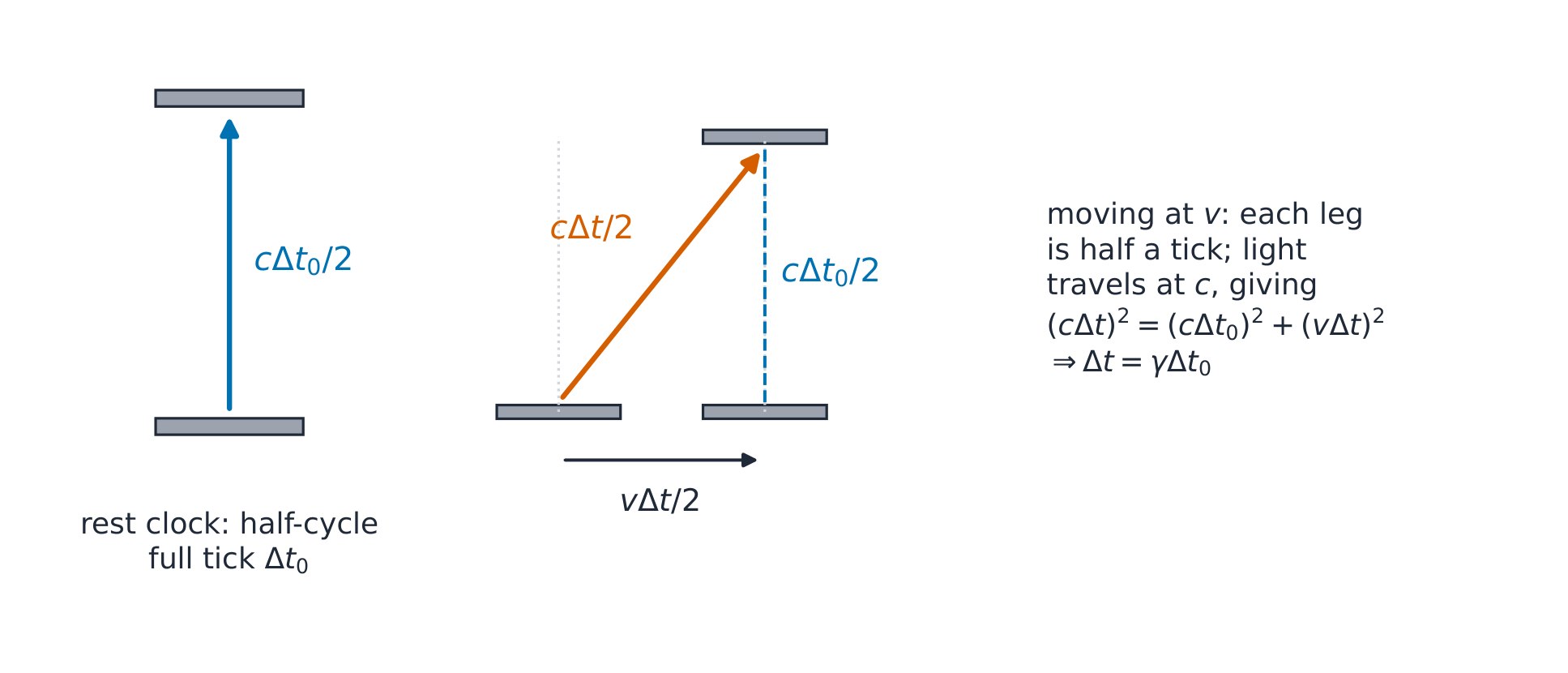
Which light-clock event pair defines a full tick that is a same-place proper-time interval in the clock’s rest frame?
Dificultad 1/5 · 100 monedas + un pequeño bono en el primer intento de hoy
A full return tick starts and ends at the same lower-mirror position in the rest frame. The diagram shows only half of that tick; the upper reflection is at a different place.
AHL: Measure moving length with simultaneous endpoints
- Proper length L₀ is measured in the object's rest frame. A frame seeing motion along the object's length obtains $L=L_0/\gamma$ from endpoint positions measured at the same coordinate time in that measuring frame. A 100 m craft moving along its length at 0.80c is measured as 60 m long in the Earth frame. A 2.0 m rod at 0.60c is measured as 1.6 m.
- Contraction affects the direction parallel to the relative motion, not the transverse dimensions. It is a statement about coordinated measurements, not a simple photograph: light from different points can arrive at different times. Do not choose one endpoint event in one frame and the other in another, or use endpoint readings at different measuring-frame times and call their separation the moving length.
A model rod has proper length 2.0 m and moves parallel to its length at 0.60c. Find its moving-frame length from simultaneous endpoint measurements.
Dificultad 2/5 · 140 monedas + un pequeño bono en el primer intento de hoy
At .60c, gamma is 1.25. L = L₀/γ = 2.0/1.25 = 1.6 m. The endpoint readings must be simultaneous in the frame measuring that moving length.
AHL: Calculate the relativity of simultaneity
- Suppose event B occurs 3,000 m farther along +x than event A, and both have the same time in S. For a frame moving at +0.60c, $\Delta t'= -\gamma v\Delta x/c^2$. Substituting gamma 1.25 gives −7.5 microseconds for B minus A: B happens earlier in S′. The conclusion concerns assigned event times, not just whose light reaches a single observer first.
- Reversing the relative frame velocity reverses this ordering for the same simultaneous-in-S pair. A line of simultaneous events in a moving frame is tilted on the other frame's space–time plot. Events that occur at the same place and time are one coincidence and remain coincident; an observer cannot turn that local coincidence into two different times simply by changing frame.
In S, B is 3,000 m farther along +x than A and both events are simultaneous. S′ moves at +0.60c. Find t′B − t′A in microseconds; use c = 3.00 × 10⁸ m/s.
Dificultad 2/5 · 140 monedas + un pequeño bono en el primer intento de hoy
Δt′ = −γvΔx/c² = −1.25 × .60 × 3,000/c = −7.5 microseconds. B is earlier in S′; this is assigned event time, not just a light-arrival delay.
AHL: Check the invariant interval and classify the pair
- In one spatial dimension define the squared interval $s^2=(c\Delta t)^2-(\Delta x)^2$. For the 600 m, ct = 900 m event pair it is 450,000 m². In the transformed frame it is $700^2-(-200)^2=450{,}000$ m² too. The square, rather than every coordinate or every coordinate-time difference, is invariant under the Lorentz transformation.
- Positive s² is timelike: a sub-light-speed inertial clock can connect the events, and its proper interval is about 2.236 microseconds here. Zero s² is lightlike; negative s² is spacelike, with no material clock able to pass through both events. For spacelike events there is no frame placing them at one spatial point and no real same-clock proper-time interval of this kind. Do not take a negative square root as evidence for imaginary laboratory clock readings.
Two events have Δx = 600 m and cΔt = 900 m. Find their squared space–time interval using s² = (cΔt)² − Δx².
Dificultad 2/5 · 140 monedas + un pequeño bono en el primer intento de hoy
900² − 600² = 450,000 m², positive and timelike. The primed coordinates cΔt′ = 700 m and Δx′ = −200 m give the same value.
AHL: Read space–time axes and world lines
- Draw x horizontally and ct vertically, with equal metre scales if using the familiar 45° light lines. A stationary object's world line is vertical; a constant-velocity object's line is straight. Its angle θ from the ct axis satisfies $\tan\theta=v/c$. A 25° angle therefore gives speed about 0.466c. A massive particle's future-directed world line stays inside the light cone; light lies on its boundary.
- For S′ moving at +0.60c, the ct′ axis is the world line of its origin and tilts about 31° from ct toward the positive light line. The x′ axis is the set t′ = 0 and tilts about 31° above x. Read primed coordinates by drawing parallels to the primed axes, not ordinary perpendicular projections. Their calibrated scales are not equal to simple Euclidean lengths on the original plot.
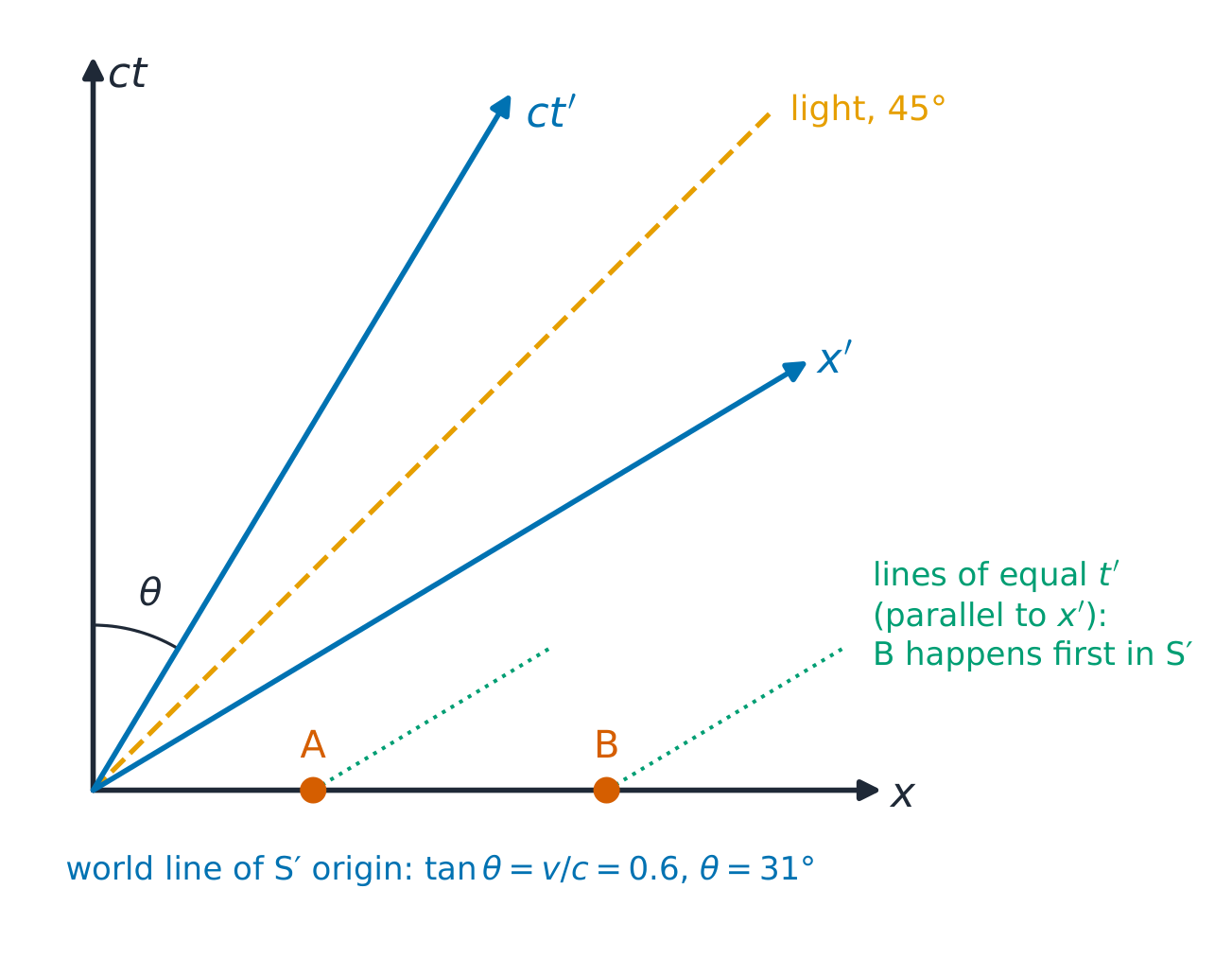
On a space–time diagram with equally scaled x and ct axes, a particle’s world line is 25 degrees from the positive ct axis. Find its speed as a fraction of c.
Dificultad 2/5 · 140 monedas + un pequeño bono en el primer intento de hoy
tanθ = v/c, so v/c = tan25° ≈ .4663. Measure the angle from the time axis, and require equal spatial and ct scales for this geometric rule.
AHL: Predict muon survival in both frames
- As an illustrative model, let muons travel 10 km at constant 0.995c, neglecting energy loss and a spread of creation heights or speeds. Take proper half-life 1.56 microseconds and gamma approximately 10. Earth-frame travel time is about 33.5 microseconds. Without dilation this would be about 21.5 proper half-lives, predicting a surviving fraction about $3.4\times10^{-7}$; with half-life dilated to about 15.6 microseconds, the prediction is about 0.23.
- In the muon frame the path contracts to about 1.0 km and the atmosphere passes in about 3.35 microseconds: again about 2.15 half-lives and the same survival fraction. Half-life and mean lifetime differ; use $2^{-t/t_{1/2}}$ for a specified half-life, not $e^{-t/t_{1/2}}$. A model at 0.98c over 2.0 km gives about 0.548 survival in either frame. These curves and percentages are calculations, not measured particle counts.
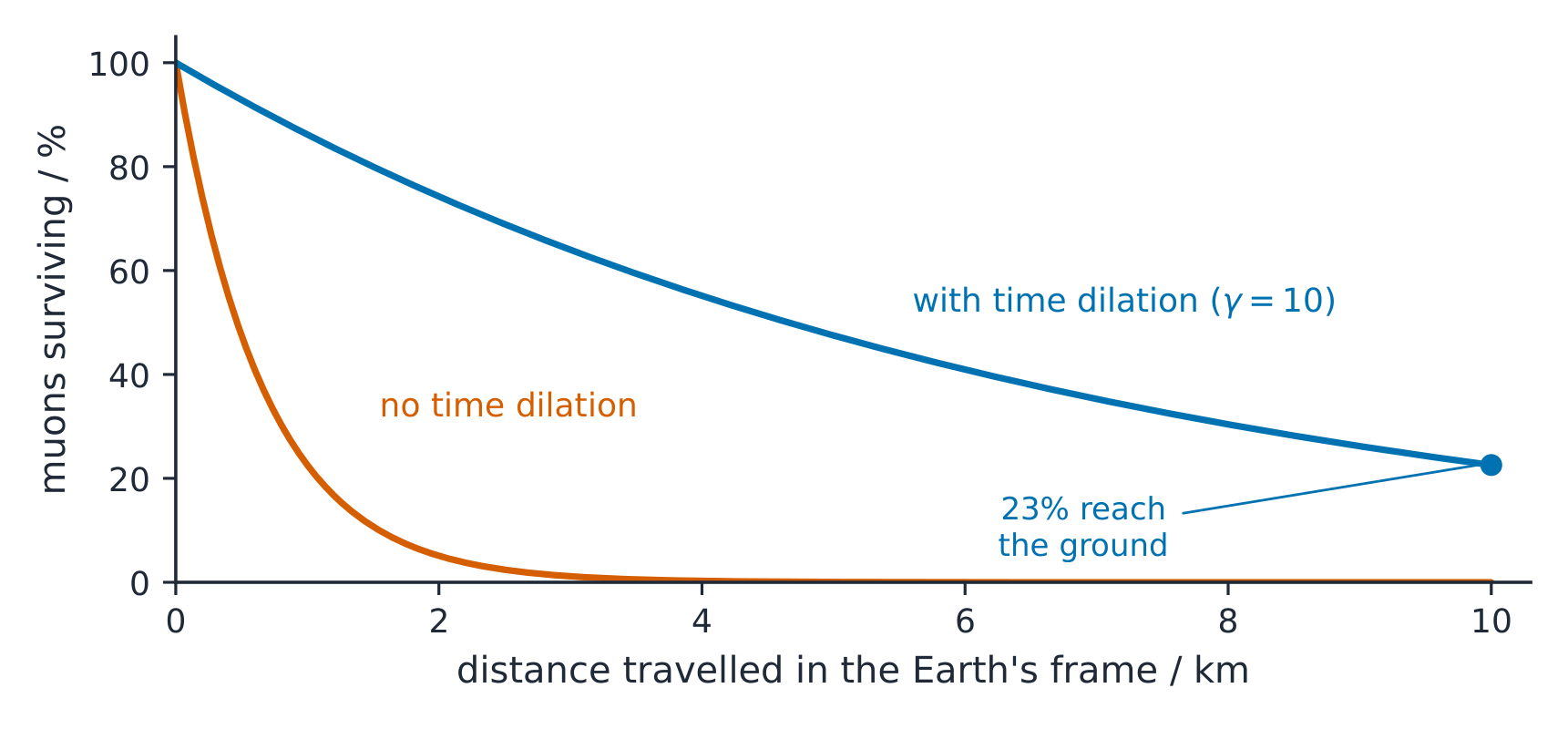
In an illustrative constant-speed model, muons cross 2.0 km at 0.98c. Proper half-life is 1.56 microseconds. Use c = 3.00 × 10⁸ m/s and find the surviving fraction (0 to 1).
Dificultad 2/5 · 140 monedas + un pequeño bono en el primer intento de hoy
γ = 1/√(1 − .98²) ≈ 5.02519. Convert distance: 2.0 km = 2,000 m. Earth-frame flight time = 2,000/(.98 × 3.00 × 10⁸) ≈ 6.80272 microseconds. Dilated half-life = γ × 1.56 ≈ 7.83929 microseconds. Surviving fraction = 2^(−6.80272/7.83929) ≈ .548. In the muon frame, distance = 2,000/γ and flight time ≈ 1.35372 microseconds; dividing by the proper half-life 1.56 gives the same exponent. These are model predictions, not measured counts.
AHL: Separate experimental evidence from an illustrative curve
- The Rossi–Hall abstract reports that a less penetrating particle group decayed about three times faster than a more penetrating group, consistent with the relativistic moving-clock prediction. This is an experimental comparison, separate from our invented fixed-height survival example. It does not establish that a measured ground-level fraction was exactly our calculated 23%.
- To test a survival model, control or measure particle speeds, path length, detector acceptance, observation time, background and energy loss. Compare surviving counts for matched selections and report uncertainty. Before accepting a calculation, transform both event coordinates or compare both frames' survival fractions, check the interval and light-speed limit, and identify which measured quantity is proper. A large disagreement may reveal mixed frames or a half-life/mean-lifetime mix-up before it challenges the physical model.
Explain how to solve and check a relativity measurement problem without mixing frames. Include proper quantities, event transformations and a model/evidence distinction.
The measured quantity, events and frame determine which relation applies; a plausible number alone does not establish a valid comparison.