English listening and reading inference
Introducido| English | Significado |
|---|---|
| inference/ˈɪnfərəns/ | inferencia |
| explicit/ekˈsplɪsɪt/ | Stated directly. |
| implicit/ɪmˈplɪsɪt/ | Suggested but not stated directly. |
| qualified | Limited or partly changed by a condition or reservation, such as an opinion with a but. |
Six words, one story
- "For sale: baby shoes, never worn." These six words, often attributed to Ernest Hemingway, tell no story directly — yet almost every reader feels a loss.
- The reader works out what the writer does not say. This is inference 推断, and IB English B Paper 2 tests it in every reading and listening text.
Explicit and implicit meaning
- Explicit 明确的 information is stated directly: "The journey took four hours." Implicit 隐含的 meaning must be worked out from clues: "By the time we arrived, the children had stopped asking how much longer."
- To infer, collect clues — word choice, details, what is left out — and ask what they suggest together.
Classify each statement about the text "We left at dawn and still arrived after dark."
Dificultad 2/5 · 140 monedas + un pequeño bono en el primer intento de hoy
The length of the journey is inferred from the two times.
"She checked her phone for the tenth time and looked at the door again." What can you infer?
Dificultad 1/5 · 100 monedas + un pequeño bono en el primer intento de hoy
Repeated checking and looking at the door suggest she is waiting and impatient.
Attitude and qualified opinions
- Writers often hold a qualified 有保留的 opinion: partly positive, partly negative. Words such as "but", "although" and "still" signal the turn.
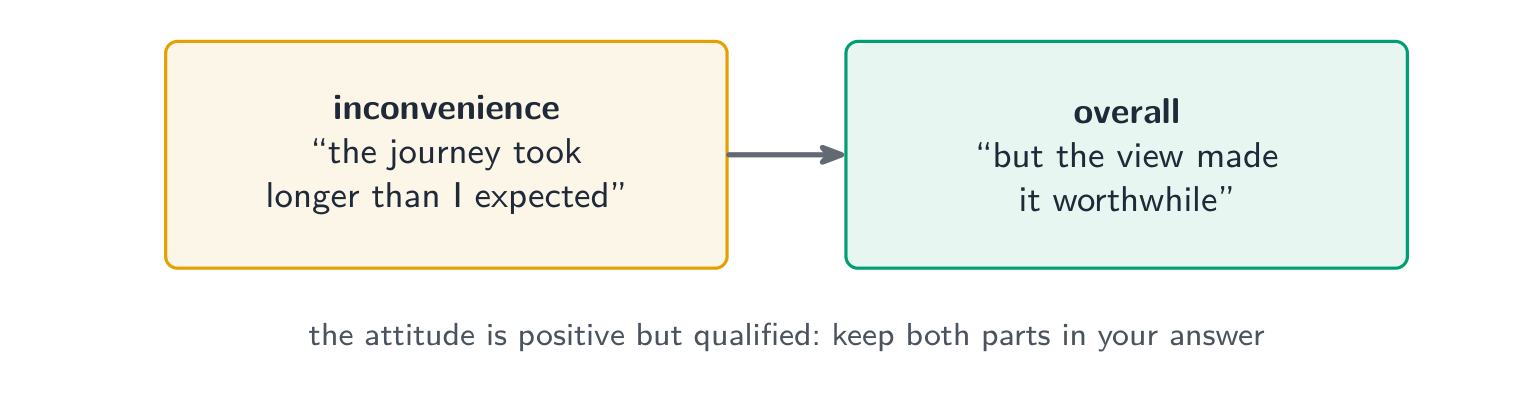
- An answer must keep both parts. "The writer liked the trip" misses half of "The journey took longer than expected, but the view made it worthwhile."
"The film is far too long, but the final scene is unforgettable." What is the writer's attitude?
Dificultad 1/5 · 100 monedas + un pequeño bono en el primer intento de hoy
"But" signals a qualified opinion; keep both parts.
Worked example: reading an attitude
"I had heard so much about the night market that I expected something magical. It was crowded, and the prices were higher than in the guidebook. Still, the grilled squid was the best thing I ate all week." What is the writer's attitude?
- Clues against: "expected something magical" (it was not), "crowded", "higher prices".
- Clue for: "Still" turns the paragraph; "the best thing I ate all week" is strong praise.
- Answer: mildly disappointed by the market overall, but delighted by the food. A one-word answer such as "negative" would lose the mark.
In the night-market example, which word marks the turn to a positive view?
Dificultad 1/5 · 100 monedas + un pequeño bono en el primer intento de hoy
"Still" introduces the contrast with the earlier disappointment.
Listening strategies
- Before listening, read the questions and predict the kind of answer: a number, a place, an opinion. Listen for signposts: "the main reason is", "however", "what surprised me most".
- Speakers often correct themselves ("on Tuesday — no, Wednesday"). Write the final answer, not the first word you hear.
A speaker says "The meeting is on Tuesday — sorry, Wednesday." The correct answer is Tuesday.
Dificultad 1/5 · 100 monedas + un pequeño bono en el primer intento de hoy
Write the corrected information, Wednesday.
Which phrases often signal an important point in a talk?
Dificultad 2/5 · 140 monedas + un pequeño bono en el primer intento de hoy
Fillers like "um" carry no meaning.
Question types
- Multiple-choice options often repeat words from the text but change the meaning; check the whole sentence. For "true/false with justification", quote the few words that prove your answer.
- For "which word means…" questions, replace the word in the text with your choice and check the sentence still makes sense.
"If an option uses words from the text, it must be right" is wrong. Examiners often build wrong options from the text's own words, attached to the wrong idea. Match the meaning of the whole option, not single words.
An option that repeats several words from the text is usually correct.
Dificultad 1/5 · 100 monedas + un pequeño bono en el primer intento de hoy
Wrong options are often built from the text's words with a changed meaning.
Separate explicit information from implicit meaning, and infer from clues such as word choice and turns like "but" and "still". Keep both parts of a qualified opinion. In listening, predict, follow signposts and note corrections; in reading, match meanings, not repeated words.
"The new library is beautiful, with huge windows and soft chairs. Finding a book, however, is another matter." Describe the writer's attitude and support it with words from the text.
Keep both parts and prove each with the text.