Historical sources and contextual evaluation
Introducido| English | Significado |
|---|---|
| source/sɔːs/ | The document or testimony a knowledge claim depends on. |
| secondary source/ˈsekəndəri sɔːs/ | A later account or interpretation of past events, written by historians. |
| primary source/ˈpraɪməri sɔːs/ | evidence produced at the time of the events studied, such as a letter, photograph or official record |
| context/ˈkɒntekst/ | The surrounding circumstances, information or language that help determine meaning and interpretation. |
| corroboration/kəˌrɒbəˈreɪʃn/ | corroboración |
The diaries that fooled a magazine, 1983
- In April 1983 the German magazine Stern announced it had found 60 volumes of Hitler's secret diaries and paid about 9 million marks for them. A famous historian confirmed they were real.
- Within two weeks, forensic tests showed the paper and glue were made after 1945. The diaries were forgeries. Every historian's first job is to test a source 史料 before trusting it.
Primary and secondary sources
- A primary source 原始史料 comes from the time studied: a letter, a newspaper, a photograph, a government order. A secondary source 二手史料 is a later account, such as a historian's book.
- Neither kind is automatically reliable. A primary source shows one person's view at one moment; a secondary source may use more evidence but has its own argument.
Classify each source for a study of the 1986 Chernobyl disaster.
Dificultad 2/5 · 140 monedas + un pequeño bono en el primer intento de hoy
Primary sources come from the time; secondary sources are later accounts.
Origin, purpose, value, limitation
- Origin: who made it, when and where. Purpose: why it was made and for whom. These decide its value (what it can tell us) and its limitation (what it cannot).
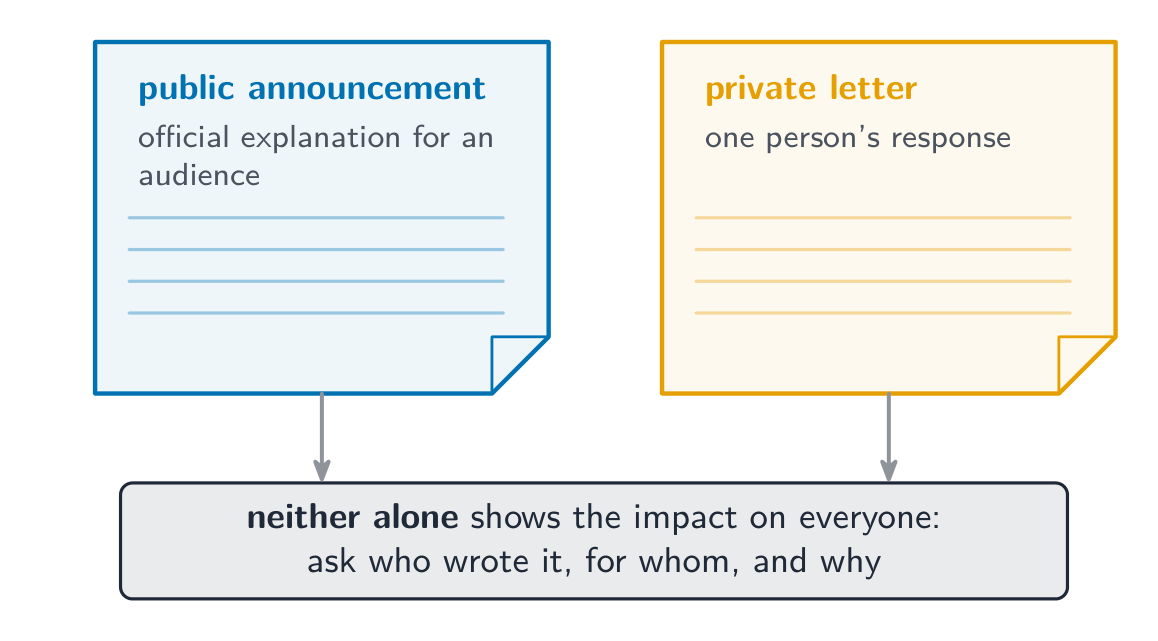
- A government announcement is valuable for the official line but limited as a guide to what people felt. A private letter is the reverse.
A government poster from 1942 urges citizens to save food. What is its main value to a historian?
Dificultad 1/5 · 100 monedas + un pequeño bono en el primer intento de hoy
Propaganda is strong evidence of official aims, weak evidence of actual behaviour.
Match each question to the part of the evaluation.
Dificultad 2/5 · 140 monedas + un pequeño bono en el primer intento de hoy
Origin and purpose lead to value and limitation.
Worked example: the Chernobyl announcement
Source A: the Soviet news agency TASS, 28 April 1986 (two days after the explosion), in a statement of about 20 seconds: "An accident has occurred at the Chernobyl nuclear power station. Measures are being taken." Source B: a private letter from a Kyiv resident, May 1986, describing rumours, queues for iodine and fear for the children. Evaluate their value for studying the disaster's impact.
- A — origin and purpose: the state news agency, released after radiation alarms in Sweden; aimed to reassure the public and the world. Value: shows the official response and its delay. Limitation: minimises the scale; says nothing about people's experience.
- B — origin and purpose: one private person writing to family; no reason to please the state. Value: shows fear and the information gap. Limitation: one person in one city; rumours may be inaccurate.
- Together: the gap between A's calm and B's fear is itself evidence of how the Soviet state controlled information in 1986.
What is the main limitation of the TASS statement for studying the disaster's impact?
Dificultad 1/5 · 100 monedas + un pequeño bono en el primer intento de hoy
Its purpose was to reassure, so it reveals little about the impact.
In 1983 the "Hitler diaries" were exposed by testing the materials they were made from.
Dificultad 1/5 · 100 monedas + un pequeño bono en el primer intento de hoy
Forensic tests showed the paper and glue dated from after 1945.
Context
- Context 背景 is what was happening when the source was made. Knowing that the Soviet state controlled all media explains A's tone; knowing that the accident was first detected abroad explains its timing.
- Use your own knowledge to place each source and to check its claims.
Which context helps explain the TASS statement?
Dificultad 2/5 · 140 monedas + un pequeño bono en el primer intento de hoy
Television existed; the other three explain the statement's tone and timing.
Corroboration
- Corroboration 相互印证 compares sources to see where they agree and differ. Agreement between independent sources raises confidence; disagreement needs explaining.
- In Paper 1 you compare and contrast sources and then use them with your own knowledge to answer a question.
"Primary sources are always more reliable than secondary ones" is wrong. The TASS statement is primary but misleading; a historian writing in 2019 with opened Soviet archives may be far more accurate. Judge every source by its origin, purpose and content, not by its label.
A primary source is always more reliable than a secondary source.
Dificultad 1/5 · 100 monedas + un pequeño bono en el primer intento de hoy
Reliability depends on origin, purpose and content, not the label.
Test every source: who made it, when, why and for whom. Origin and purpose decide what it can and cannot show. Place it in context, corroborate it with other sources, and remember that a biased source is still valuable evidence of the view it expresses.
A factory owner's speech in 1850 says child workers are "happy and well fed". Evaluate its value and limitation for studying child labour.
Use OPVL and suggest corroboration.