Tu plan de aprendizaje · Continuar · Revisar →
Adj + 得很 (muy)
IntroducidoTu posición guardada se conserva en este navegador. Continuar no completa la lección ni responde sus preguntas.
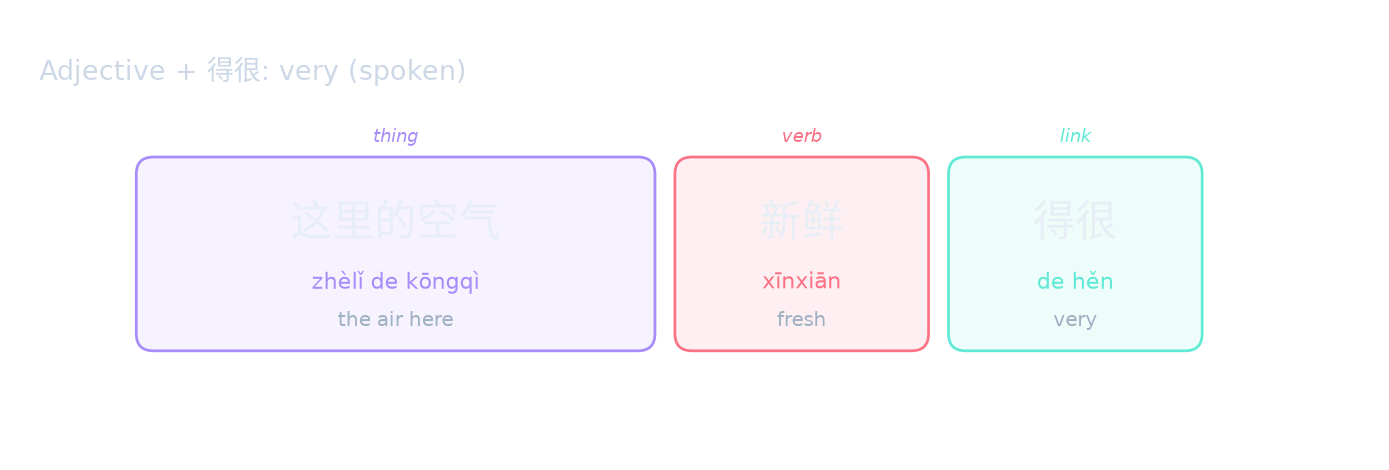
Aire fresco en el parque
- Después de una semana en una ciudad contaminada, caminas en un parque montañoso.
- here这里(modifier / structural particle)的air空气fresh新鲜(degree marker)得degree / adjective linker很。 — "El aire aquí está muy fresco."}
Adj + (degree marker)得degree / adjective linker很 = muy, realmente
- Adj + (degree marker)得degree / adjective linker很 = "muy, realmente", un poco más enfático y animado que degree / adjective linker很 + Adj.
- Termina la cláusula: good好(degree marker)得degree / adjective linker很 (muy bueno), clear清楚(degree marker)得degree / adjective linker很 (muy claro), cheap便宜(degree marker)得degree / adjective linker很 (muy barato).
this这张map地图clear清楚very得很。
Complete: “This hotel is really cheap.” 这家酒店便宜____。
Dificultad 1/5 · 100 monedas + un pequeño bono en el primer intento de hoy
Adj + 得很.
Comentarios con confianza
- his他(modifier / structural particle)的Chinese中文good好(degree marker)得degree / adjective linker很,you你need not不用anxious担心。 — "Su chino es realmente bueno; no te preocupes."
- Dicho de forma plana, puede ser irónico: good好(degree marker)得degree / adjective linker很,again又to arrive late迟到(completed / change)了! — "Genial, ¡otro retraso!"
his他的Chinese中文good好very得很。
Build: “His Chinese is really good.”
Dificultad 3/5 · 200 monedas + un pequeño bono en el primer intento de hoy
Subject + Adj + 得很.
degree / adjective linker很 después, no antes
- No agregar degree / adjective linker很 también antes: fresh新鲜(degree marker)得degree / adjective linker很 (muy fresco), no degree / adjective linker很fresh新鲜(degree marker)得degree / adjective linker很.
- Mantener (degree marker)得: good好(degree marker)得degree / adjective linker很, no good好degree / adjective linker很.
Which sentence is correct?
Dificultad 1/5 · 100 monedas + un pequeño bono en el primer intento de hoy
空气新鲜得很 is right: a bare adjective + 得很. A second 很 is redundant, and 得 must follow the adjective.
(degree marker)得degree / adjective linker很 versus (degree marker)得desperately serious不得了 y degree / adjective linker很
- degree / adjective linker很fresh新鲜 es neutral; fresh新鲜(degree marker)得degree / adjective linker很 es más enfático; fresh新鲜(degree marker)得desperately serious不得了 es el más fuerte.
- Los verbos también toman un complemento (degree marker)得, pero (degree marker)得degree / adjective linker很 sigue principalmente a adjetivos y verbos de sentimiento: his他likes it喜欢(degree marker)得degree / adjective linker很 (le gusta mucho).
he他likes it喜欢very much得很。
得不得了 is usually stronger than 得很.
Dificultad 1/5 · 100 monedas + un pequeño bono en el primer intento de hoy
The scale is 很 → 得很 → 得不得了.
Resumen
- Adj + (degree marker)得degree / adjective linker很 = muy, realmente (enfático, coloquial).
- Escala: degree / adjective linker很 + Adj → Adj + (degree marker)得degree / adjective linker很 → Adj + (degree marker)得desperately serious不得了.
Lee la referencia completa: Gramática HSK 5 — Adjetivos.
After a week in a smoggy city, you walk in a mountain park. Close the examples. Say a Mandarin response, then write it in Chinese. Explain briefly in English what the lesson’s pattern adds. Compare with the model, then change one detail and try again.
This is supported productive practice. Compare meaning and structure; your answer need not copy the model. A partner or teacher must hear the spoken response to comment on pronunciation.