Tu plan de aprendizaje · Continuar · Revisar →
任何 + Sustantivo + 都 / 也 (cualquier)
IntroducidoTu posición guardada se conserva en este navegador. Continuar no completa la lección ni responde sus preguntas.
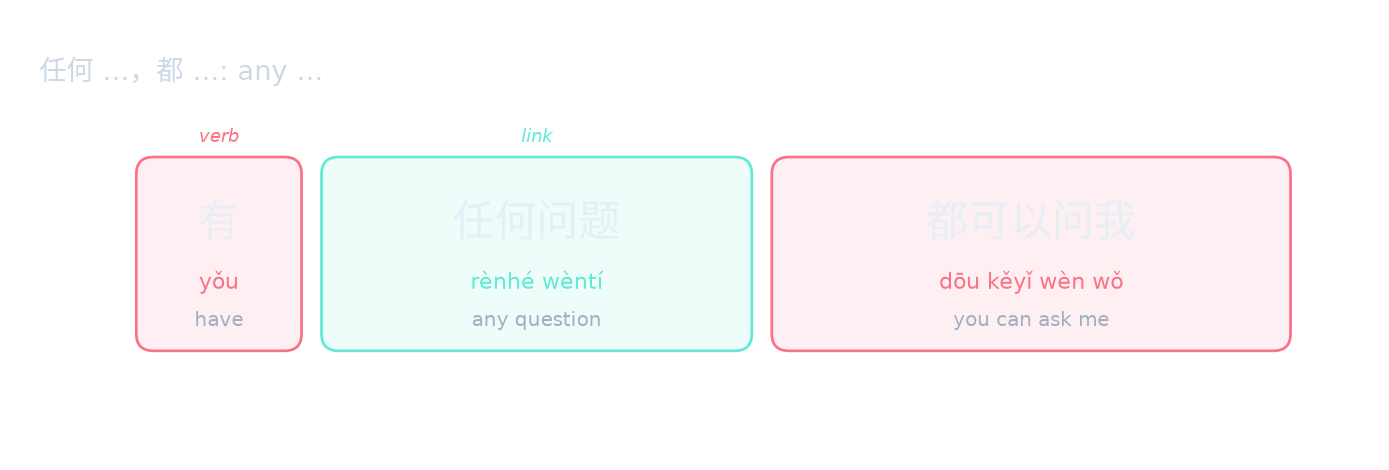
¿Alguna pregunta?
- Al final de la clase, tu profesor quiere asegurarse de que todos entendieron.
- to have / there is有any任何question问题,(all)都can可以to ask问I我。 — "Si tienen alguna pregunta en absoluto, pueden preguntarme."
any任何 + Sustantivo + (all)都 / also也
- any任何 + sustantivo = "cualquier (en absoluto)"; usually follows (all)都 or also也: any任何person人(all)都can可以take part参加 (Cualquiera puede participar).
- En la negativa: any任何person人(all)都won't不to know知道 / he / him他not have / haven't没有any任何question问题 — "nadie / no … en absoluto".
any任何person人(all)都can可以take part参加。
Complete: “Anyone can take part.” ____人都可以参加。
Dificultad 1/5 · 100 monedas + un pequeño bono en el primer intento de hoy
任何 + noun + 都.
Total de afirmaciones
- I我improbable不会tell告诉any任何person人。 — "No le diré a nadie.".
- any任何time; when时候you你(all)都can可以to / for / give给I我to make a telephone call打电话。 — "Puedes llamarme en cualquier momento.".
I我won't不(will)会tell告诉any任何person人。
Build: “I won't tell anyone.”
Dificultad 3/5 · 200 monedas + un pequeño bono en el primer intento de hoy
Negative verb + 任何 + noun.
Añadir (all)都 como sujeto
- Como sujeto, any任何 + sustantivo necesita (all)都 / also也: any任何person人(all)都to know知道 (Cualquiera lo sabe), no any任何person人to know知道.
- any任何 va antes de un sustantivo solo; no se usa solo: any任何person人 (alguien/cualquiera), no solo any任何.
Which sentence is correct?
Dificultad 1/5 · 100 monedas + un pequeño bono en el primer intento de hoy
任何人都知道这件事 is right: 任何 + noun as the subject needs 都 before the verb, and 任何 always comes before its noun.
any任何 versus palabra interrogativa + (all)都
- Hablado: anyone谁(all)都can可以come来 — "Cualquiera puede venir.".
- any任何person人(all)都can可以come来 dice lo mismo pero de forma más formal.
anyone谁(all)都can可以come来。
谁都可以来 is a spoken way to say 任何人都可以来.
Dificultad 1/5 · 100 monedas + un pequeño bono en el primer intento de hoy
QW + 都 is the spoken equivalent.
Resumen
- any任何 + sustantivo + (all)都 / also也 = cualquier … en absoluto; negativo = no … en absoluto.
- Necesita un sustantivo y, como sujeto, (all)都 / also也. anyone谁(all)都 es el equivalente hablado.
Lee la referencia completa: Gramática HSK 4 — Patrones de oraciones.
At the end of the lesson your teacher wants to be sure everyone understood. Close the examples. Say a Mandarin response, then write it in Chinese. Explain briefly in English what the lesson’s pattern adds. Compare with the model, then change one detail and try again.
This is supported productive practice. Compare meaning and structure; your answer need not copy the model. A partner or teacher must hear the spoken response to comment on pronunciation.