Tu plan de aprendizaje · Continuar · Revisar →
来 como verbo de relleno (lo haré yo)
IntroducidoTu posición guardada se conserva en este navegador. Continuar no completa la lección ni responde sus preguntas.
Let me do it
- Your grandmother is struggling with a heavy box. You step in.
- I我(will)来(suggestion)吧! — "Let me do it!" (will)来 stands in for the real action.
- Goal: offer to do something with (will)来 as a stand-in verb (I我(will)来(suggestion)吧).
(will)来 as a stand-in verb
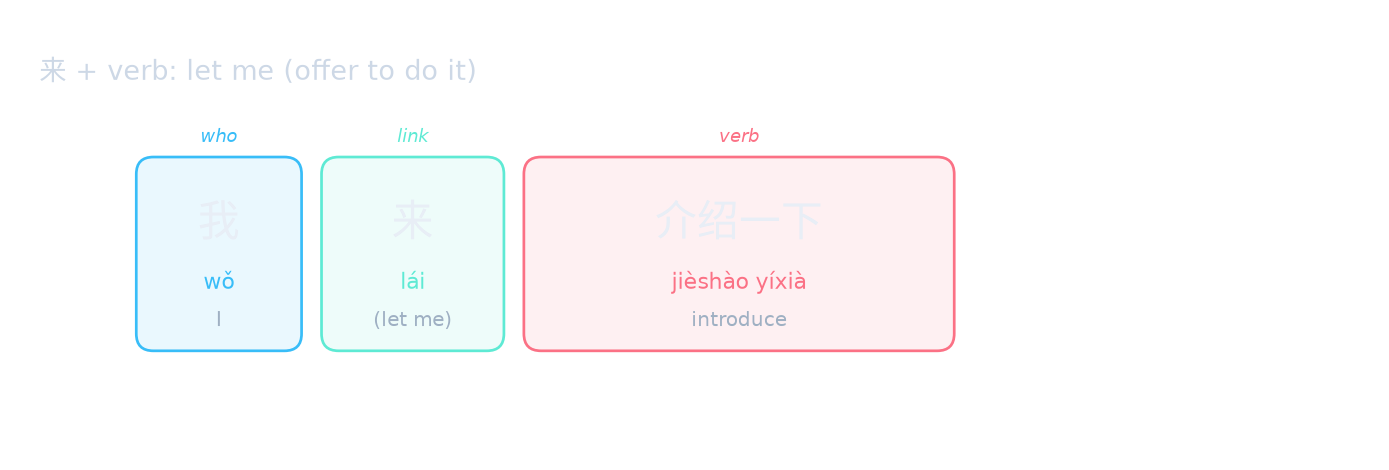
- (I我)(will)来 + (Verb) = "I'll do it, let me take care of it". (will)来 replaces or introduces the action.
- With a verb after it: I我(will)来introduce介绍briefly一下 — "Let me introduce …".
I我(will)来introduce介绍briefly一下。
Offer to pay: “Let me pay!” 我____付钱!
Dificultad 1/5 · 100 monedas + un pequeño bono en el primer intento de hoy
我来 + verb = let me do it.
Build: “Let me introduce (him/her) briefly.”
Dificultad 3/5 · 200 monedas + un pequeño bono en el primer intento de hoy
我来 + verb + 一下.
Ordering and serving
- In a restaurant: (will)来a bowl of一碗beef noodles牛肉面。 — "A bowl of beef noodles, please." (will)来 = "bring / give me".
- again / then再(will)来一个! — "One more!" (an encore, another dish).
bring来a bowl of一碗beef noodles牛肉面。
In a restaurant, what does 来两瓶啤酒 mean?
Dificultad 1/5 · 100 monedas + un pequeño bono en el primer intento de hoy
来 + item = bring me / I'll have.
Casual and context-bound
- This (will)来 is spoken; the real action must be clear from context (carrying, paying, ordering).
- It does not mean "come" here: I我(will)来(suggestion)吧 is "let me (do it)", not "let me come".
我来吧 here means “let me come”.
Dificultad 1/5 · 100 monedas + un pequeño bono en el primer intento de hoy
It means “let me (do it)”.
(will)来 versus go去 before a verb
- I我(will)来to do; to make做 = I'll do it (here, I'm taking it on).
- I我go去buy买 = I'll go and buy it (moving away to do it).
I我go去buy买吧。
Recap
- I我(will)来 (+ Verb) = let me do it; (will)来 + item = bring me / I'll have (ordering).
- Spoken; the action is clear from context. go去 + Verb = go and do it.
Read the full reference: HSK 4 grammar — Verbs.
Your grandmother is struggling with a heavy box. You step in. Close the examples. Say a Mandarin response, then write it in Chinese. Explain briefly in English what the lesson’s pattern adds. Compare with the model, then change one detail and try again.
This is supported productive practice. Compare meaning and structure; your answer need not copy the model. A partner or teacher must hear the spoken response to comment on pronunciation.